Death of a Champion

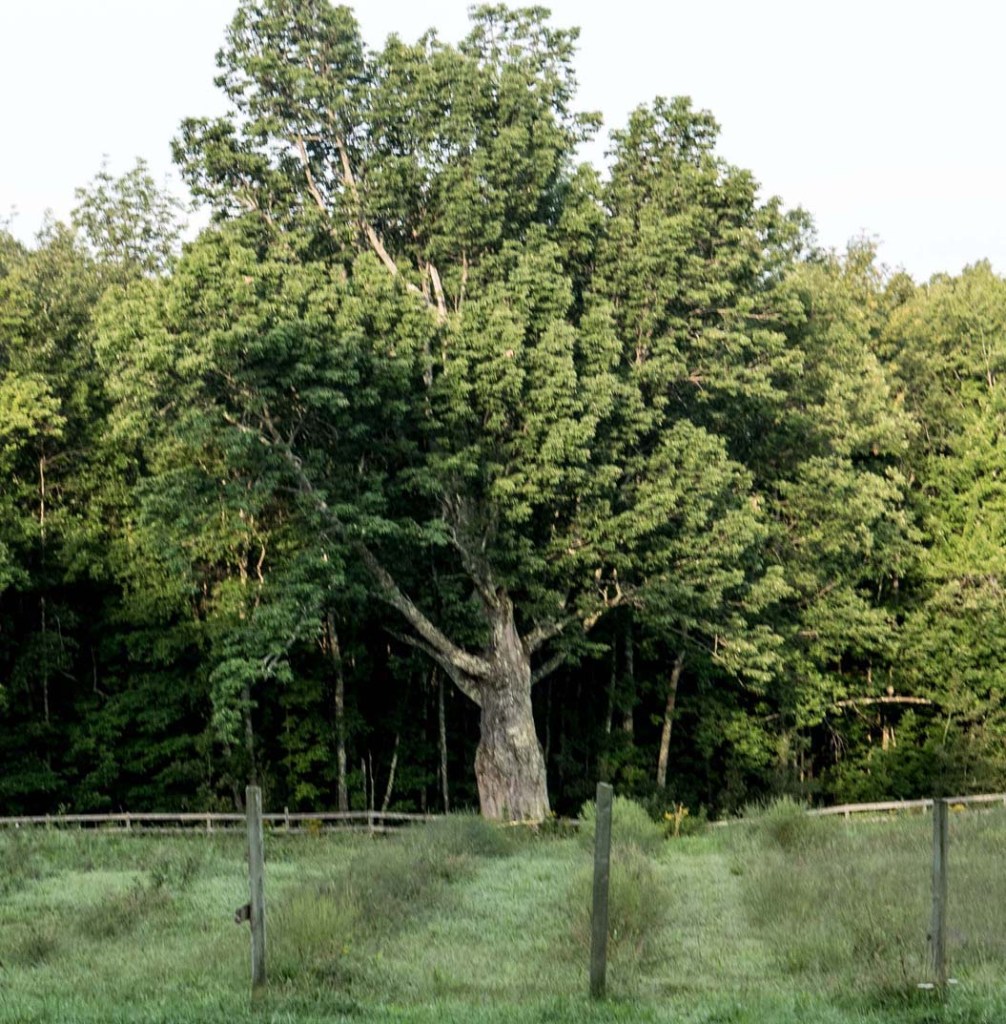
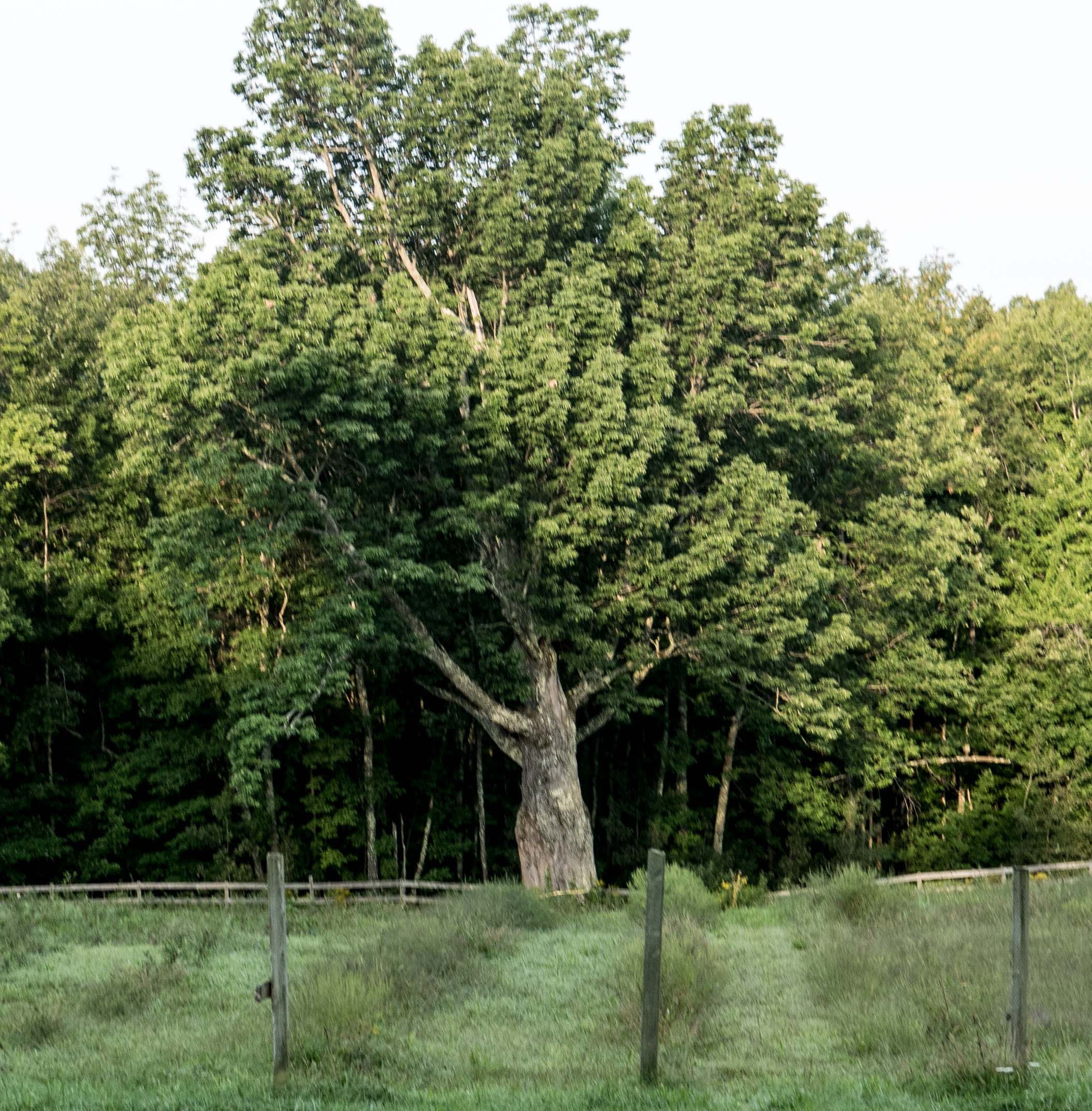
The Bicknell White Ash, summer 2018

Ann Bicknell’s White Ash Tree began its life an estimated three hundred-sixty-odd years ago on what was once known as the Poor Farm, on Old County Road. The tree is surely among, if not THE, oldest residents of our town this wonderful tree has stood at what is now the edge of a field of blueberries on Old County Road. Before the blueberries the field was a horse pasture and before that … this was the Poor Farm that is marked on the 1858 map of Deering. And before that?
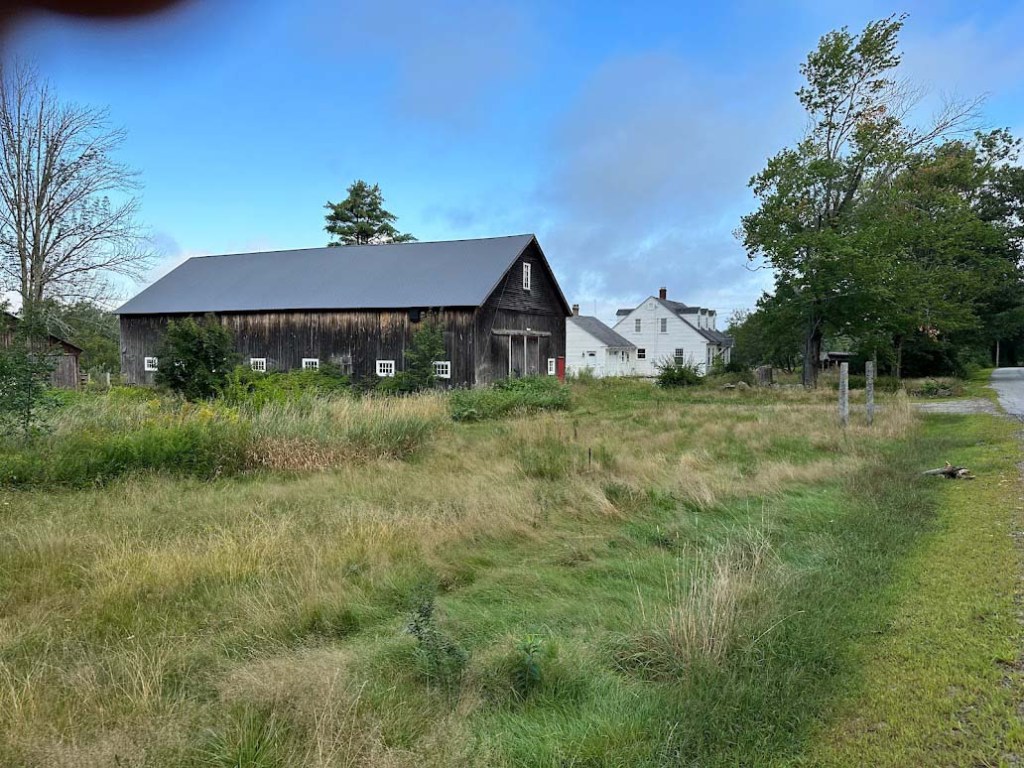
The 19th Century Deering Poor Farm from Old County Road

Mark and Ann Bicknell took up residence with this old tree in 2015. She came from an urban life. The farm on Old County Road was the fulfillment of Ann’s dream of a place to have horses. She had found the perfect place. Horses gamboled in the pasture and eyed me suspiciously as I made my (not quite) daily morning walk past them. My first recollection of Ann and Mark was when they brought us Christmas cookies in their horse-drawn sleigh, crossing the fields and open land that separated our two houses.

Mike Margulies, resident on Old County Road since he was a teen in 1954, used to walk along the road each morning too. An outgoing guy, he stopped to talk to the newcomer Mark Bicknell and in the course of their conversation Mike learned that Mark was a Bicknell and that Mike and Mark’s father had worked together as short-order cooks some time earlier. Small world? We call it ‘Deering Magic.” Mike and his wife Bette brought up their family on Old County road, not more than a quarter mile from the Bicknell White Ash. They were the doyennes of our little group.

Mike was a man of many many interests. For nearly forty years he taught 6th through 8th grades in Bennington and Hillsborough until he retired in 2002. He taught model rocketry and hunter safety to kids in town. For several years he kept a sled dog kennel and raced teams around New England. He was a musician, playing bass in local classic rock bands. Mike Margulies was the true Renaissance Gentleman and a great friend.

Not long after Mark and Ann settled in Deering Ann was diagnosed with a brain tumor that would prove fatal. Ann loved her white ash tree. She understood that this very big and very old tree was special, and knowing that I was keeping a list of our town’s biggest trees, urged me to add her tree to the list.

The original Big Tree list for Deering was compiled in 1980 with an update in 1985. I inherited the list, an unruly pile of bits of paper, around 2012 or 2013. Somehow the original compilers of the list missed obvious trees, including this wonderful ash tree. Clearly visible from Old County Road (although I note that Old County Road at that time was unpaved and did not carry as much traffic as it does now that it has been paved), I do not know how nobody included it in the list. Ann was passionate about having this tree recognized.

One Sunday morning in mid March of 2015 a small team set out to measure the tree. Ann and Mark Bicknell, Mike Margulies, neighbor and friend Kay Hartnett, my wife Patty and me. First, we breakfasted on pancakes with maple syrup and coffee in Ann and Marks kitchen, a most convivial affair. Then we put on our snow shoes and crossed the field to the tree, measuring tape in my pocket.
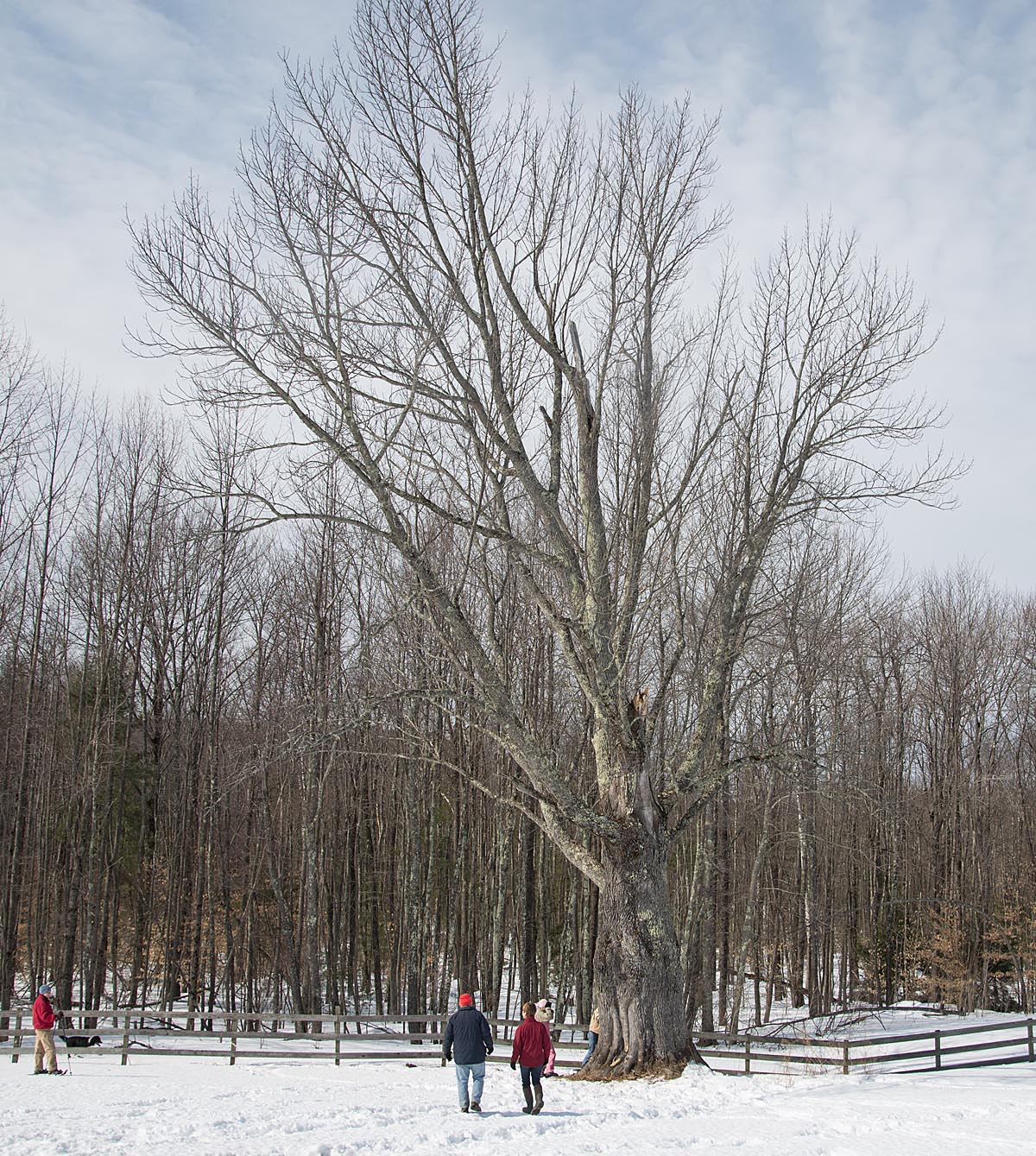
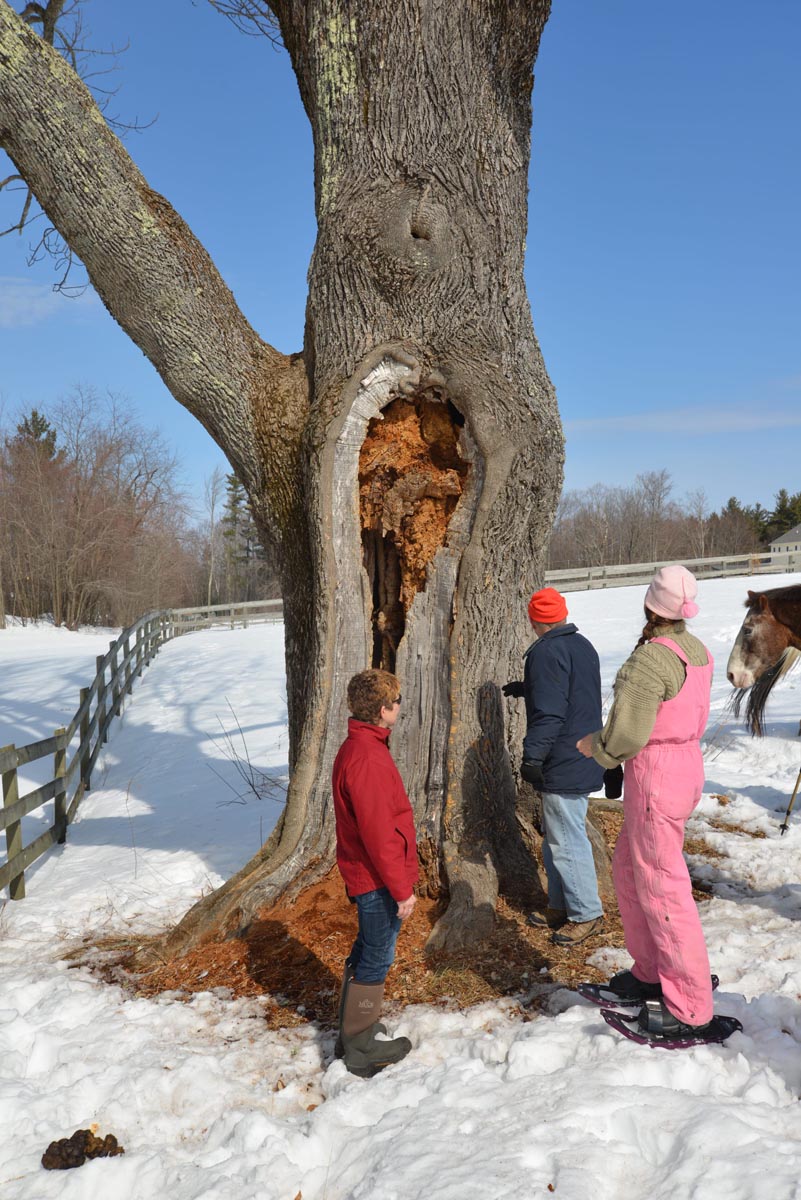
Image on the right, from the left: Kay , Ann, Mark, Patty and Mike

I had not been up close to the tree before this Sunday. The deep gulch of a heart rot hollowed the trunk, but the surrounding sapwood was thick and strong. Strong enough to support the massive branches and spreading canopy. Mike recalled the time when a large branch broke away from the tree, but now despite the heart rot and hollowed trunk, the tree seemed to be doing well.

This beautiful tree was big! It took all of us to bring the measuring tape around the trunk at a height of 4 feet. It appeared to me that this white ash was bigger than any of those that were included in the UNH Big Tree List. My nomination lead to the arrival of an official measuring team of the UNH Big Tree Project. They measured height and canopy spread in addition to the circumference of the trunk and found that it was indeed a big white ash tree!
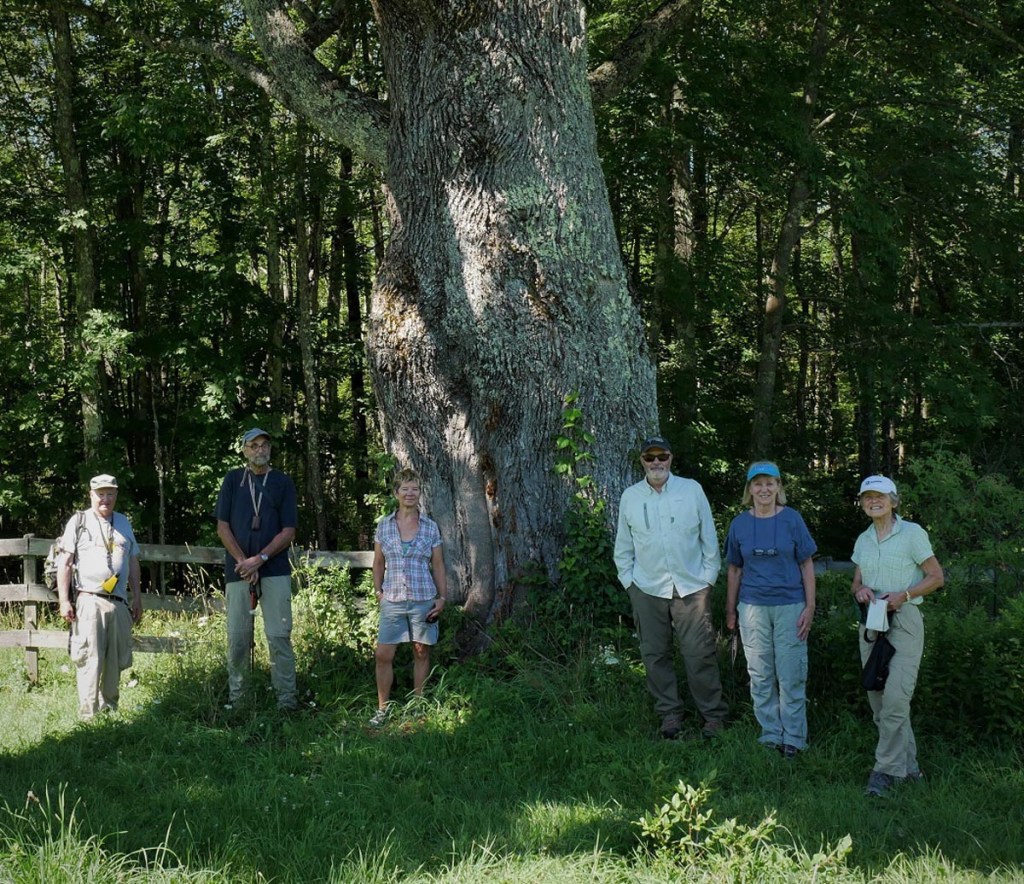
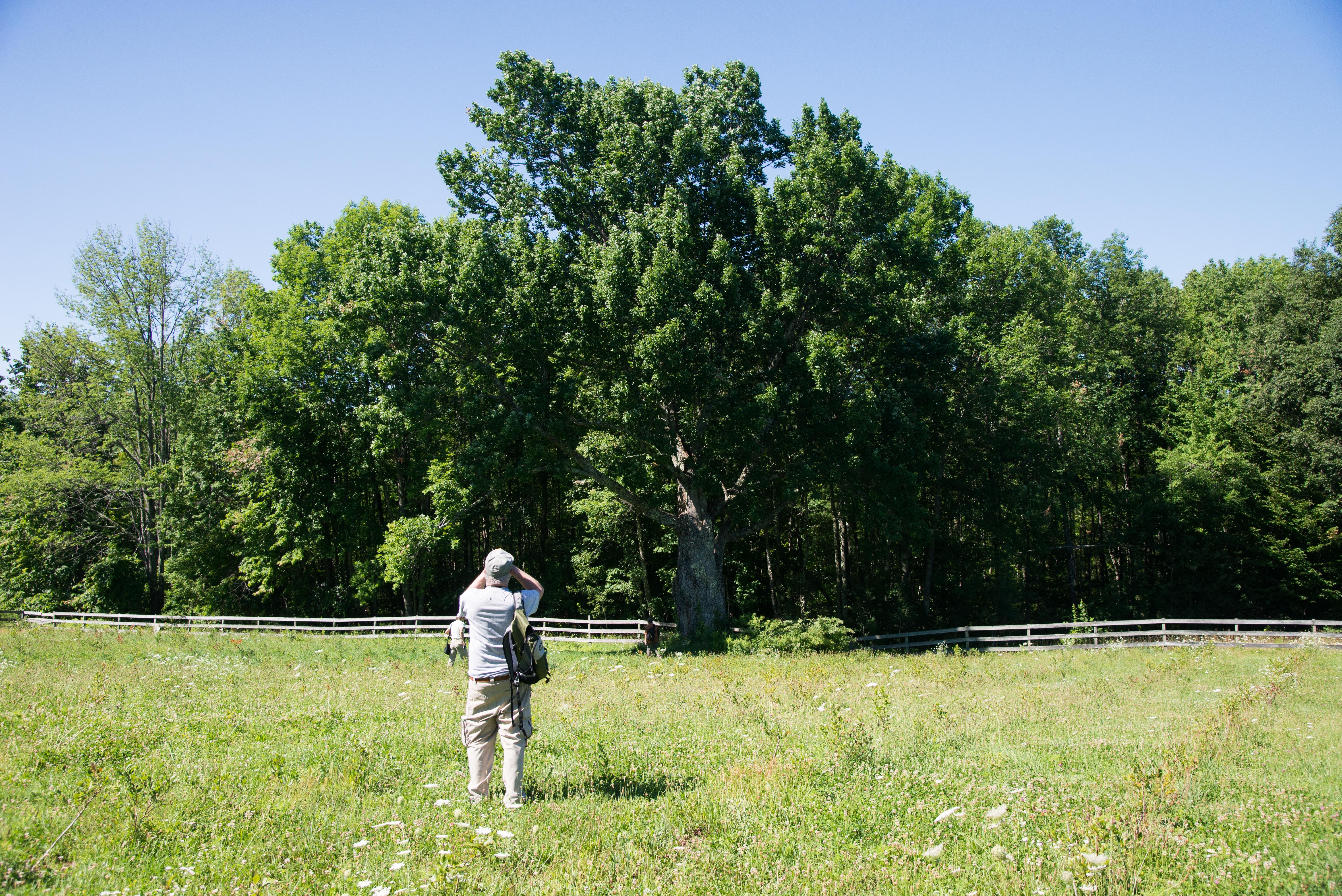
In 2020, Fraxinus americana Tree Number 1079, the Bicknell White Ash, was named the State Champion White Ash with a height of 81 ft, crown spread of 68 ft, and circumference of 234 inches. Today the tree is recognized as a National Co-champion White Ash Tree, sharing the honor with a tree in Madbury (https://extension.unh.edu/natural-resources/forests-trees/trees/nh-big-trees).

Emerald Ash Borer was first noticed in New Hampshire, in the Concord area, in 2013 and it was first recorded for Deering four years later, in 2017. The effect of the disease is notable around town, with many trees having been removed, but the Bicknell Ash seemed immune. Younger trees surrounding it, maybe its children, looked unhealthy, but this old tree continued to produce a dense dark green canopy of leaves. Until this year.

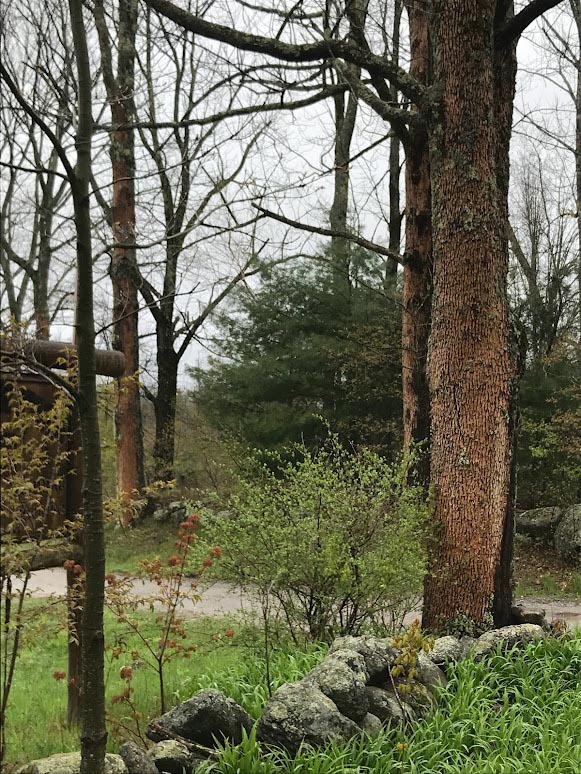
Infected, 100-year-old ash trees at the Spinner Farm on Old County Road

In March of this year signs of Emerald Ash Borer showed up in our Old County/Hedgehog Mountain Road neighborhood. A row of roughly 100-year-old ash trees at the Spinner Farm, next to the Bicknell Farm, was entirely infected. At the same time the Bicknell’s White Ash tree, which had so far seemed immune, was obviously badly infected. Blonding of the bark, the white flecks of bark the result of woodpeckers pecking away the bark to get to the beetle’s larvae, was visible throughout the sad looking tree.
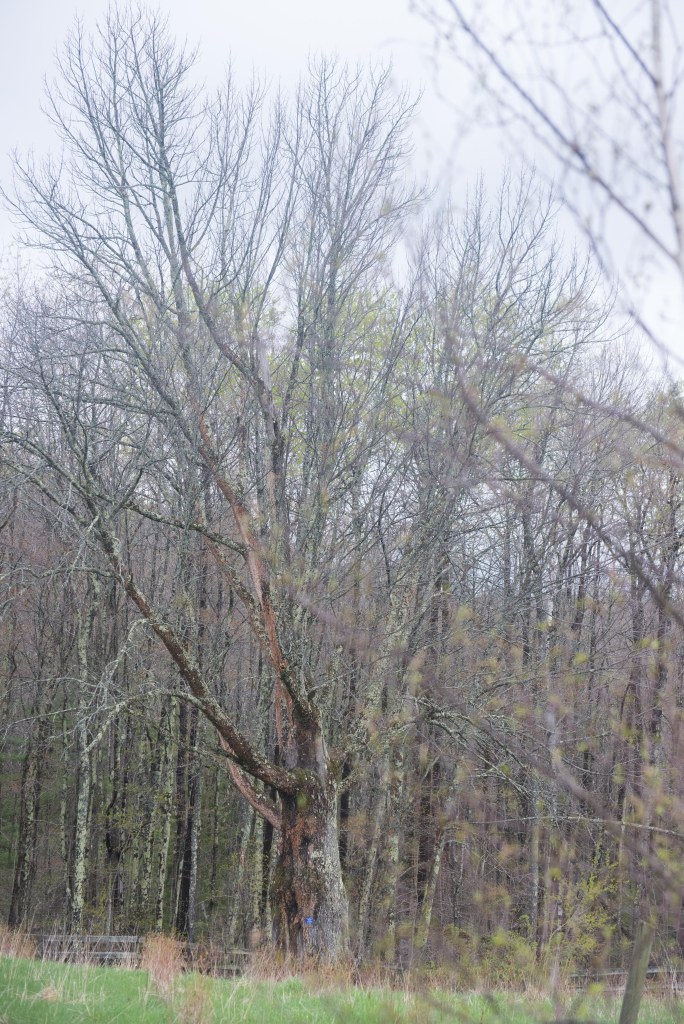
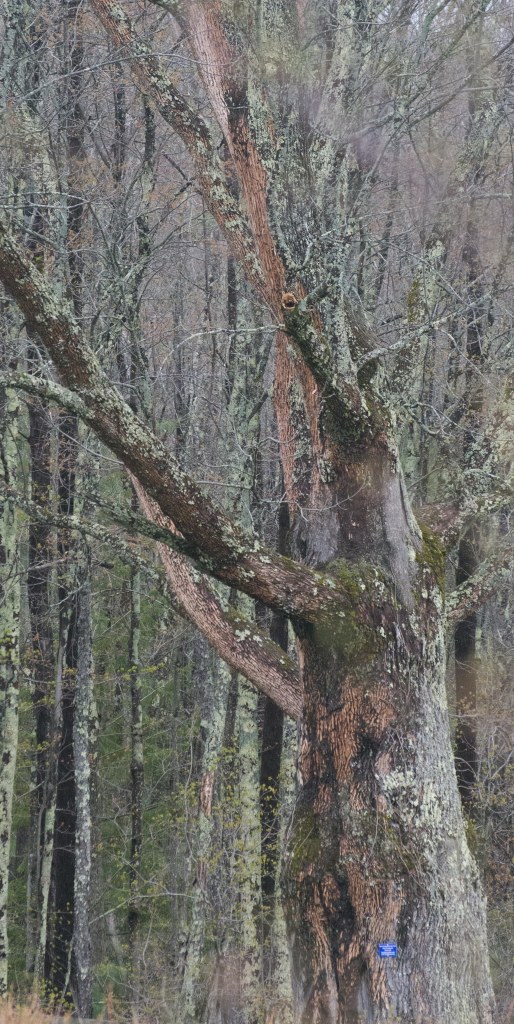
As the season progressed the canopy of this grant being had only a sparse production of leaves.

Peeling the bark away reveals the serpentine larval feeding galleries. They disrupt the sapwood of the tree, preventing the transport of water from the roots to the crown.

At this point the only thing to do is remove affected trees in the likely vain hope of limiting spread of the beetle.

This might not be the last year for Deering’s own magnificent National co-champion White Ash tree. It might hang on a while longer, producing fewer leaves each year if its new owner, a child of Mark Bicknell, does not have it cut out.

But the death of this champion is only a part of the tragedy of the Bicknell White Ash.

Ann Bicknell did not live to see her White Ash crowned a champion. She knew it was a champion none the less. Her stewardship of this wonderful arboreal companion ended in April of 2015, just short of her 50th birthday. Her husband Mark, a melancholy man, could not adjust to life without Ann. He died in 2022, short of his 60th birthday. Their ashes are placed at the base of the tree. Mike Margulies, a gentleman and a scholar in every good sense, passed away at 80 years in 2020. Good friends all.

We are a small, rural town. A lot of our area is forested. Big trees share the Deering space with us. They provide seed for our forests; they shelter other residents in their broad canopies and in the soil below them. They provide comfort, physical and emotional, for us as needed. They hold the climatic history of our town over centuries in their trunks. They were here long before us. Is Ann’s ash cognizant of us? I don’t know, but I, like Ann, cherish this tree and am saddened by (personal pronoun) passing.

,
,
,

HUMMINGBIRD CLEARWING MOTH

Patty had two dreams. One was to acquire and protect as much land asd she could afford. The second was to develop a garden in which there were blooming flowers bloomed for as much of the year as flowers can bloom here in New England.

It did not take her any time to persuade me to share her dreams.

Patty found 85 acres of forested land in southern New Hampshire in one of those supermarket real estate advertising magazines. The land had been recently, respectfully, logged, and a pretty brook ran through the oak/hemlock woods for nearly the entire 2200 ft length of the lot.

Deering, Hedgehog Mountain, is where we decided to call home, and where we built our timberpeg home (another of Patty’s dreams) in 2011.

And Patty started gardening as soon as we moved in.

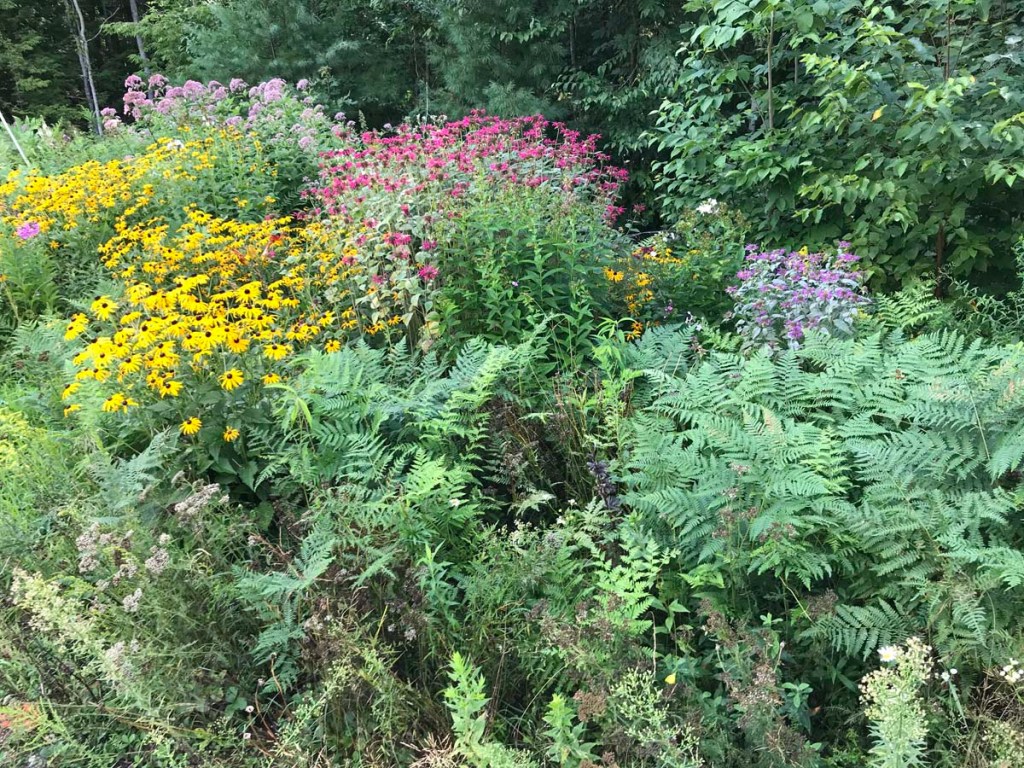
Now, a bit over 10 years later, her dream of a glorious garden is being realized. A progression of flowers, early spring to late autumn has responded to near constant care: weeding, watering, thinning, dividing, moving about, and so on.

The collateral effects of the garden include apart from, of course, the pure beauty, a refugium from an otherwise pretty crappy world, a whole bunch of pollinating insects and ruby throated hummingbirds. Butterflies, bees of all sorts, and the hummingbirds dip and zoom around the flowers finding pollen and nectar among the echinacea, lavender, bee balm, Joe Pye weed … and St John’s Worts and evening primrose and lupins … the list just goes on! Caterpillars such as those of the glorious monarch butterfly find a good home here in all the untouched milkweed.

Pollinator’s delight in Patty’s ggarden!

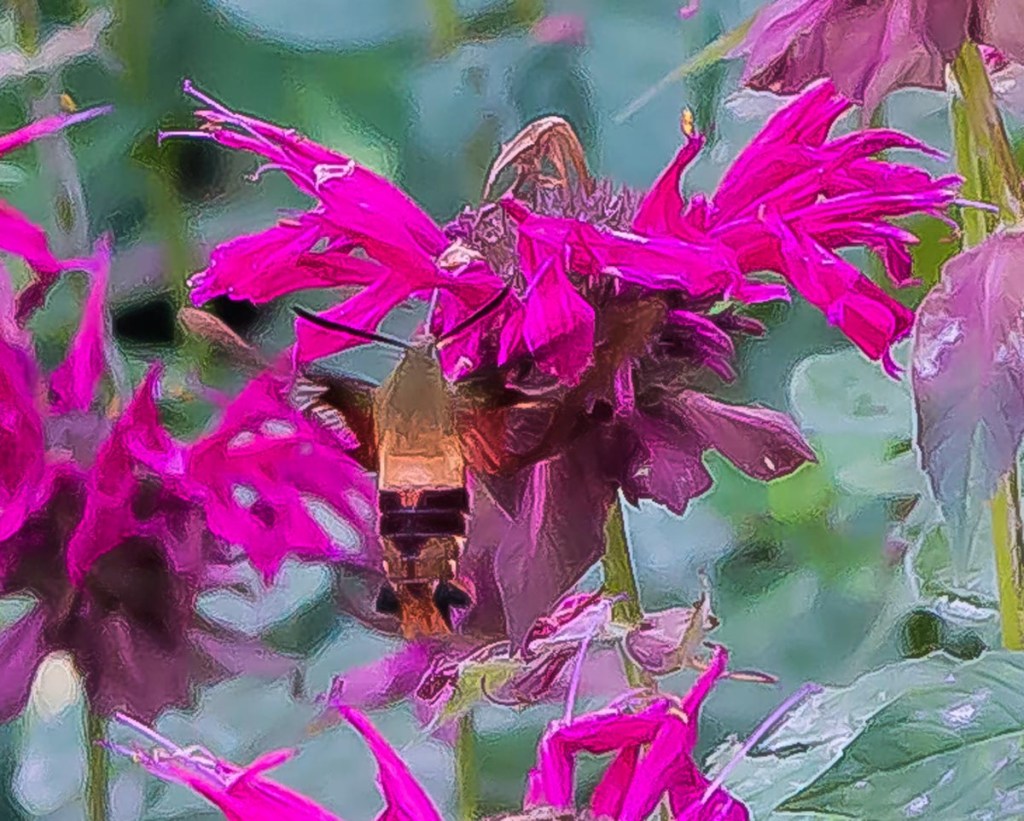
Among the most interesting of the insect visitors to garden has been the Hummingbird Clearwing moth, Hemaris thysbe.

The Hummingbird Clearwing, a sphinx, or hawkmoth, is active on warm, sunny summer days. It is maybe a quarter the size (wingspan 1.5 – 2 “) of a ruby throated hummingbird, but its super rapidly beating wings give the same humming sound as the bird as it dashes from flower to flower, never alighting for more than the briefest of moments. Like the hummingbird, the clearwing hawkmoth can hover over prospective nectar sources. I have read that wings of the clearwing beat at 85 beats per second, while those of the hummingbird barely chug along at a mere 50 bps. Of course, its ability to hover enables to clearwing to suck nectar from flowers through it long proboscis — a superb example of coevolution. Hovering also makes sense for this heavy insect because delicate flowers do not provide feeding ledges for their pollinators — a serious revolutionary oversight! Moreover, remaining airborne gives the insect a head start should it need to escape a hungry predator. Males hawkmoths have a flared tail, again like the hummingbird, and their long straw-like proboscis unfurls to reach the nectar deep within flowers.

Hummingbird clearwing moth drawing nectar from monarda flowers

Despite the wide range of lowers and flower colors in Patty’s garden, we have only seen the clearwing on the red monarda. It apparently doesn’t even visit the nearby purple monarda. In fact, this clearwing is known to show preference for red and purple flowers.

Four species of hummingbird moths occur in North America. Hemaris thysbe is most abundant in eastern North America, but it ranges widely in North America.

Caterpillars of the clearwing hawkmoth feed on cherry trees, European cranberry bush, hawthorns, honeysuckle, and snowberry. The insect overwinters in the soil as brown, hard-shelled pupae. In the late spring, it emerges as an adult moth.

These fascinating insects have been well=studied and a lot of information about them is available on-line. Much of the information given in this post comes from three web sites https://todayshomeowner.com/hummingbird-moths-in-the-garden/ , https://www.jungledragon.com/specie/4250/hummingbird_clearwing.html, and https://www.seacoastonline.com/story/lifestyle/2007/08/15/sue-s-nature-news-hummingbird/52821096007/.

Thanks to my friend and extraordinary naturalist Mike Thomas for identifying the hummingbird clearwing and many other insects.

THE ASH-TREE BOLETE AND ITS APHID FRIENDS

First, allow me to orient you with a little bit of Mycology 101. Specifically two basic sorts of mushrooms.

The mushroom is the result of sexual reproduction. The process? Not sexy. A couple of nuclei get together in a special cell and the process cascades: nuclear fusion and meiosis —  where basically the genes get sorted — and finally a spore containing the recombined genes forms. What you see in a mushroom is the launching platform for the spore. The spores of all mushrooms are born externally on specialized cells. How and where those cells are placed distinguishes two major groups of mushrooms.

In one group the cells line thin sheets, or gills. So, if you look on the underside of the cap of one of these mushrooms you see the edges of a lot of gills radiating from the center, the stalk. The common supermarket mushroom is one of these, so is matsutake.

In another group of mushrooms the cells that bear the spores form inside tubes. If you look on the underside of one of these mushrooms you will see tiny pores. These are colloquially called boletes and the most famous bolete is the Cep.

This story is about one kind of bolete.

Many boletes and other gilled mushrooms form associations with the roots of trees and other plants to share nutrients — called mycorrhizae. It’s a  mutualism wherein all partners get — and give — something. Some people think that the fungus body,  filaments radiating through the substratum that you never see, connect trees and mushrooms in a kind of messaging system. These are good guys.

The ash-tree bolete — Boletinellus merulioides — is not a good guy.

At least not good for the ash trees.

Boletinellus merulioides is not mycorrhizal. It is in a symbiotic relationship with the ‘leafcurl ash aphid’ or ‘wooly ash aphid,’ Meliarhizophagus fraxinifolii. An ash pathogen.

This aphid has a complicated life, but it is inextricably tied up with several species of ash trees. Eggs, which overwinter in laid in cracks of the bark, hatch in the spring. After hatching, the aphids feed first on shoots, and then a new generation feeds on newly developing ash leaves. The leaves become distorted and ultimately form ‘pseudogalls,’ within which there is another generation of aphids. Eventually, as early as August, some of those aphids fly off and lay eggs. During summer  some of the females change their behavior. They begin to feed on roots of ash trees. A new generation of males and females develops from those root-feeding aphids to complete the cycle.

But some of the root population remains in the soil all year, feeding on roots. They form a symbiotic relationship with the ash-tree bolete.  The mushroom’s mycelium protects  aphid by producing little knots of tissue around them. In return the honeydew produced by the aphid nourishes the bolete.

The ash ash aphid is native to North America but it has become a problem on European ash trees.


Black Swallow wort: a nasty invasive in our zip code!

A bunch of invading plants that no walls can keep out are living in our town of Deering, a small rural community located in south central New Hampshire/the  Monadnock Region,.

We have been successful thanks to a Lake Hosts boat inspection program and an active group of Weed Watchers, in preventing the introduction of highly invasive Variable Milfoil into our lake, and — unlike most towns in our area — Japanese Knotweed is not a conspicuous feature of our roadsides because members of the Conservation Commission  cut the stuff back each year.

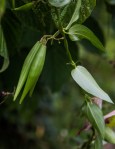
But this year I am noticing a whole lot of black swallow wort in town. This plant — Cynanchium louisiae — is disastrously invasive. It grows thickly on the ground and quickly covers everything, preventing the growth of other plants. Even covering street signs! Like all successful invasive species, black swallow wort has no local  parasites or browsers to limit its development. And, like milkweed, the seed come out of the pods in a fluff that is easily scattered by wind.

There is a dense growth of this invasive in the Tom Rush meadows, but few go up there to see it. Where it is most conspicuous is along roadsides, probably in front of your own home. Lurking in rock walls or around your mail box.

Black swallow wort is a native of Europe that was introduced into the United States, through Massachusetts, in the mid 19th Century. The plant is widely distributed in eastern USA and Canada but is not common west of the Mississippi River. A second swallow wort, Cynanchum rossicum, was introduced into New England from Europe as an ornamental late in the 19th Century. Its distribution is limited to the New England states. I have not seen it in Deering.

Black swallow wort is easily recognized. It’s a low growing herb with dark green leaves; the plant tends to vine. The leaves are paired, opposite each other on the stem, narrowly heart-shaped, and drawn to a fine point. The have a strongly developed central vein that causes the halves of the leaf blade to form a kind of V-shape down the length of the leaf. Flowers form at the tips of the vine and are small, dark purple. Kind of pretty actually. The fruit is a twin capsule. The roots are white and thick, forming a mat in the soil; there can be a tap root.

Apart from its invasive nature, black swallow wort and other swallow worts, which are related to milkweed, are toxic to Monarch butterflies, deer and cattle. The plants themselves contain the toxin, and they put toxins into the soil that prevents  growth of other plants.

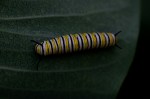
We all know by now that milkweed is the preferred medium for development of Monarch butterflies. The butterflies mate, most famously in Mexico, but in other western sites as well. They then migrate north and east looking for a place to lay their eggs. In March and April they lay their eggs on milkweed and, lamentably, black swallow wort .  About two days later the eggs hatch to the distinctive caterpillar, which feeds on milkweed.

However Monarch caterpillars that hatch on swallow worts are not able to feed. They avoid the toxin in the plants, and thus do not survive. From an ecological point of view, they are wasted.

After two weeks, the caterpillars on attach themselves to a stem or leaf of milkweed and begin the process of metamorphosis that leads to the beautiful Monarch butterfly.  The emergent butterfly will fly away to enjoy about two weeks of feeding on all sorts of flowers but, just before dying, they lay their eggs.


Clearly, black swallow wort is a bad actor. But you can help to control it.

Cutting it back is not good because that will only encourage more growth. Most of what I see in town along roadsides can maybe controlled by digging. You can dig it out, but dig deeply so as to get as much root as possible. You will have to return and dig out what you have missed but eventually . Glyphosate is effective.

EUTHAMNIA GRAMINIFOLIA: A DISTINCTIVE GOLDENROD

Late summer here in Deering and fields and roadsides have been yellow for a while now. First came the black-eyed Susans, now goldenrods dominate. They’re the ones that form great swathes of yellow in sunny meadows and along roadsides.

Small digression . . .

Solidago, a name derived from Medieval Latin, Soldago (to make whole), was applied to this group of plants because of their medicinal value. There are lots of links for goldenrods and Solidago, on the WEB.

Goldenrods are a tricky proposition for anybody who wants to identify species. However, some species can be identified readily from a distance of 2 meters based on their form and/or flower color.

For example . . .

Solidago bicolor

The flowers of Solidago bicolor, which are just now (end of August) opening, are white with maybe just a touch of yellow. You might not think this one was a ‘goldenrod,’ but it is. This species is common here along roadsides and other dry sites in full sun.


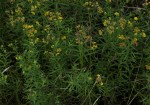
Another distinctive goldenrod is no longer classified in the genus Solidago.  Euthamnia graminifolia, which you will still find in wildflower guides under Solidago, really does not look like your average goldenrod. Its two common names reflect the differences. The very narrow, pointy leaves suggest leaves of grass, hence the species name graminifolia. The second distinctive characteristic of this species is the fact that the heads of flowers all form at more or less the same level (unlike other goldenrods where ‘flowers’ (really, heads of flowers or ‘racemes’)  can look like fountains – – or star burst fireworks!). Thus the common name ‘flat-top-goldenrod.’

But, something else distinguishes flat-top-grass-leaved-goldenrod.

It’s an insect. A kind of a fly  known as a ‘gall midge.’ Euthamnia graminifolia is the one and only host for the gall midge Asteromyia euthamniae. I have not found much information about this gall midge on line, but infected plants are pretty common here in Deering. Typically the larva of a gall midge burrows into the leaf’ and this elicits a response from the plant, which results in the formation of this characteristic gall.  The gall is first bright yellow but becomes the tarry black shown in these pictures. After pupation an adult emerges to repeat the cycle. The Euthamnia gall midge, a nondescript fly, can repeat the cycle two or more times from spring through fall. Not all, but many grass-leaved goldenrod plants are affected and the species is common in Deering.

Euthamnina graminifolia is a native of North America, where it is widely distributed. The species typically occurs in damp places, but it can also be found under dry conditions along roadsides and in fields.  This is one species that has been spread to Europe from North America. The species is commercially avilable.


INVASIVE LAND PLANTS IN NEW HAMPSHIRE

Which Invasive Upland Plant Species occur in our town?  
There are easily 5 or 6 plant species which have escaped managed landscape environments and are becoming a nuisance in both the natural and urban environments of Antrim.  The invading plants are Japanese Barberry, Oriental Bittersweet, Autumn Olive, Japanese Knotweed, Glossy and Common Buckthorn and Burning Bush. Once you know what to look for you will see just how common and widespread they are.
It is the same story here in Deering.
How to find out more about New Hampshire’s Invasive Upland Plant Species? 
Save the Date because on April 4, 2018, Douglas Cygan, Invasive Species Coordinator from the NH Department of Agriculture will provide a presentation at 7pm at Antrim Town Hall. His presentation will take an in-depth look at upland invasive plant species in NH.  Attendees will learn about the various issues invasive species present to natural and managed environments, NH rules and regulations regarding invasive species, identifying features and characteristics of invasive species and best management control measures of some of the most aggressive non-native plants in the Granite State. This presentation is co-sponsored by the Antrim Parks and Recreation Commission, the Antrim Grange and the Antrim Conservation Commission. 

A STICK WITH LEGS!

The Northern Walking Stick (Diapheromera femorata) is a wingless insect in the order Phasmatodea that is easily overlooked due to its close resemblance to a dead twig.  When frightened, it will straighten out its twig-like body and front legs and remain motionless for long periods.  By blending into its surroundings it gains protection from predators, mostly from birds.  Of the 29 species in the United States, the Northern Walking Stick is the only one found in New England, occurring from southern Canada to northern Florida, and westward to North Dakota and New Mexico.

The Walking Stick is one of the most unusual insects that you can see in your backyard.  The one pictured at the right  pretended to be a dead twig on a porch screen in Deering one September day.

The biology of this insect is quite fascinating, as populations in our area require two years to complete their development.  Walking sticks are a hemimetabolous species, with only three life stages (egg, nymph, and adult), and unlike holometabolous species which undergo complete metamorphosis, they lack a pupal stage.  In the late summer and fall, females drop their eggs from the trees onto the forest floor where they overwinter in the leaf litter.  The adults cannot survive freezing temperatures and die with the first killing frost.  Most of the overwintering eggs remain unhatched through the following spring and summer, and overwinter a second year before hatching the following May or early June.  The green nymphs climb up low-growing shrubs and trees where they feed on the leaves.  When mature, they turn from green to brown and feed primarily on the leaves of oaks and cherry in our area.

So the next time you see a twig swaying on a windless day, look again.  It just might be a Northern Walking Stick!

Invasion of the Painted Ladies

Painted Lady butterflies (Vanessa cardui) are resident in the deserts of northern Mexico, so why are they showing up in Deering in large numbers this fall?  In most years, they are uncommon or absent in our area.  For reasons not fully understood, Painted Ladies occasionally migrate northward in huge numbers, and under favorable conditions their numbers increase as they migrate northward with each successive generation.  Then in the fall they migrate southward to escape the cold temperatures.  We may be witnessing one of the greatest migrations of Painted Ladies to occur in our area in a lifetime.  This past weekend, over a dozen were observed nectaring on zinnias in our flower garden.  This phenomena isn’t just happening in Deering, but is being reported throughout New England and elsewhere across the continent.  If fact, this year the migration has been large enough to register on the National Weather Service’s radar imagery.  I hope you enjoy the flash of orange and black wings in your gardens as we have.

Hunting for Caterpillars

Caterpillars, the larvae of butterflies and moths (Order Lepidoptera), are exquisite creatures that display an array of colors, patterns, and interesting behaviors. Although some species are considered pests in our gardens and forests, they are extremely important in terrestrial food webs, serving as the primary food source for many of our resident and migrant songbirds. Without caterpillars, our forest would be silent in spring. Caterpillars also play an important role as macrodecomposers by shredding and consuming leaves which helps to accelerate the nutrient cycling process. Fall is a great time of year to hunt for caterpillars. Some species, like the familiar wooly bear (Pyrrharctia isabella) pictured below,  can be found roaming about in search of a hibernaculum, such as your wood pile, where they overwinter. Not only is caterpillar hunting good sport, it can give us a greater appreciation for the little creatures that go unnoticed around us.

One doesn’t have to travel to some far away exotic place to find caterpillars. They can be found right in ones backyard along forest edges, fields, and gardens. Many species have evolved cryptic coloration and behaviors that can fool even the most intelligent predators (including caterpillar hunters). The first step to finding caterpillars, or for that matter any insect, is to walk more slowly, observe more closely, and magically they will start to appear as you develop a “search image”. Rarely will the caterpillar be sitting exposed on the leaf surface, so be sure to examine the underside and along the leaf margins, stems, and on flower heads. A more efficient method is to use a beating sheet or “drop cloth”. This can be as simple as using a white bed sheet, or umbrella, and placing it under a limb of a tree or shrub and hitting the limb with a stick to dislodge the caterpillars from the foliage. In addition to caterpillars, a multitude of other species including jumping spiders, ants, beetles, and stinkbugs can be found on the sheet, but that is another story. One word of caution, be careful when handling spiny or hairy caterpillars, as the hairs of some species can cause an allergic reaction to some people.

Once you find a caterpillar, the next step is figuring out what it is and learning about its life history. Questions like: What does it turn into? What does it eat? What is its range? Is it a pest in my garden? These questions can best be answered by referring to a field guide of the caterpillars occurring in your area. An outstanding guide is “Caterpillars of Eastern North America” by David Wagner, which will enable you to identify just about any species you will find in your backyard or in our region.

Provided below are some photographs I recently took during a caterpillar hunt in Deering, along with a few brief comments. If you find any caterpillars that you would like to share, please don’t hesitate to email images to mikethomas206@comcast.net.

Polyphemus Moth (Anthera polyphemus)

Antheraea polyhemus, the polyphemus moth

You can imagine my excitement when I turned over the leaves of a sugar

maple and found this spectacular fluorescent green silkmoth caterpillar. It has been reported that Polyphemus caterpillars sometimes make a snapping sound with their mandibles.


Great Ash Sphinx (Sphinx chersis)

Great ash sphinx (Sphinx chersis)

White Ash (Fraxinus americana) is a common tree in Deering, so it comes as no surprise to find this large ash-feeding species. However, this may quickly change now that the invasive emerald ash borer (Agrilus planipennis) has been detected in town (2017). This beetle has already killed hundreds of millions of ash trees in the eastern United States. Infested trees die quickly; within 3-5 years. For more information about this destructive forest pest and what you can do, please refer to nhbugs.org. It’s sad to think that if we lose our ash trees, we may no longer see the Great Ash Sphinx, or the other species that depend on ash for their survival.

Monkey Slug (Phobetron pithecium)

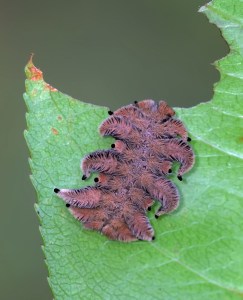
Monkey Slug Phobetron picthec

One of the strangest looking caterpillars I have ever encountered, with its slug-like body. I was lucky to find two monkey slugs on the same day; one on cherry and the other on oak in a field. It’s hard to imagine what this bizarre creature is trying to look like.


Wooly Bear (Pyrrharctia isabella)

Wooly bear (Pyrrharctia isabella)

Perhaps one of our best known caterpillars, it is frequently seen this time of year crossing roads and driveways. I remember as a child being told that the width of the orange band can predict the severity of the coming winter. It turns out the width of the band is quite variable, increasing in size as it molts.


Red-humped Oakworm (Symmerista canicosta)

Red-humped Oakworm Symmerista canicosta

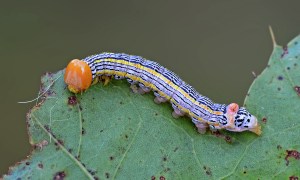
This is a good year for red-humped oakworms, as caterpillars were found in just about every beating sample from red oak. The caterpillars start life as gregarious feeders forming large clusters on the underside of leaves and become solitary in later instars. They have been known to cause widespread defoliation of oaks, especially in the northeast. Full-grown caterpillars drop to the ground in late September and pupate in the leaf litter.

Southern Oak Dagger Moth (Acronicta increta)

Southern Oak Dagger Acronicta increta complex

The color of this caterpillar is variable, ranging from green to a beautiful salmon-pink, with pairs of white spots on top of the abdomen. It was found resting on the underside of a red oak leaf in a characteristic position with the head bent back along the abdomen. This moth is a part of a difficult species complex making identifications quite challenging.

Unicorn Caterpillar (Schizura unicornis)

Unicorn caterpillar (Schizura unicornis)

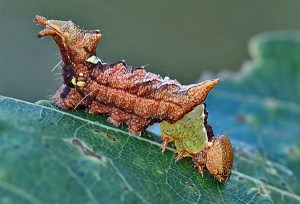
This caterpillar is aptly named for its unicorn-like horn on its abdomen. A master of camouflage, it is easily overlook when mimicking the edge of a partially eaten leaf. It feeds on a wide range of trees and shrubs, including cherry.


Hickory Tussock Moth (Lophocampa caryae)


Hickory Tussock Moth (Lophocampa caryae)

The common name of this moth is somewhat misleading, as it feeds on a number of trees species other than hickory. In fact, I’m not aware of any hickory growing in the area where this caterpillar was commonly seen feeding on white ash, red oak, and birch. The hairs of this species can cause an allergic reaction in some people.

Banded Tussock Moth (Halysidota tessellaris)

Banded Tussock Moth (Halysidota tessellaris)

One of the few caterpillars in our area that will rest entirely exposed on the upper surface of the leaf, suggesting they are distasteful to birds. This caterpillar is a generalist, feeding on many species of woody shrubs and trees.


Eastern Tiger Swallowtail (Papilio glaucus)

Eastern Tiger Swallowtail (Papilio glaucus)


Its life as a caterpillar is nearly over, as it prepares to pupate and overwinter as a chrysalis. Just prior to pupation, the caterpillar turns from green to dark brown and spins a silken girdle around the thorax to hold the chrysalis in an upright position.


Gray furcula (Furcula cinerea)

Gray Furcula (Furcula cinerea)

A favorite among caterpillar hunters with its long anal prolegs that resemble a forked tail. when disturbed, the larva raises the erect ‘tail’ above its body in a threatening-like manner. It was found feeding on a poplar along the edge of a field.