Welcome to Deering

FAVORITE OLD TREES IN AND AROUND DEERING

My favorite time of year here in New England is autumn. When I was much younger it was in the fall when I would fall in love. Even at this outer edge of my life the deepest of blue sky in autumn, and the leaves in their annual riot of color cause a frisson of joy. But leaf fall, the onset of winter, does not trigger depression in me. Winter is just another season and it one of breathtaking  beauty.  One of the favorite treats of winter is leafless old trees.

Now we’re in spring, at last. Before long our trees are going to leaf out and we’ll be into another summer. Take advantage of this in between time and  really look at our trees before their branches are hidden behind leaves.

There is a lot of forest here in Deering, and in nearby town. The magnificence of the architecture of old trees is on full display now and has been throughout the winter. Look at a solitary old maple in the forest. The trunk all knotty and cankered, signs of depredation over even centuries. Deeply furrowed, the trunk sometimes seemingly twisted. Incredibly muscular branches that have supported generations of birds and squirrels. Solitary trees sometimes surrounded by their progeny, younger trees waiting their turn. These trees shade the forest floor to ensure regeneration of all sorts of life. They protect their young, and the young of others as they, in their own time will replace their elders. We now know that  the trees are interconnected and communicate through a fungal network, and the network even extends to trees that were cut or that fell years ago. The old trees connect to us. We planted them before our houses many years ago and they stand, protecting our homes from wind, sun, and rain. They reassure us with their relative permenance.  Some would say they are sentient, and there is a story of a man who trees loved and who was eventually enfolded by them. When I look at old trees with their often wild branching words that come to mind and images include power, strength, age, wisdom, beauty and community. I wish I were a poet. Words fail me in expressing my feelings.

Look around you at old trees living near you. Here are some of my favorites.

Let me know of your favorites!
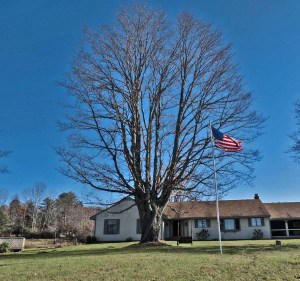
Sugar maple guarding ‘its’ house.Clearly this tree guarded another, house that is long gone from this site.

This sugar maple at the top of Deering Center Road stands before ‘its’ house.  Clearly this old tree stood before a different house, at another time. Maybe this is a modern iteration of the home that originally stood on this spot.  Each autumn it’s leaves are outstanding.


The trunk of this maple looks to have been twisted but one gets an impression of strength, of muscles, of a readiness to defend the home and its occupants against evil.
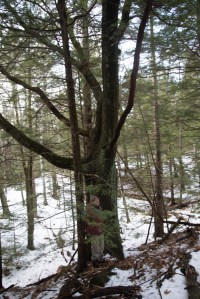


These old sugar maples are  all that remain of a population of several on the Baldwin property off Reservoir Rd. They were noted in the 1980 census of big trees but today they show signs of weariness, age.  In their day one can imagine that they provided a good lot of New Hampshire maple syrup to their happy humans. The tree on the right was a champion nearly 40 years ago but today is a dignified but hollowed trunk. A reminder of what once grew in this part of the forest.

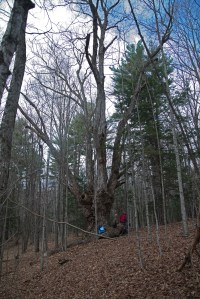
This sugar maple on East Deering Road started growing about 400 years ago.Sugar maple is not considered to be a long-lived tree! The trunk of this one is a mass of knots, scars of old branches and other predations.  Despite those ravages, the tree is hanging on, reduced to a trunk and a few long, mighty branches, but probably good for a long while yet

There is another truly elegant sugar maple where Sleepy Brown had his house on North  Road, many years ago. This tree is about 300 years old and, while looking at it leaves no doubt that it has seen a thing or two, it bears its age lightly. The Audubon Society, which now owns the tract, logged it recently and now this old tree is visible from the road.  This proud old creature, surviving in the forest for all these years, does not in the least call to mind that sappy doggerel “I think I shall never see a poem lovely as a tree.” This old maple speaks of the profane, of earth, of spirits  present and past. At once a fierce monument to survival, remembering that 150 years ago this tree likely stood in a sheep meadow, now a projection of a forest community, a wise statesman to whom we should pay close attention.
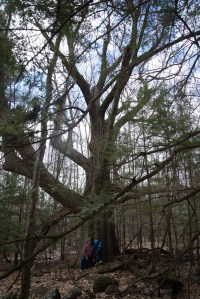
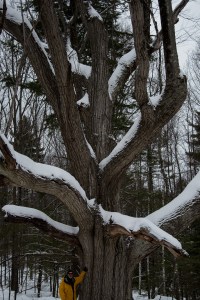


White ash on Old County road, near the site of Deering’s Poor Farm. Not succumbing to Emerald Ash Borer, this tree has serious heart rot but still, there it stands alone in a pasture, not seemingly connected to any other trees.  Certainly no trees any near in age to this one are close by, although there are two large ash trees in front of the house on the road. Maybe this is the parent to them.

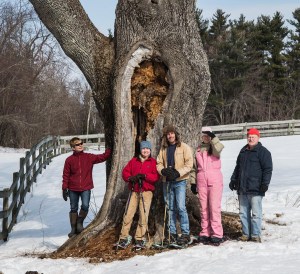
What I do know is that this stately tree was beloved of a wonderful person who is no longer with us. Her ashes are scattered around the base of her tree.  These trees, they are more than biologically connected to their ‘natural’ world. We join their networks. They reassure us. when so much else seems wrong or fleeting they remain close to us. They can enfold and protect us. It’s proven that just walking in a forest can improve our mood, influenced by ‘vapourscoming from trees.  This ash was loved by a woman whose spirit persists.  This ash will always remind of her and a wonderful day with friends. No doubt this ash has been loved before, and when we are long gone, this ash will be loved by others.
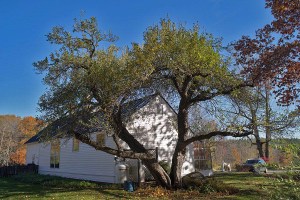
The Wilkins Family has been in Deering since the beginings of our town.  They donated land for the first cemetery, on Old County Rd, and the Wilkins House has stood since the end of the 18th Century.It has been the home of the Walmsley family since the mid 1960’s. This apple tree was there when they moved in. Actually, this apple tree has  been giving green apples since at least 1920. A very long time for an apple!
Blackgum is the longest-lived hardwood tree in eastern North America, with a maximum age of something over 600 years. Two blackgums in Deering are not that old, but they most likely were here when Deering was first settled. Blackgum was not included in the 1980 list of Deering’s biggest trees, despite there being several in town. They were most likely overlooked because they live in swamps or wet places, and the two largest are growing in a swamp that not close to any road or hiking ail.

Blackgum (Nyssa sylvatica) is a very slow growing tree that is able to grow under a wide range of conditions. Although here in New England it is more common in wet areas than on dry  sites. It never comprises more than a small percentage of species in any forest and it is usually overgrown by other species such as red maple. These two Deering trees are taller than the surrounding forest, and their distinctive canopy can be seen from some distance

The trees have long, straight trunks. They branch from near the top of the trunk and branches come off at right angles to the trunk, resulting in a nearly flat canopy. Blackgum is resistant predators, including most insects and fungi. The trees were not taken in logging because even though the wood is very hard, it tends to rot. Bark in old trees is very thick, distinctive for being deeply ridged. Their thick bark makes the trees fire fire resistant.

I know of three places in Deering where blackgum grows. In two of them the trees are solitary, but at the third site on North Road there is a  grove of maybe a dozen trees. The biggest two are found not far from each other in the Manselville swamp. I like to snowshoe out there and sit for a while in the cold of winter, looking at these wonderful trees.


A final favorite old tree is not in Deering. It is impossible to pass the Hillside (South Weare) Cemetery in Weare on route 149 from Deering to Weare an d not see the wildly branched catalpa at its entrance. It seems  an appropriate sentry, stationed at the entrance to this burying ground to discourage those, physical and spectral, who would enter and disturb the local residents.
BIG PINE FOUND

In the Big Tree Lists of 1980 and 1985 the two largest pines had circumferences of, respectively, 135″ and 132″.  The larger one was recorded by John Dawson but its location was not given. The smaller tree was recorded by H. E. Baldwin as occurring in ‘Gregg land off Longwood.’

The town of Deering acquired a 6.7 a parcel from George and Katherine Gregg in 1970. The parcel is landlocked, situated in a triangle, one leg of which is Manselville Rd. and the other is Longwood Road. This must be the ‘Gregg land off Longwood’ refereed to in the 1980 tree list.

I looked for the tree in 2017 but without luck, although I think I found mountain laurel. This year I asked Ray Daniels, whose sand pit abuts the Gregg land, if he knew this big pine. He told me that that he could see it from his house and that it is not far from the ATV trail that runs from Longwoods road.

With that in mind I set out this morning (should have worn spikes) and trudged through the rapidly disappearing snow until I saw the magnificent tree just beside the trail.

In 1980 the circumference at breast height was 132″ and today it measured 148″. This is nowhere near the county record for white pine (179″) but it’s still an impressive tree, straight and tall. In seemingly perfect health.

Now to find the Dawson tree!

TWO MUSHROOMS


Rain in the late summer and early fall can bring out a dazzling array of mushrooms in our northeastern forests.  All sizes, shapes and colors of mushrooms scatter about on the forest floor without obvious design. But there actually is a plan. Many mushrooms form more or less specific associations with roots of certain kinds of trees, either hardwoods or conifers and are essential for the health of those trees. Other mushrooms grow on decaying logs or on leaf litter without any obvious specificity as to their substrate.  Along with bacteria, insects and a host of microbes the fungi recycle rotting wood and fallen leaves and contribute to nutrient recycling of the forest. These recycling fungi are called ‘saprobes’ which means that they live on dead plant material. One would not think of saprobes as requiring specific substrates, but two apparently saprobic mushrooms that we see in the litter of our forests actually are specific as to what they grow on.

Cantharellula umbonata, also known as the grayling, grows among hair cap mosses (Polytrichum species) and is native to eastern North America. The mushroom clearly rises from the mass of mosses but does not appear to cause them any harm. It is not a big mushroom. Its cap is only an inch or so in diameter and its stalk is up to 4” long and slender. The cap is gray (hence ‘grayling’) and the gills below the cap are off white, but the cap and gills stain red when bruised. Because the gills under the cap tend to run down the stalk, similar to what is seen in the chanterelle mushroom, the grayling was once classified as a chanterelle. Unlike chanterelles, the gills of the grayling are sharp-edged, not rounded as in the chanterelle. I have not seen research into why the grayling grows only on or with the moss. The moss appears unaffected, so it is not a question of parasitism. Is there any exchange between the mushroom and the moss? An interesting subject for research! I found the grayling that we see here on the trail to High Five.

The second ‘host’ specific saprobic mushroom that I have seen in Deering is Micromphale perforans. This mushroom is very small, the cap no more than ¼” in diameter and is perched atop a very fine, black stalk that is no more than 1” long. This fungus is so small that it does not have a common name. We see it frequently here hemlock and pine forests, where you see it on the ground as tiny white spots. If you carefully pick up one of those little mushrooms and pull apart the debris you will see that the Micromphale is growing out from old hemlock, leaves or infrequently pine needles. Actually, fungi live in the roots, leaves and trunks of trees and leaves of most plants without causing any ill effects. These fungi, called endophytes, can be beneficial to the plant in several ways. It is a case of mutualism where both the fungus and the plant benefit. We do not know whether the Micromphale is an endophyte. How does it get there? Is the fungus waiting in the ground for the leaves to fall before invading them, or is it present in the leaves, only producing the little mushroom and completing its life cycle once the leaves have fallen?  This is another interesting subject for research! We know so very little about how our planet functions. It is these little interactions that, taken together, are critical for ecosystem functioning. So, yes, it is worth knowing the answers to these questions!

INVASIVE LAND PLANTS IN NEW HAMPSHIRE

Which Invasive Upland Plant Species occur in our town?  
There are easily 5 or 6 plant species which have escaped managed landscape environments and are becoming a nuisance in both the natural and urban environments of Antrim.  The invading plants are Japanese Barberry, Oriental Bittersweet, Autumn Olive, Japanese Knotweed, Glossy and Common Buckthorn and Burning Bush. Once you know what to look for you will see just how common and widespread they are.
It is the same story here in Deering.
How to find out more about New Hampshire’s Invasive Upland Plant Species? 
Save the Date because on April 4, 2018, Douglas Cygan, Invasive Species Coordinator from the NH Department of Agriculture will provide a presentation at 7pm at Antrim Town Hall. His presentation will take an in-depth look at upland invasive plant species in NH.  Attendees will learn about the various issues invasive species present to natural and managed environments, NH rules and regulations regarding invasive species, identifying features and characteristics of invasive species and best management control measures of some of the most aggressive non-native plants in the Granite State. This presentation is co-sponsored by the Antrim Parks and Recreation Commission, the Antrim Grange and the Antrim Conservation Commission. 

Hypholoma sublateritium, a late season mushroom

It’s early November. We had unseasonably warm weather not so long ago, but over the past week the temperatures have fallen and now are hovering around freezing during the day.  Happy as I am for this return to normalcy, it’s not good for mushrooms.

Mushrooms do have seasons. Morels in the spring start the ‘shroom year and the number of species increases as the year advances, peaking in the fall with the return of rain after a dry summer.  As temperatures fall, though, the number of mushrooms coming up declines. Here at the end of the year, apart from brackets that are tough, few mushrooms are fruiting.

The oyster mushroom, Pleurotus ostreatus, begins fruiting soon after the fall rains, on various hardwood trees. This species will continue to fruit through into Spring. Oysters are fairly common around Deering and are highly prized as edibles.

Brick Cap, Hypholoma sublateritium

Another late season mushroom that is fruiting widely in Deering now (11 November) is the Brick Cap, Hypholoma sublateritium. This species comes up on hardwood stumps and buried wood, often in fascicles of several. It is notable for its brick-red cap that is paler, ochre, toward the margin; gills that are yellowish at first but become grayish-brown or grayish-olive. The spore print is   purple-brown.  There is no ring on the stipe, which is yellow above and reddish toward the bottom. Brick Cap fruits through fall into early winter. I have been noticing it in the past week in Deering (Dudley Brook – the Venter conservation easement, and the trail to High Five).

Brick Cap, Hypholoma sublateritium

Brick Cap is common in the east and is said to be edible. But, as always, you have to be careful. Galerina autumnalis is a somewhat similar mushroom in its small size and in having a brown cap and a ring on the stalk. It is deadly poisonous. Another somewhat similar poisonous mushroom is the Sulphur Tuft, Hypholoma fasciulare. This species has a yellow cap that can be brown or ochre in the center. Like Brick Cap, this species grows in fascicles from stumps and buried wood of hardwoods and conifers.  It fruits through fall into winter and is widely distributed in North America.


A STICK WITH LEGS!

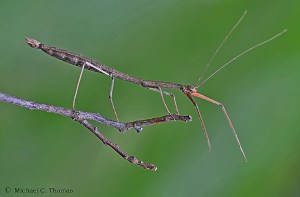
The Northern Walking Stick (Diapheromera femorata) is a wingless insect in the order Phasmatodea that is easily overlooked due to its close resemblance to a dead twig.  When frightened, it will straighten out its twig-like body and front legs and remain motionless for long periods.  By blending into its surroundings it gains protection from predators, mostly from birds.  Of the 29 species in the United States, the Northern Walking Stick is the only one found in New England, occurring from southern Canada to northern Florida, and westward to North Dakota and New Mexico.

The Walking Stick is one of the most unusual insects that you can see in your backyard.  The one pictured at the right  pretended to be a dead twig on a porch screen in Deering one September day.

The biology of this insect is quite fascinating, as populations in our area require two years to complete their development.  Walking sticks are a hemimetabolous species, with only three life stages (egg, nymph, and adult), and unlike holometabolous species which undergo complete metamorphosis, they lack a pupal stage.  In the late summer and fall, females drop their eggs from the trees onto the forest floor where they overwinter in the leaf litter.  The adults cannot survive freezing temperatures and die with the first killing frost.  Most of the overwintering eggs remain unhatched through the following spring and summer, and overwinter a second year before hatching the following May or early June.  The green nymphs climb up low-growing shrubs and trees where they feed on the leaves.  When mature, they turn from green to brown and feed primarily on the leaves of oaks and cherry in our area.

So the next time you see a twig swaying on a windless day, look again.  It just might be a Northern Walking Stick!

Cow-wheat and Beech-drops, two parasitic flowering plants

Most plants produce their own food by taking carbon dioxide from the air and transforming it, via chlorophyll and photosynthesis, into sugar. Some plants lack chlorophyll and the ability to produce their own food. They need to get nourishment from somewhere, so they parasitize other organisms, including plants and fungi. They form specialized structures that enter the roots of their plant hosts and steal nutrients.  Still other plants have both a parasitic and a photosynthetic ability. They have chlorophyll and can make some food, but they still need to get nutrients from other plants. These plants are called ‘hemiparasities.’

Two native plants that are common in Deering are members of a whole family of plants that are parasites on roots of trees: narrow-leaved cow-wheat and beech-drops.

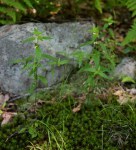
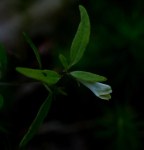
Melampyrum lineare, also known as narrow-leaved cow-wheat, is a hemiparasite because it has chlorophyll, but still it enters their roots and parasitizes several species of pine, poplar, sugar maple, red oak and low-bush blueberry. This small, native, woodland annual has flowers that resemble a snakes head. The small yellow flowers are more or less tubular and are pollinated by long-tongued bees. Cow-wheat is found in man-made or disturbed habitats, cliffs, balds, or ledges, forests, grassland, meadows and fields, sand plains and barrens, woodlands. In Deering I have found it growing in an exposed spot along the Hedgehog Ridge Trail and in meadow along the trail through the Wilkins-Campbell Forest. Certainly it grows elsewhere in town. Our cow-wheat is native to North America. The plant occurs in most of the eastern states as far west as Illinois and Wisconsin, south to Georgia, and across Canada; it also is found in Montana, Idaho and Washington. The name Melampyrum (dark seed) refers to the black seed that is produced by some species and this seed can sometimes get into harvested grain, thus ‘cow-wheat.’ An European species of cow-wheat, M. pratense, also parasitizes roots of pine trees. One study found that these cow-wheat plants were much healthier when parasitizing trees that had associations with some fungi (mushroom species) through their roots than when parasitizing trees that lacked these ‘mycorrhizal’ associations. The conclusion was that the mycorrhizal fungus enables the tree to produce more nutrients than the unassociated trees, and these nutrients are transported to the parasitic cow-wheat plant.


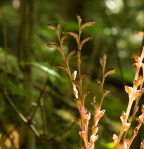
Epifagus virginiana, beech-drops, a relative of cow-wheat, is an annual herb that depends on getting its nourishment from the roots of beech trees. Thus it is a host-specific parasite. In Deering you can find beech-drops everywhere beech trees are found. It appears as leafless (the leaves are reduced to scales), brown plants growing up from around beech trees. Plants of beech-drops occur singly or in clusters and are often densely disposed around the tree; typically 8 – 12” tall, they can get as tall as 18”. Flowering occurs late in the year, August through October. Flowers are small and trumpet-shaped, striped in red and purple. They arise singly along the stalk. Toward the base of the stalk there are flowers that do not open. These ‘cleistogamous’ (hidden gametes) flowers are capable of self-pollination. At the end of the season the whole plant becomes brown and brittle. One study found that the plant is pollinated by various insects but the most common species observed in that study was Prenolepis imparis, winter ant. The winter ant avoids competition with other ants by only becoming active when temperatures fall and other ants are less active …. and beech-drops is flowering.

Invasion of the Painted Ladies

Painted Lady butterflies (Vanessa cardui) are resident in the deserts of northern Mexico, so why are they showing up in Deering in large numbers this fall?  In most years, they are uncommon or absent in our area.  For reasons not fully understood, Painted Ladies occasionally migrate northward in huge numbers, and under favorable conditions their numbers increase as they migrate northward with each successive generation.  Then in the fall they migrate southward to escape the cold temperatures.  We may be witnessing one of the greatest migrations of Painted Ladies to occur in our area in a lifetime.  This past weekend, over a dozen were observed nectaring on zinnias in our flower garden.  This phenomena isn’t just happening in Deering, but is being reported throughout New England and elsewhere across the continent.  If fact, this year the migration has been large enough to register on the National Weather Service’s radar imagery.  I hope you enjoy the flash of orange and black wings in your gardens as we have.
Hunting for Caterpillars

Caterpillars, the larvae of butterflies and moths (Order Lepidoptera), are exquisite creatures that display an array of colors, patterns, and interesting behaviors. Although some species are considered pests in our gardens and forests, they are extremely important in terrestrial food webs, serving as the primary food source for many of our resident and migrant songbirds. Without caterpillars, our forest would be silent in spring. Caterpillars also play an important role as macrodecomposers by shredding and consuming leaves which helps to accelerate the nutrient cycling process. Fall is a great time of year to hunt for caterpillars. Some species, like the familiar wooly bear (Pyrrharctia isabella) pictured below,  can be found roaming about in search of a hibernaculum, such as your wood pile, where they overwinter. Not only is caterpillar hunting good sport, it can give us a greater appreciation for the little creatures that go unnoticed around us.

One doesn’t have to travel to some far away exotic place to find caterpillars. They can be found right in ones backyard along forest edges, fields, and gardens. Many species have evolved cryptic coloration and behaviors that can fool even the most intelligent predators (including caterpillar hunters). The first step to finding caterpillars, or for that matter any insect, is to walk more slowly, observe more closely, and magically they will start to appear as you develop a “search image”. Rarely will the caterpillar be sitting exposed on the leaf surface, so be sure to examine the underside and along the leaf margins, stems, and on flower heads. A more efficient method is to use a beating sheet or “drop cloth”. This can be as simple as using a white bed sheet, or umbrella, and placing it under a limb of a tree or shrub and hitting the limb with a stick to dislodge the caterpillars from the foliage. In addition to caterpillars, a multitude of other species including jumping spiders, ants, beetles, and stinkbugs can be found on the sheet, but that is another story. One word of caution, be careful when handling spiny or hairy caterpillars, as the hairs of some species can cause an allergic reaction to some people.

Once you find a caterpillar, the next step is figuring out what it is and learning about its life history. Questions like: What does it turn into? What does it eat? What is its range? Is it a pest in my garden? These questions can best be answered by referring to a field guide of the caterpillars occurring in your area. An outstanding guide is “Caterpillars of Eastern North America” by David Wagner, which will enable you to identify just about any species you will find in your backyard or in our region.

Provided below are some photographs I recently took during a caterpillar hunt in Deering, along with a few brief comments. If you find any caterpillars that you would like to share, please don’t hesitate to email images to mikethomas206@comcast.net.

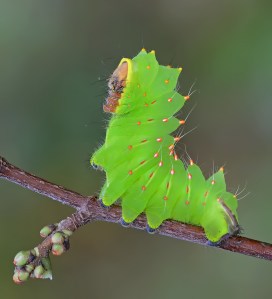
Polyphemus Moth (Anthera polyphemus)

Antheraea polyhemus, the polyphemus moth

You can imagine my excitement when I turned over the leaves of a sugar

maple and found this spectacular fluorescent green silkmoth caterpillar. It has been reported that Polyphemus caterpillars sometimes make a snapping sound with their mandibles.


Great Ash Sphinx (Sphinx chersis)

Great ash sphinx (Sphinx chersis)

White Ash (Fraxinus americana) is a common tree in Deering, so it comes as no surprise to find this large ash-feeding species. However, this may quickly change now that the invasive emerald ash borer (Agrilus planipennis) has been detected in town (2017). This beetle has already killed hundreds of millions of ash trees in the eastern United States. Infested trees die quickly; within 3-5 years. For more information about this destructive forest pest and what you can do, please refer to nhbugs.org. It’s sad to think that if we lose our ash trees, we may no longer see the Great Ash Sphinx, or the other species that depend on ash for their survival.

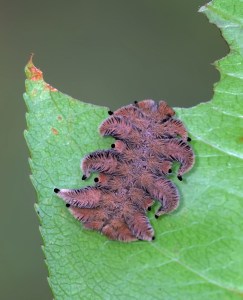
Monkey Slug (Phobetron pithecium)

Monkey Slug Phobetron picthec

One of the strangest looking caterpillars I have ever encountered, with its slug-like body. I was lucky to find two monkey slugs on the same day; one on cherry and the other on oak in a field. It’s hard to imagine what this bizarre creature is trying to look like.


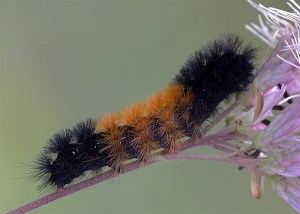
Wooly Bear (Pyrrharctia isabella)

Wooly bear (Pyrrharctia isabella)

Perhaps one of our best known caterpillars, it is frequently seen this time of year crossing roads and driveways. I remember as a child being told that the width of the orange band can predict the severity of the coming winter. It turns out the width of the band is quite variable, increasing in size as it molts.


Red-humped Oakworm (Symmerista canicosta)

Red-humped Oakworm Symmerista canicosta

This is a good year for red-humped oakworms, as caterpillars were found in just about every beating sample from red oak. The caterpillars start life as gregarious feeders forming large clusters on the underside of leaves and become solitary in later instars. They have been known to cause widespread defoliation of oaks, especially in the northeast. Full-grown caterpillars drop to the ground in late September and pupate in the leaf litter.

Southern Oak Dagger Moth (Acronicta increta)

Southern Oak Dagger Acronicta increta complex

The color of this caterpillar is variable, ranging from green to a beautiful salmon-pink, with pairs of white spots on top of the abdomen. It was found resting on the underside of a red oak leaf in a characteristic position with the head bent back along the abdomen. This moth is a part of a difficult species complex making identifications quite challenging.

Unicorn Caterpillar (Schizura unicornis)

Unicorn caterpillar (Schizura unicornis)

This caterpillar is aptly named for its unicorn-like horn on its abdomen. A master of camouflage, it is easily overlook when mimicking the edge of a partially eaten leaf. It feeds on a wide range of trees and shrubs, including cherry.


Hickory Tussock Moth (Lophocampa caryae)


Hickory Tussock Moth (Lophocampa caryae)

The common name of this moth is somewhat misleading, as it feeds on a number of trees species other than hickory. In fact, I’m not aware of any hickory growing in the area where this caterpillar was commonly seen feeding on white ash, red oak, and birch. The hairs of this species can cause an allergic reaction in some people.

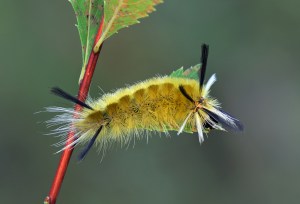
Banded Tussock Moth (Halysidota tessellaris)

Banded Tussock Moth (Halysidota tessellaris)

One of the few caterpillars in our area that will rest entirely exposed on the upper surface of the leaf, suggesting they are distasteful to birds. This caterpillar is a generalist, feeding on many species of woody shrubs and trees.


Eastern Tiger Swallowtail (Papilio glaucus)

Eastern Tiger Swallowtail (Papilio glaucus)


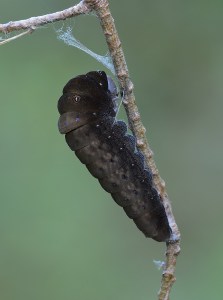
Its life as a caterpillar is nearly over, as it prepares to pupate and overwinter as a chrysalis. Just prior to pupation, the caterpillar turns from green to dark brown and spins a silken girdle around the thorax to hold the chrysalis in an upright position.


Gray furcula (Furcula cinerea)

Gray Furcula (Furcula cinerea)

A favorite among caterpillar hunters with its long anal prolegs that resemble a forked tail. when disturbed, the larva raises the erect ‘tail’ above its body in a threatening-like manner. It was found feeding on a poplar along the edge of a field.


HONEY MUSHROOM

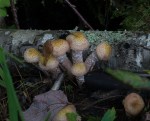
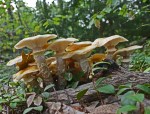
In the past couple of weeks, in mid-September, the honey mushroom, Armilariella mellea, has been coming up in different places around town.

The name, honey mushroom, refers to the Latin species name, mellea, which means honey. It’s a very attractive fungus and it’s name quite apt because the cap has a (sort of) light honey color.  According to David Arora, Mushrooms Demystified, A. mellea, is highly variable and may actually be a complex of species because of this variability. Some have recognized as many as 14 species in the complex! The critical elements for the complex are the presence of a veil, or ring around the stalk, a fibrous stalk, bitter taste (that apparently some cannot taste. I have not tried, yet), frequent presence of small dark hairs on the cap, growth on wood (often buried, rotten wood), and white or faintly yellowish spores (the cap may have a dusting of white spores).

The species is considered by some to be edible and delicious but there are reports of allergic reactions in some people. In addition, there are poisonous species, some deadly  that look a bit like A. mellea. One of them, the deadly poisonous Galerina autumnalis, also grows on wood. The spores of these poisonous species are brown.

Armilariella mellea is a sort of Jekyll and Hyde fungus.

As Jekyll, this species is edible, that’s good for a start.  More than that, Armilariella mellea has been used for hundreds of years in traditional Chinese medicine, and recent research suggests that the species has an anti-tumor potential, and polysaccharides isolated from it exhibit antioxidant activity that may provide protective effects against neurodegenerative diseases such as Alzheimer’s Disease.

On the Hyde side, this species – or species complex — is a serious forest pathogen. It affects roots of hundreds of species trees, shrubs, vines, and forbs growing in forests, along roadsides, and in cultivated areas. It is a widespread, native species and a natural component of the forest ecosystem, where they live undetected on coarse roots and stems of hardwood and conifer species. They become pathogenic when the host plant is weakened by other factors such as drought stress or other pathogens. Armilariella mellea can also weaken a host such that it becomes susceptible by other pathogens.

The Indian pipe, Monotropa uniflora, is common in Deering and is always connected to roots of trees via fungi in a peculiar two-way mycorrhizal association that benefits both the flower and the tree. One of the fungal associates of Indian pipe is this pathogen, A. mellea.