Residents of Deering have always valued the rural character of their town. They have consistently supported conserving forested land and active farms over commercial development in order to maintain that rural character of the place. They spent a lot of time outside in nature, whether as hunters or just enjoying their natural environment
In 1980 a group of Deering residents set out to locate the largest native and nonnative trees in town. This list was updated in 1985. You can see and download the Big Tree list here.
In 2016 members of the Deering Association began a project of once again updating the list of big trees by locating and documenting those on the old list and adding new records and species. Finding a particular trees that was included on a list thirty-five years ago is a difficult task. At that time it was not possible to add map coordinates to tree locations; there was no smart phones or GPS devices! Locations were given by property owner so even then it is difficult to locate a specific tree in a given parcel. Moreover, many of those properties have passed hands and there is no easily accessible way to find out where a specific parcel is today. Sadly, many of those who reported trees thirty-five years ago have passed away or just do not remember.A small part of our History gone.
In this Big Tree category we present the results of trying to find Deering’s biggest trees. We certainly encourage Deering residents who might know of the location of a particular large tree, or even a tree that is on the list, to contact us.
Engagement of our Community in this project, just as the Community was engaged all those years ago, will be very helpful as we attempt to account for Deering’s largest trees!
You can download a map of hiking trails in Deering here.
About 1/3 of Deering’s land, 7155 acres, is in conservation easement and thus is protected forever. Most of the hiking trails are Class 6 roads, roads that are seasonally passable but that are not maintained by the town. These are great places for leisurely walking in nature. Often there will be rock walls alongside the roads, or wetlands. Examples are Hedgehog Mt. Rd, Falls Rd and Lead Mine Rd.
There are a few marked trails through forests. These include the Hedgehog Mt. Ridge trail, from Hedgehog Mt. Rd through to High Five, about 5 miles. This is the longest marked trail in town. Other marked trails are much shorter. They are found in the Deering Audubon Sanctuary on Clement Hill Rd, the Pinnacles on Peter Wood Rd at North Rd., Wilkins-Campbell Forest from Wolf Hill Rd to the Deering Reservoir, the Burke Family Wildlife Preserve on Pleasant Pond Rd near Rt. 149, and a very short trail at the Deering Preserve at Falls Rd, off Old County Rd. The walk from Sky Farm Rd to High Five is along a dirt road and is about 1/3 mile in length. Some people go to High Five for star gazing or viewing the full moon.
With the exception of the Hedgehog Ridge trails, the other marked trails are rather short but are level and ,more or less smooth and fairly easy to walk on.
I have added links to XML files that should enable you to download hiking trails to your Garmin device.
Remember that dogs should be kept on leashes, there should be no fires or camping in Deering’s conserved lands.
Most roads in Deering are lined by trees. Sometimes homes are guarded by old sugar maples, singly or in a line in front, but mostly secondary forest is kept at bay behind ancient rock walls. Little spring flowering trees are common along disturbed roadsides and in wetlands. Shadbush, at first, then chokeberry, pin cherry and choke cherry bear clusters of pretty white flowers at the tips of branches, are common.
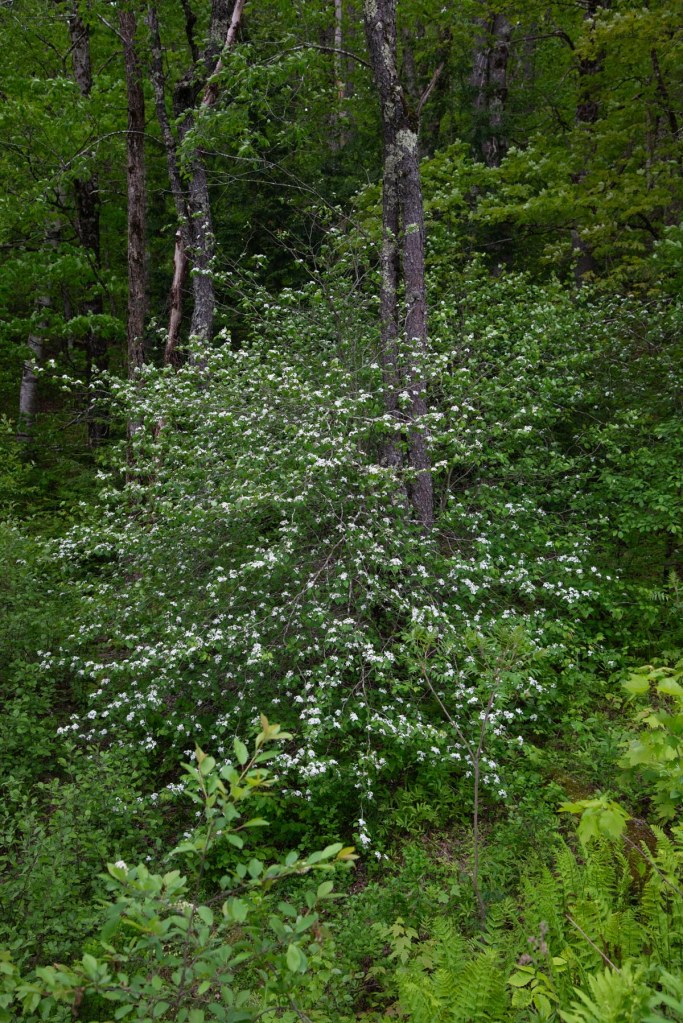
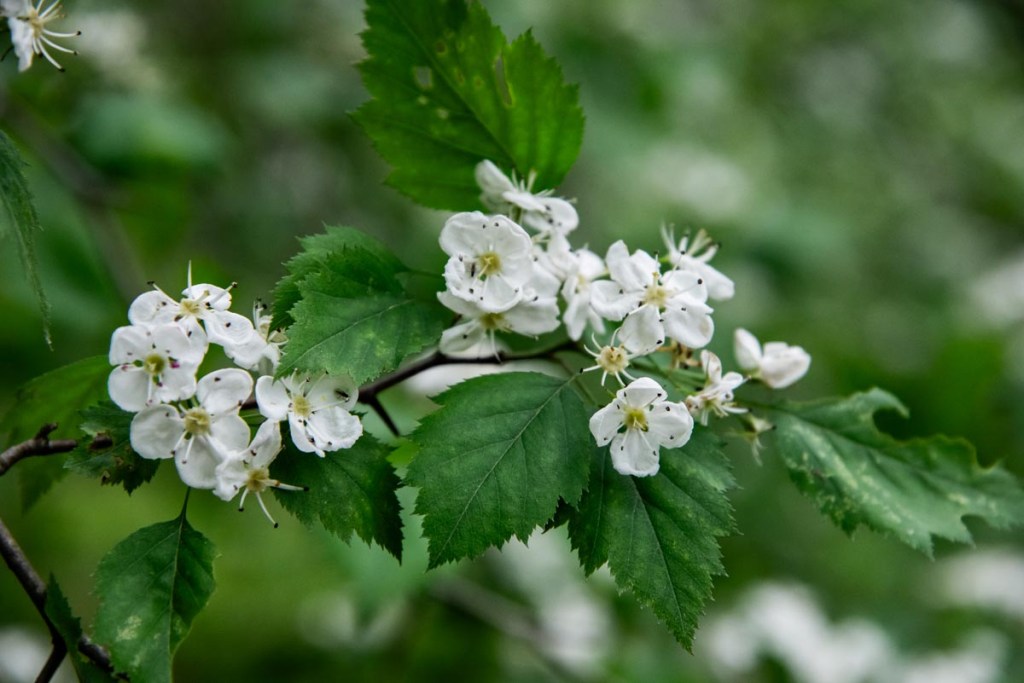
Hawthorns are not common, or at any rate I have seen only two widely separated trees in flower here in Deering. I might be wrong about the commonness of hawthorn because two wee volunteer seedlings have become well established in our garden on Hedgehog Mountain. Doubtless I have not seen all the hawthorns in town. .
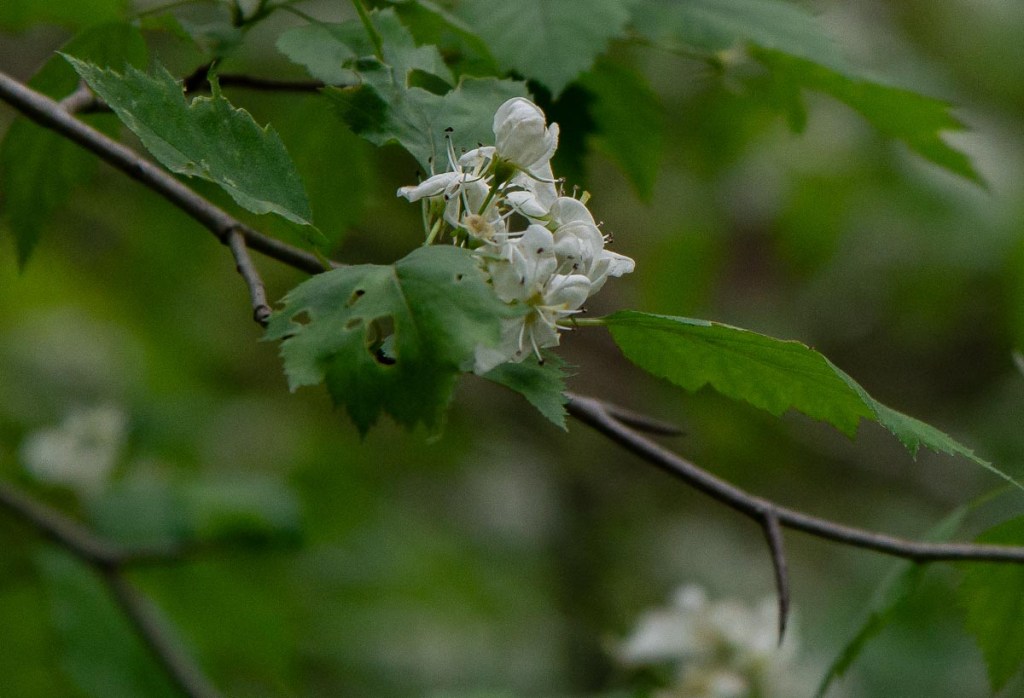
Hawthorn along North Road
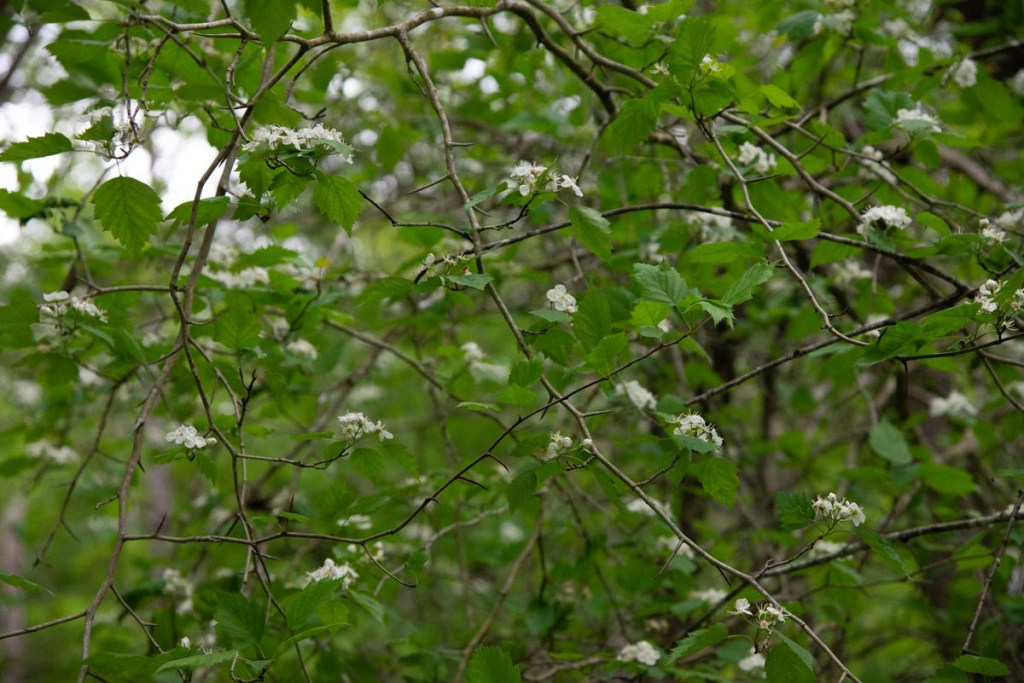
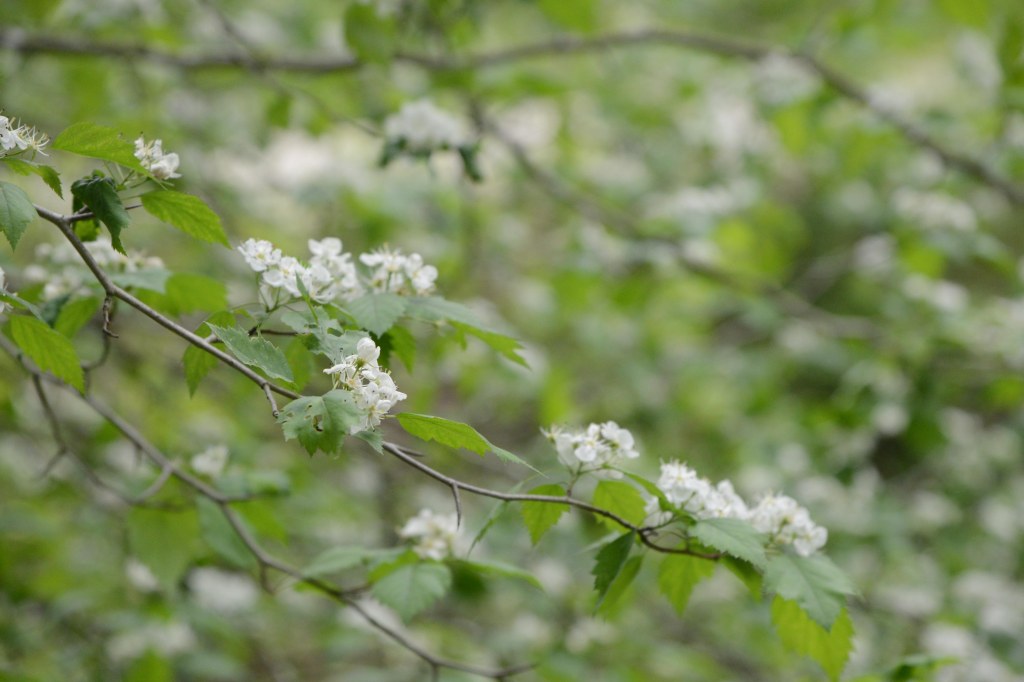
Hawthorns are species of the genus Crataegus and the 47 species of this genus found in New England make it the second largest genus of flowering plants in New England. Identification of species is quite difficult. The major hurdle to identification is the large number of species that have been recognized by taxonomists (aka ‘Splitters’). I navigated the Go Botany (the Native Plant Trust) key to C. populnea for our North Road hawthorn, an identification that was supported when i submitted an image of the flower to iNaturalist.
Crataegus poplnea, poplar hawthorn, is a species of northeastern USA and southeastern Canada but is rare in New England. Go Botany does not show any records for Hillsborough County. So, you can see my reservation in this identification. This identification is based on the flowering specimen growing on North Road. A second specimen growing some distance away at ‘The View,’ at the intersection of Deering Center Road and Old County Road, had completely finished flowering by mid May, so could be a different species. Go Botany says that C. populnea could be a hybrid between two other species, C. macrosperma and C. pruinosa. Flowers of C. pruinosa are fringed in pink and the species is not known for Hillsborough County. Crataegus macrosperma is widely distributed in New Hampshire, but its edible fruit appear to be larger than those of our Deering specimen. Poplar hawthorn is found in man-made or disturbed habitats, forest edges, forests, meadows and fields.
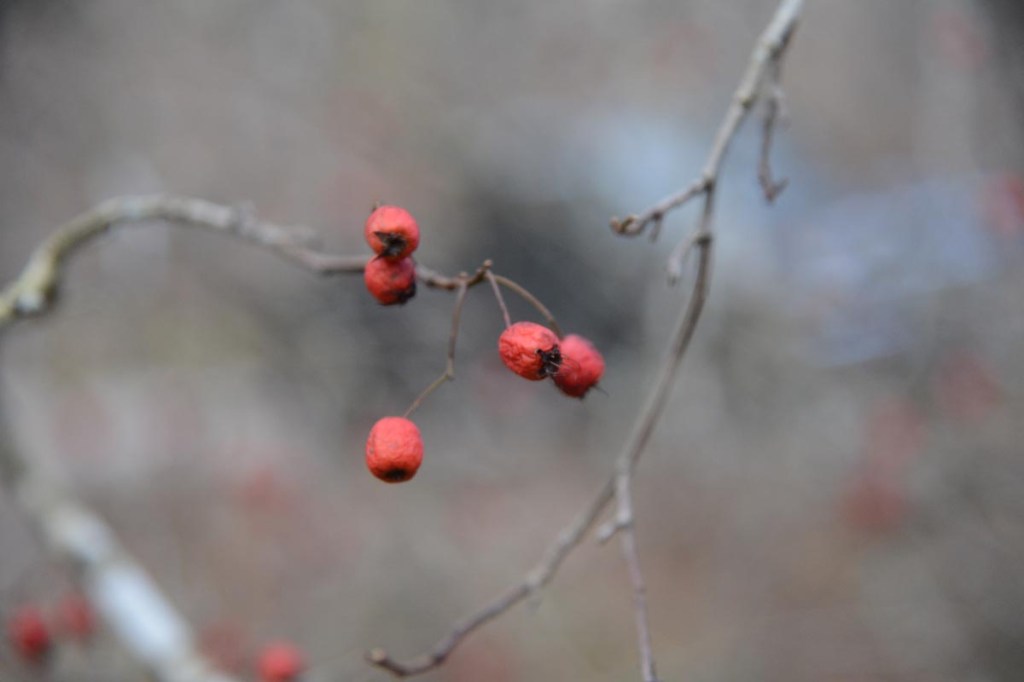
old hawthorn fruit
Crataegus is a genus of the rose family, so is related to apple, cherry, shadbush, and many others. The white flowers resemble flowers of all of them. Hawthorns are readily distinguished by having very long and sharp thorns (which are actually aborted branches and once were used as awls). The leaves of popular hawthorn are sightly lobed but deeply toothed. The fruit of hawthorn, like apples, are pomes and can vary in color from yellow to red to black. They have little nutrient content. Although edible, there is great variability in their edibility, some being mealy and others ‘just right.’ Native Americans dried the fruit in cakes for winter cooking. Decoction of the root is supposed to ease menstrual pain.
Haw is an old English word for ‘hedge’ and hawthorn hedges often separated fields. Maybe the most famous hawthorn hedge is the one in the village of Combray, in France, where young Marcel Proust walked on Sunday mornings with his family. Here is where young Marcel first discovered the sensuous beauty of nature, its colors and scent. Peeping through the hedge, he is transfixed by the beauty of a young girl with strawberry blonde hair in her family garden. Gilberte Swann remains Proust’s idee fixe through many of the 3000 pages of his novel In Search of Lost Time.
The hawthorns of Deering are not so romantic or even as sensuous as those in the hedge in Combray. But they are pretty little trees and I am glad to have found them here.
Mushrooms are a very conspicuous component of Deering’s forested land. The often large, often brightly colored and often edible mushrooms stand out. The gaudy, brightly colored Amanitas, deadly or otherwise, Russulas and Lactarius stand out in the dark forest. Some Boletes such as the Cep lookalike Boletus nobilis, and the shelving Chicken of the Woods are culinary delights in addition to being highly attractive. But far more mushrooms are nondescript, small or drab or both. LBM’s — Little Brown Mushrooms — growing from leaf litter and rotting wood are just not visually interesting, nor are they big enough to consider their taste — unless your were lost (in Deering?) and really, really hungry.
In that case you really must remember to stay away from mushrooms that have brown gills/spores and boletes that stain blue as a general principle. Most of these won’t kill you, just make you pretty ill and wish you were dead — but some will kill you, and your death will not be pretty.
So it is with Galerina marginata (earlier known as G. autumnalis). A little brown mushroom if ever there was one. This little mushroom contains the same toxins as the deadly amanitas, such as A. bisporigera — a common species here. It’s a slow death. First you will be sick, then you will get better — and then a day or so later your liver will deteriorate and, without a liver transplant, you will die. There is no antidote to these amatoxins.
Galerina marginata, and all Galerina species, grows from rotting wood and often in association with mosses. Where it’s been investigated the moss suffers from the association, unlike other moss-mushroom pairings that are mutualistic, with each partner benefiting from the relationship. This Galerina is variable in its form, but the basics are a smallish orange-brown cap (maybe up to 4 inches in diameter), a narrow stem with a membranous or fibrillose ring around the top, just below the cap, and rusty brown spores. But, because the species is variable, it has been described under several other names, in addition to G. autumnalis. The scary part is that it can look to some like edible species of Armillaria, Pholiota, Kuehneromyces or Flammulina.
Although G. marginata can appear from June to fall, it is more common in the fall. I have seen this species twice in Deering in recent weeks this late fall.
Galerina marginata and other wood inhabiting species perform an important role in nutrient recycling in forests. Rather than forming mycorrhizal associations with trees, and sharing nutrients with them, these fungi break down components in wood and return that carbon to the cycle of life in our forests.
Fungi have long been associated with ghoulish and otherwise creepy activities. Zombie ants? Well, not in Deering, but in tropical America a fungus takes over the ant, commanding the creature to climb up into a tree so as to enhance the ability of the fungus to disperse its spores — to other ants. St Vitus Dance, induced by consuming ergot baked in rye bread, the ergot a reproductive unit of a fungus that invades and takes over the seed of rye and is gathered with the grain and baked into poor people’s bread. This is what lead Massachusetts colonists to hang some poor girls, ascribing their witchy behaviour to work of the devil.
Here is my Halloween offering : a selection of spookily named fungi — and one plant — that I have found in Deering.
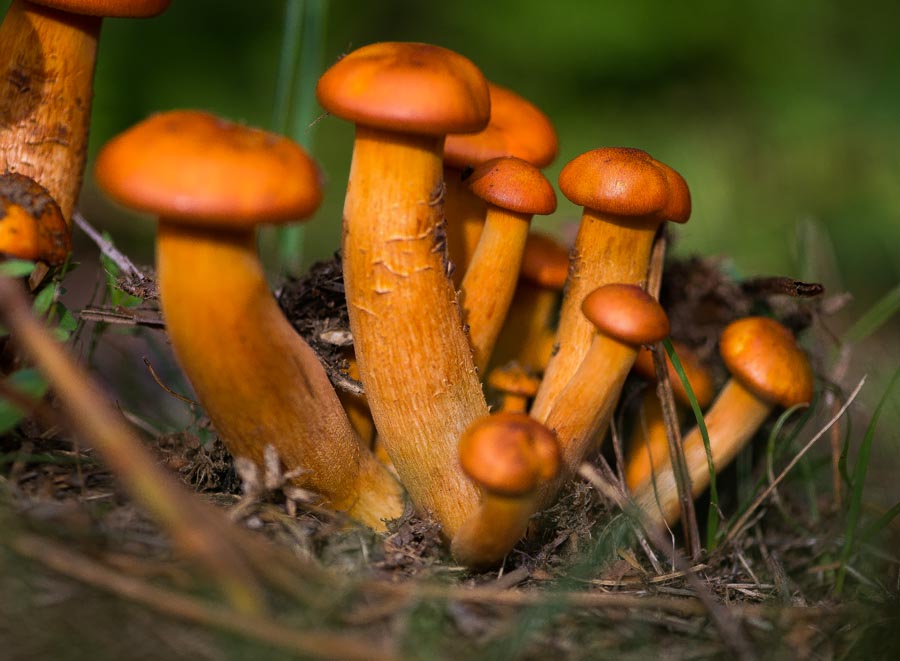
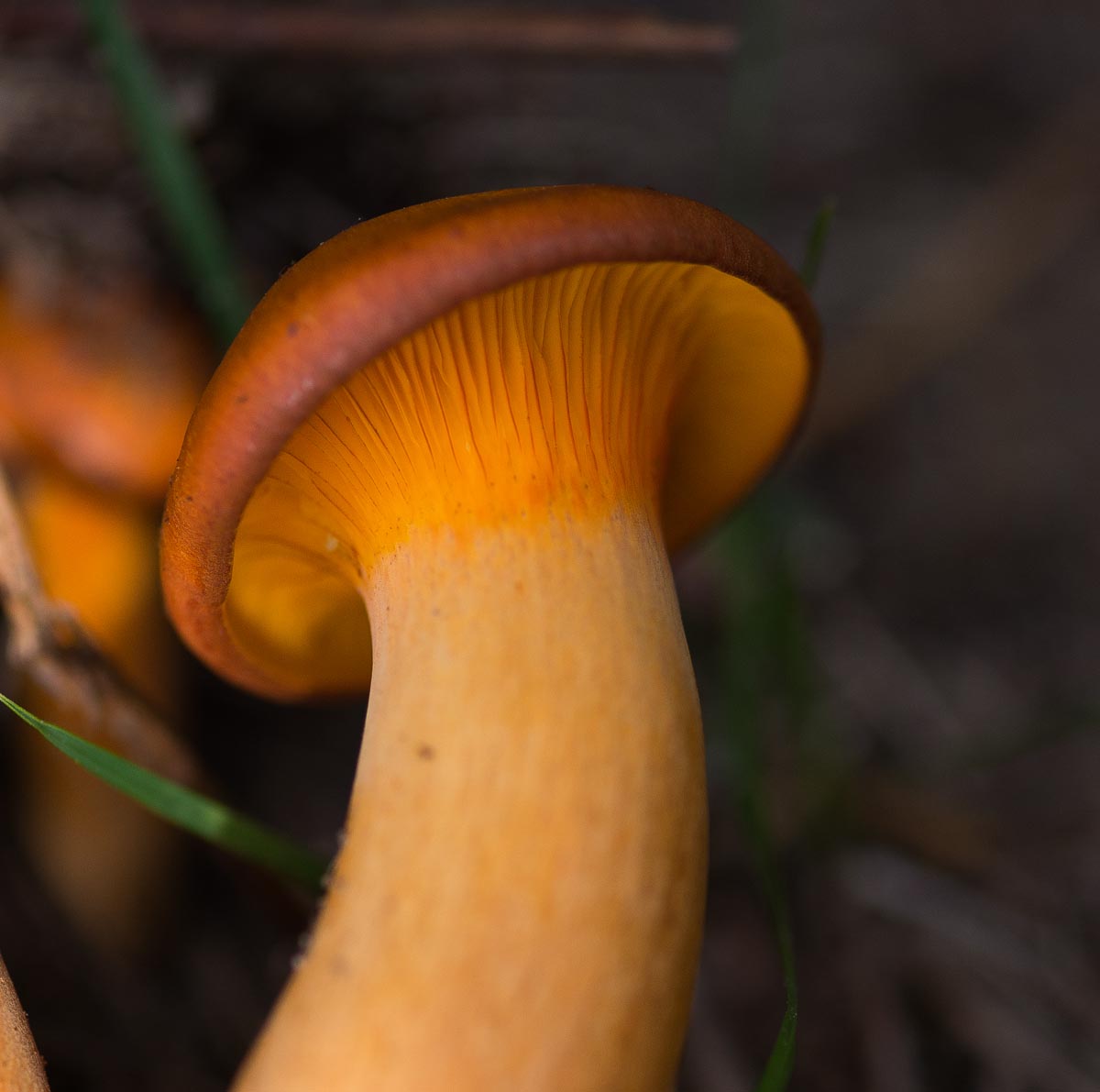
Omphalotus illudens: Jack O’Lantern Mushroom
Apart from the pumpkinny color that suggests the season, the Jack O’Lantern mushroom glows in the dark. Spooky, right? Wrap it in aluminum foil and put it in a dark place, such as a dresser drawer, and when you awaken during the night you might se it glowing. This is where the species name ‘illudens‘ comes from. The gills, where the spores are formed, tend to run down the stalk, as can be seen in the right hand picture. This, and the color, suggest the golden chanterelle. But don’t be tempted to eat this one because if you do, you are likely to end up with an unhappy stomach. Omphalotus illudens is a fairly wide spread and common fungus, growing on stumps and buried wood, typically oak.
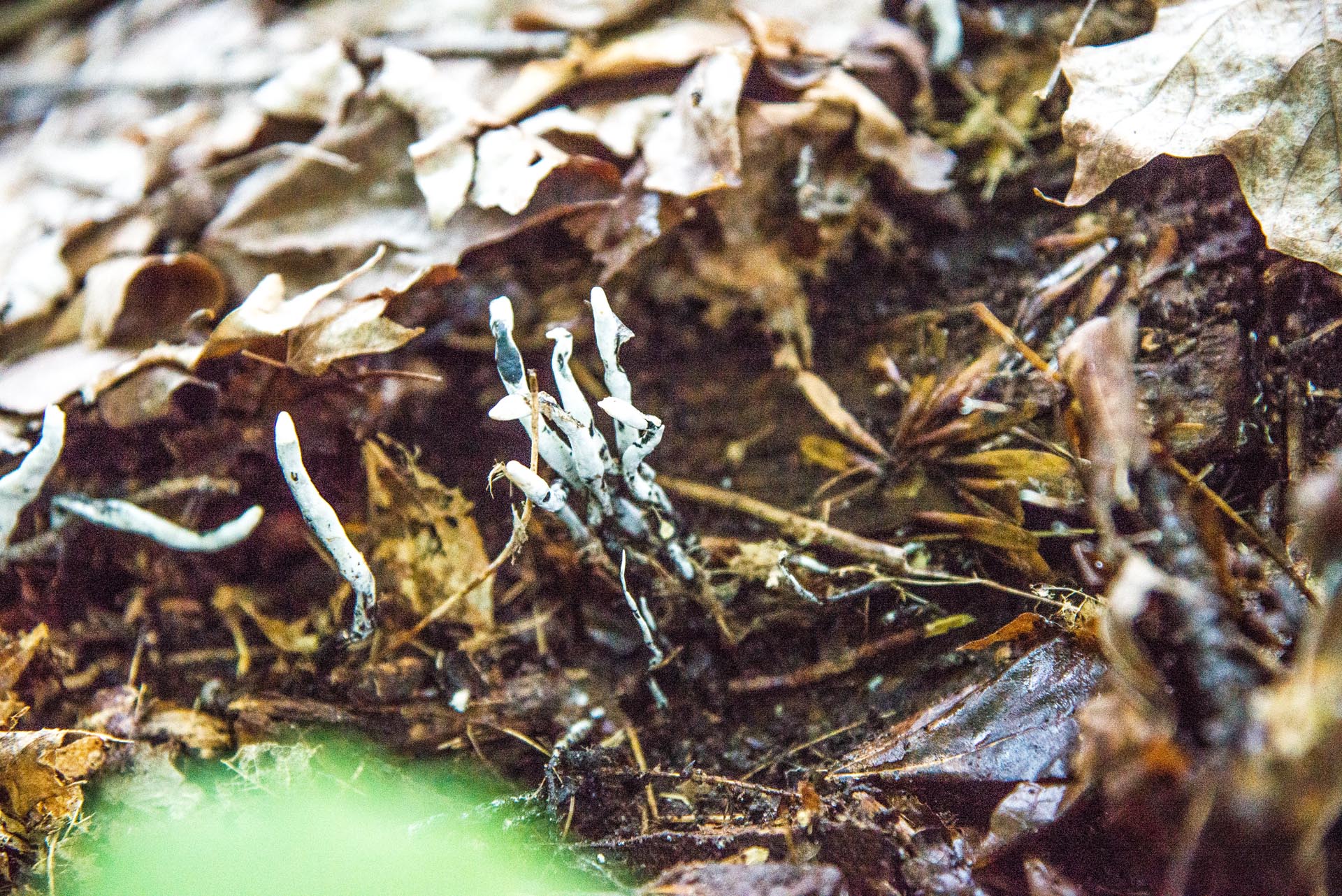
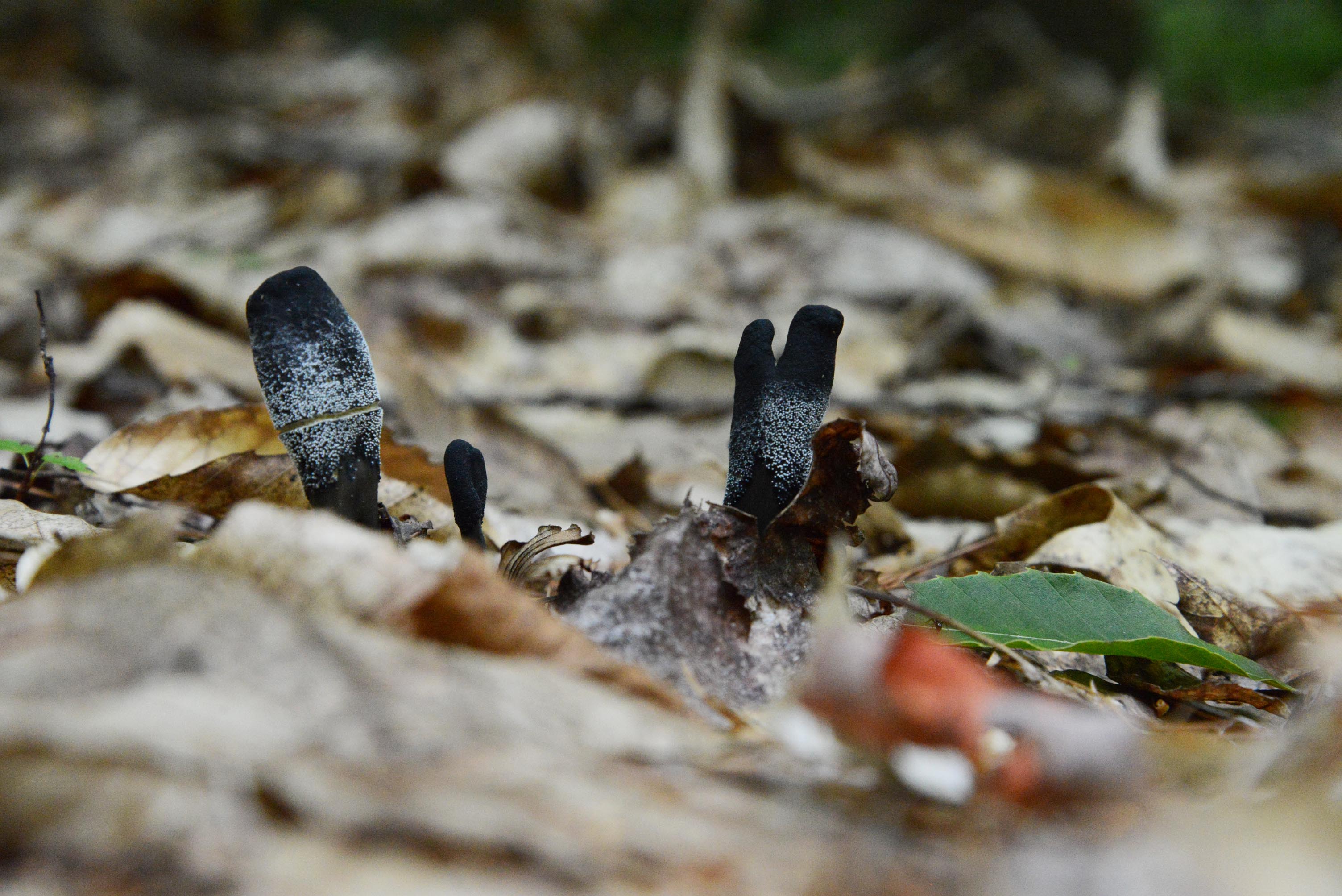
Dead Man’s Fingers: Xylaria species
Xylaria species, asexual/spring form on the left and sexual/summer,fall form on the right
Black fingers reaching out from the dense leaf litter. An undead soul seeking revenge? Dead Man’s fingers they are, and if you are brave enough to try to pull them out of the ground you might meet with some unexpected resistance. That is because the structure is often firmly attached to decaying wood. The structure (called a stroma), the reproductive part of the fungus — its body is a network of filaments that are growing in the substratum. Early in the year it is often covered with white powder, such as is seen in the picture above on the left. The powder is the asexual spores that disperse the fungus but that are clones of the particular individual. Later in the season sexual reproduction might take place and special spore-producing bodies form immersed in the stroma. These spores are the result of sexual recombination and disperse new genotypes into the environment.
Xylaria is a genus with many fungi. It is an Ascomycete, a group that is more or less parallel to the mushroom/basidiomycete fungi. Ascomycetes give us Roquefort cheese, wine, penicillin, Chestnut Blight, truffles, ergot and Dutch Elm Disease. Xylaria species are best known as wood decay fungi, and the diversity in tropical countries is truly amazing, but you might also find them growing within apparently asymptomatic leaves of the trees that surround us. These are endophytes and we don’t know what they are doing, but they are very common.
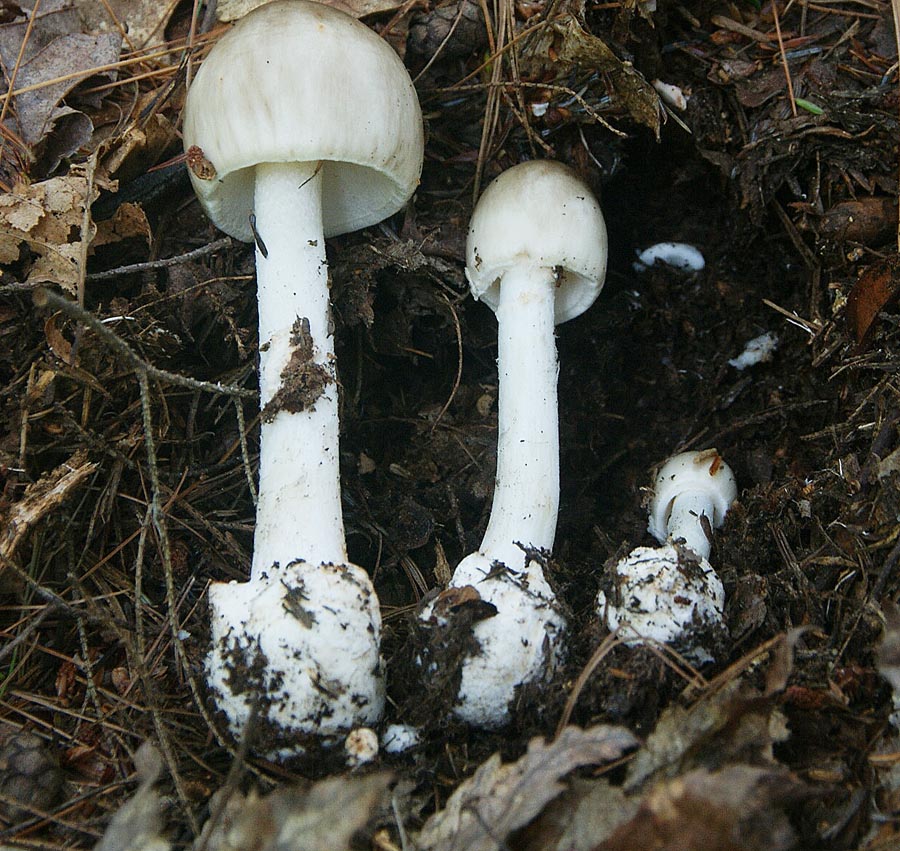
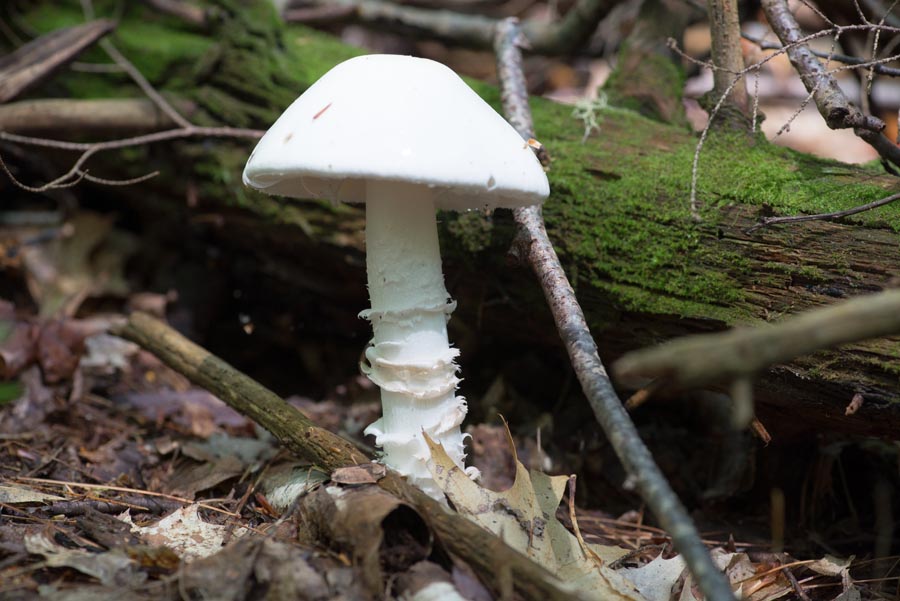
DESTROYING ANGEL: Amanita bisporigera
Amanita bisporigera lives up to its name: Destroying Angel, and one of its close relatives is Death Cap. These beautiful and common fungi will lead you to a most uncomfortable death in a somewhat protracted time. In the end your liver is destroyed and there is no known antidote.
You can recognize this fungus by its whiteness, a ring around the stalk just below the cap, and a bulbous base. The cap of A. bisporigera is smooth, unlike some Amanitas that have white patches scattered over the surface of the cap.
Most Amanita species form mycorrhizal associations with trees, so are part of the Wood Wide Web. Amanita bisporigera hooks up with broad-leaved trees. These fungi provide the tree with nutrients obtained from scavenging and receive sugar, produced by photosynthesis. They are important members of the Forest Community. Just don’t eat them.
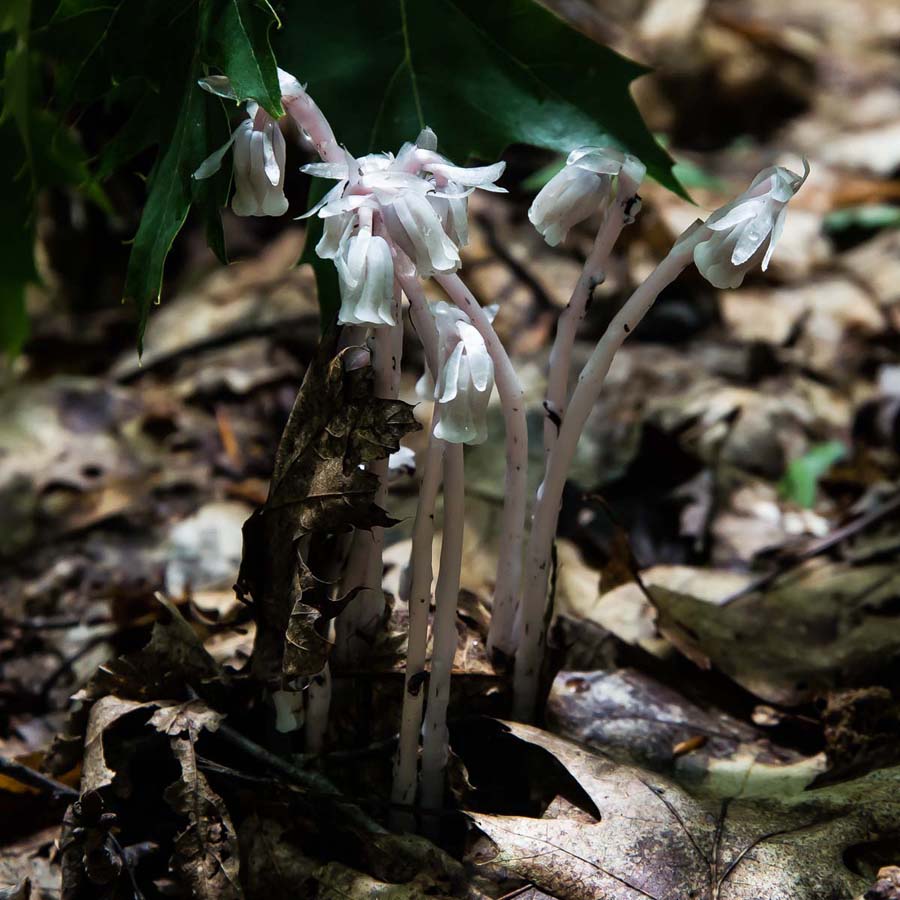
Ghost Plant: Monotropa uniflora
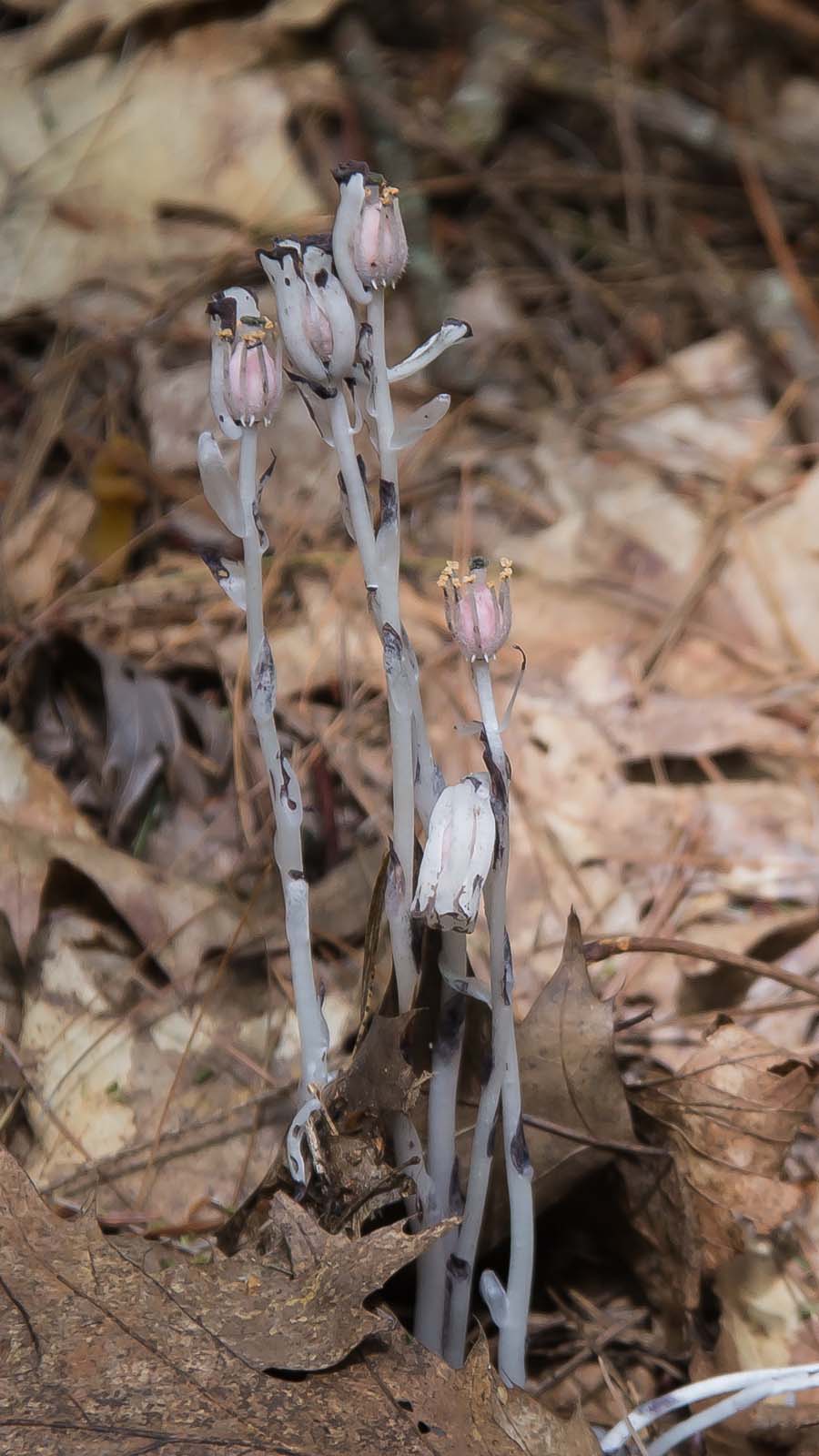
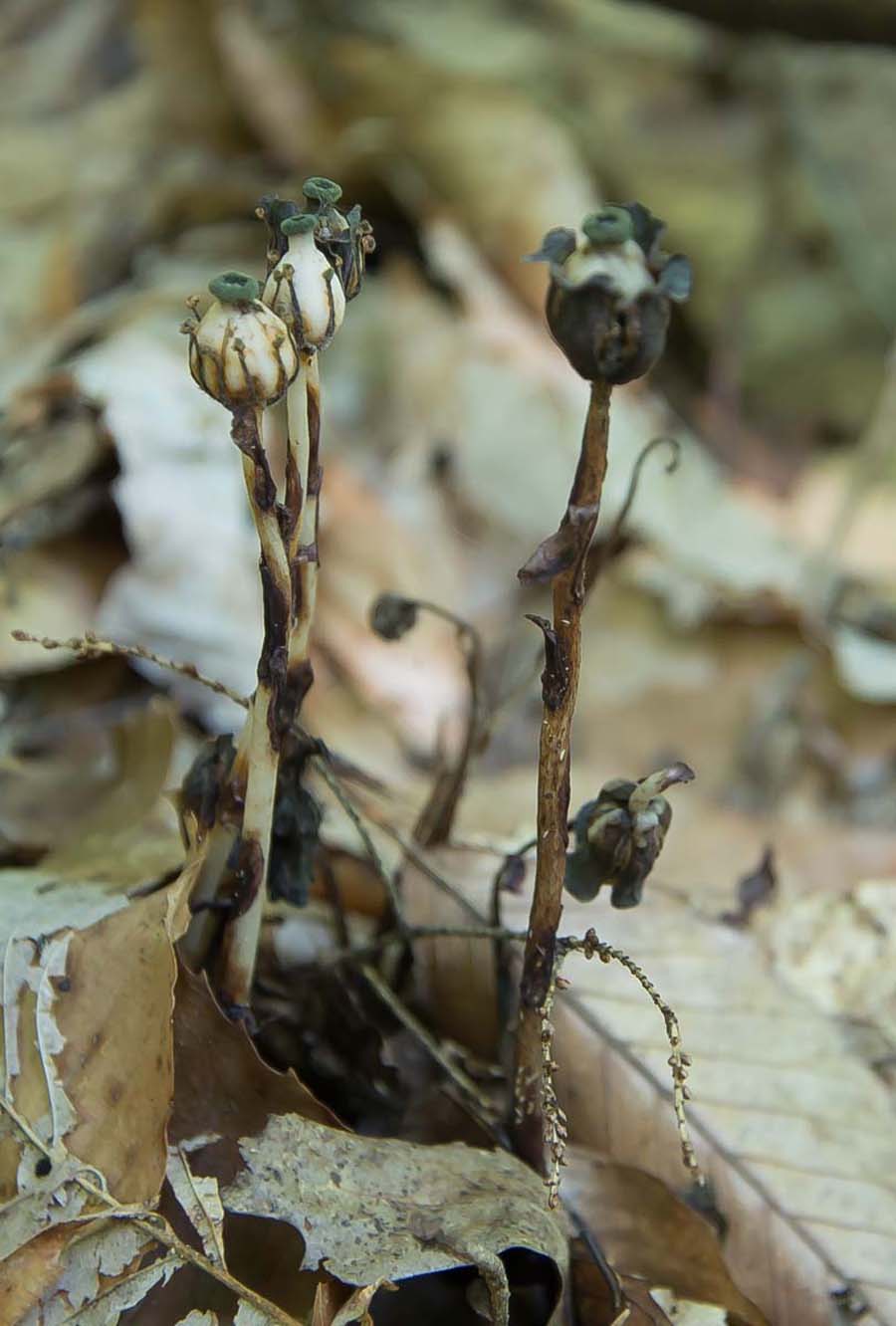
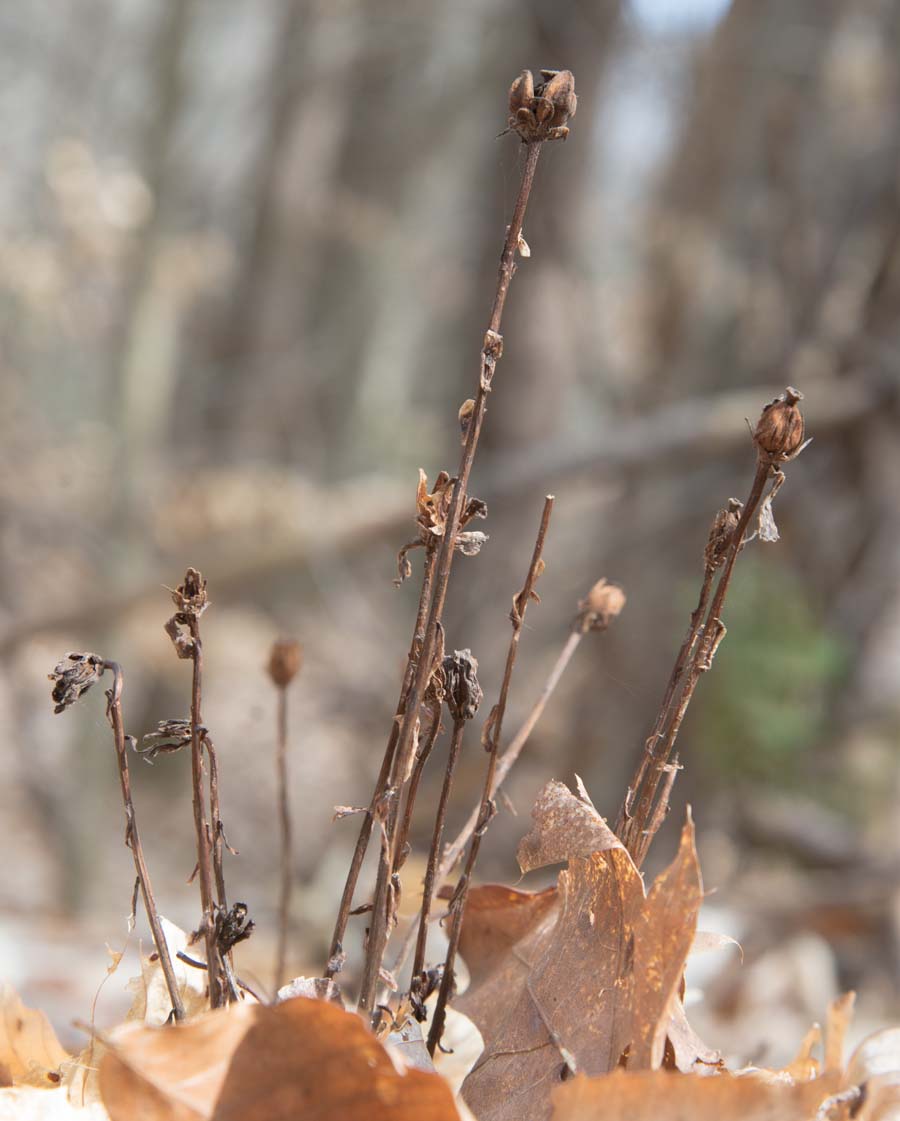
The Ghost Plant, also known as Indian Pipe, is not a fungus for all that it looks like it should be one, what with its white stems and flowers that arise from the forest floor. Early in the season the flower nods, suggesting a pipe. As the season progreses the flower gradually becomes erect to disperse its seeds. Finally all that remains are stems with spent flowers, all looking like dead sticks breaking through the forest floor.
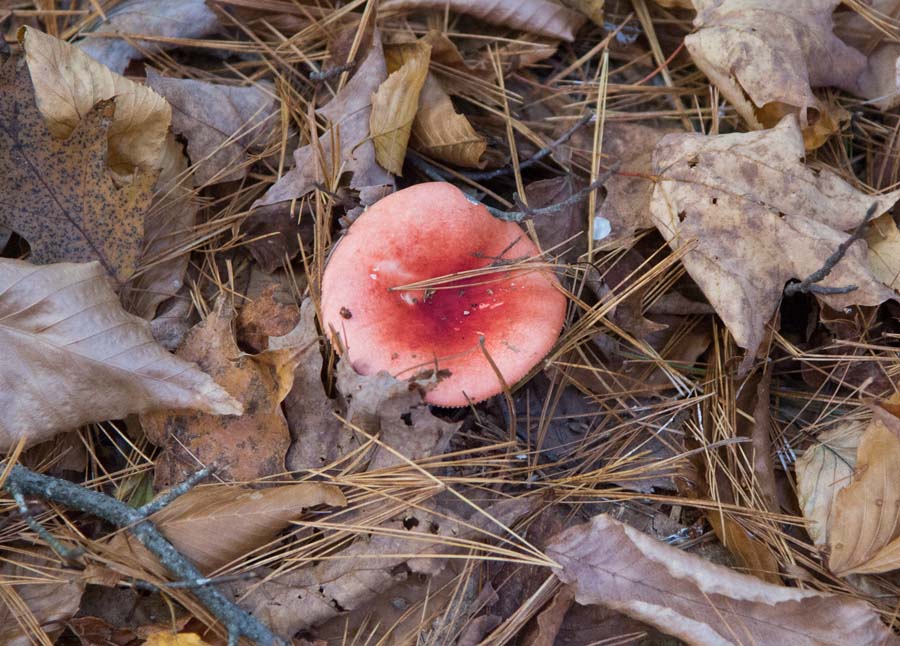
Monotropa and its relatives are actually related to blueberry, but they lack chlorophyll and thus they lack the ability to make their own food through photosynthesis. To meet that challenge, Monotropa and Hypopitys species latch onto the Wood Wide Web by parasitizing mycorrhizal mushroom-forming fungi. Monotropa uniflora parasitizes species of Russula (a typical species having a red cap is shown here), which form mycorrhizae with broad-leaved trees. In this three way affair, the Ghost Plant is a taker. The Russula gives nutrients to the Oak, which returns the favor by sending sugar into the mycelium. The Ghost Plant takes what it needs from the mycelium. The fungus doesn’t seem to mind though. This is just another way for a fungus to tell the rest of the world that “you can’t live without me!”
The great Wood-wide Web: the trees in a forest interconnected by fungi. Fungal hyphae — the filamentous actual body of any fungus — running from tree to tree, sharing out sugars from the leaves of healthy trees, and giving water and essential nutrients in return. The forest one great Superorganism mediated by fungi. An enormously popular concept, and so very true: No Fungi? No future!
In all this it’s important to understand that fungi form associations with almost all life forms, not just trees: sometimes in a good way (most obviously as lichens or mycorrhizae) — and sometimes in not such a good way (for example, zombie ants and chestnut blight).
Fungi are now thought to have been essential for enabling rootless water dwelling plants to become established on land. They entered into ‘endophytic’ relationships with primitive plants, including mosses and liverworts — the closest modern relatives of the ancestors to the earliest terrestrial plants – – well before the evolution of trees and the trees and the Wood-wide web.
Many unrelated fungi are closely associated with mosses. The individual relationships may be saprobic (gaining carbon from dead plant material), or commensal (endophytic or parasitic) and obtaining carbon (sucrose) as the direct result of plant photosynthesis.
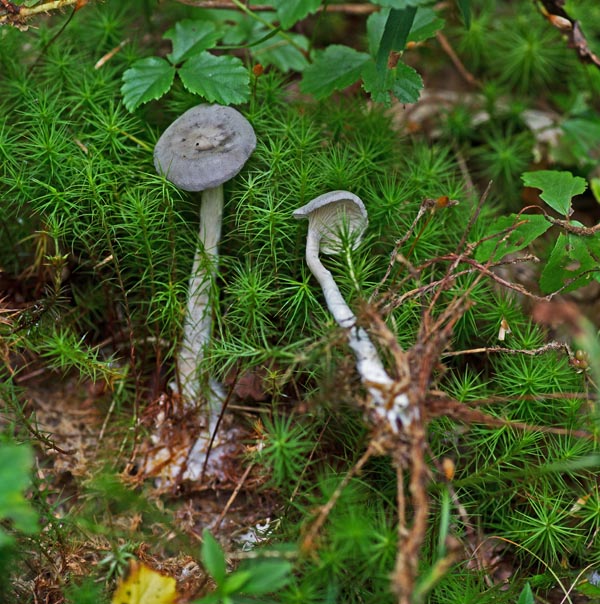
Here in Deering I have found, so far, two moss associated mushrooms: Cantharellula umbonata and Rickenella fibula. Both were associated withmosses in the genus Polytrichum., and I have found each only once.
Cantharellula umbonata
I wrote about Cantharellula umbonata, Greyling, in an earlier post. While the species is constantly associated with various mosses, I cannot find anything written about its trophic level, the nutritional nature of its relationship to the associated moss. When I collected it, I did not notice any obviously diseased areas of the patch of moss from which the mushroom arose. In this picture, on the right, one might see that the mushroom is attached to individual moss plants.
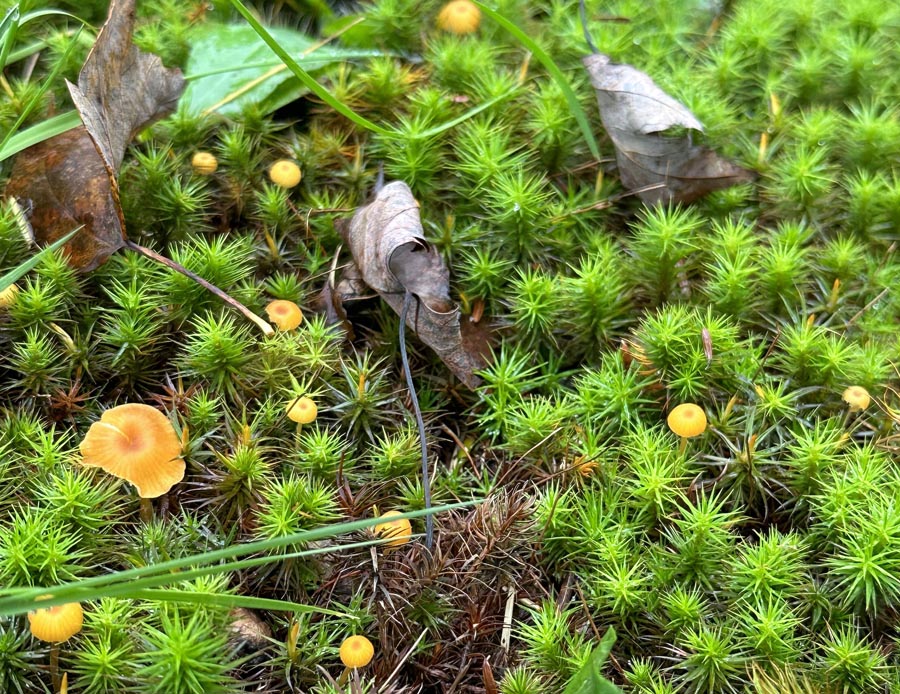
Rickenella fibula
I found Rickenella fibula, the Orange Moss Agaric, at home this fall in some of the extensive patches of Polytrichum moss that spreads in what we call ‘lawn.’ A whole herd of little yellow caps peering up at me from a bed of moss. These are little mushrooms that have small (2 – 10 mm across), orange or yellow orange caps with a depression in the center. The stem is delicate and lacks a ring. The gills are widely separated from each other and are white, they conspicuously run down the stem.
Rickenella fibula occurs late in the season, August to November in southern New Hampshire. It is widely distributed in North America and has been introduced into New Zealand. It is always associated with mosses, but not with any particular species.
The relationship of the species Rickenella fibula to moss is ambiguous, either parasitic/endophytic or mycorrhizal. The species has been shown to produce pegs, haustoria, within moss cells. These haustoria would presumably be absorbing nutrients from the moss and therefore are indicative of parasitism. A parasitic or endophytic trophic mode is supported by the fact that the some collections can produce enzymes that degrade plant cell walls. In a DNA analysis, a phylogenetic study, that included several collections all collections of R. fibula were biotrophic (mycorrhizal or parasitic/endophytic); none were saprotrophic (growing on dead plant material). However individual biotrophic collections clustered in the analysis with either mycorrhizal or parasitic/endophytic collections, the difference being how the respective groups access the sucrose produced by the moss through photosynthesis. As far as I can tell the Orange Moss Agaric that I found in my lawn does not seem to be adversely affecting its associated moss.
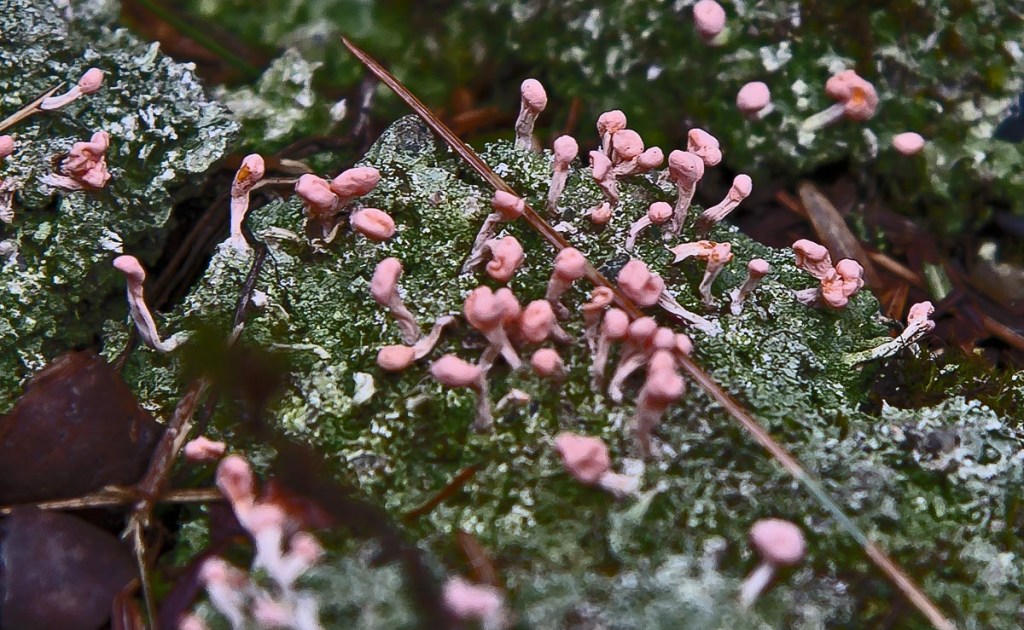
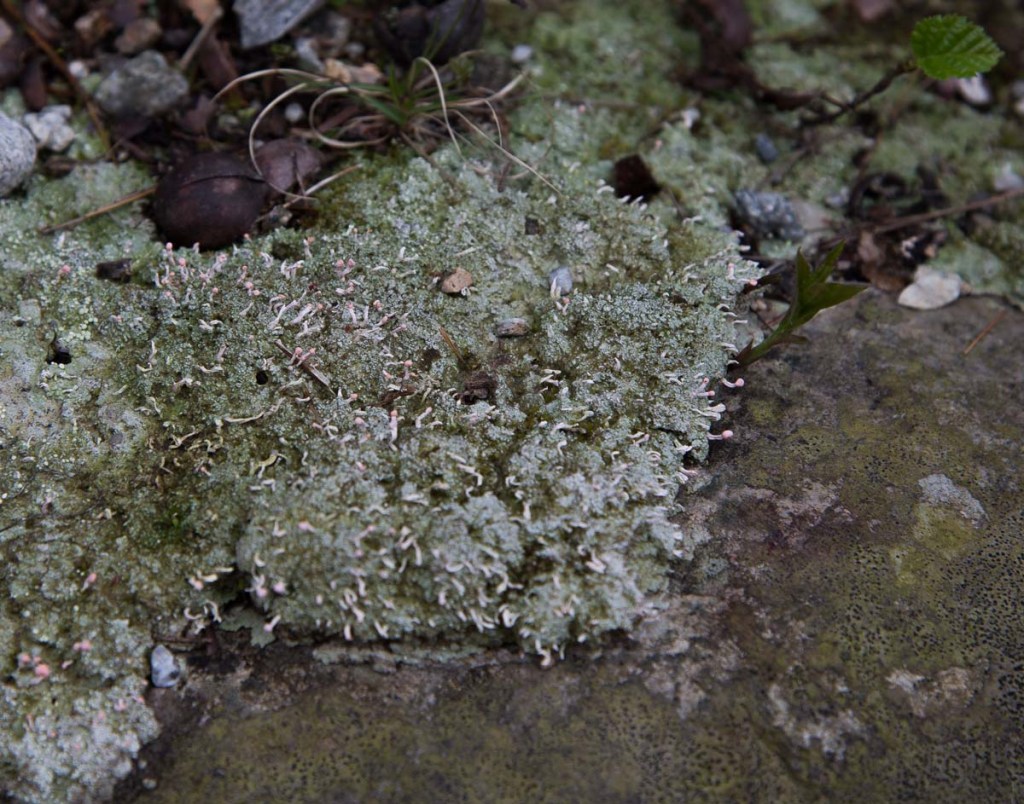
The Pink Earth Lichen, Dibaeis beomyces, can be recognized at 40 miles per hour, it’s that distinctive. But, you can be forgiven if you do not immediately recognize it as a lichen.
This lichen forms on sandy mineral soils and clay soils, often at roadsides. It is common and widely distributed in eastern USA and Canada, and Europe, reaching into the Arctic.
A lichen is the symbiotic relationship between a fungus and a green alga or a cyanobacterium. The alga, also known as the photobiont, produces nutrients through photosynthesis and these nutrients are translocated into the fungal cells. The fungus produces protective tissues within which the algal cell nestle; the fungus also produces spores that can disperse the lichen. The thallus, or body, of a lichen comprises fungal and algal cells. The thallus of Pink Earth Lichen is in the form of a crust of algal and fungal cells on the surface of the soil. The little pink mushroomy things produced by this lichen are fungal fructifications.
The fungus fructification of D. beomyces is known as an ‘apothecium.’ The pink, turban-shaped part of the fructification is completely covered by spore producing cells that, as is typical of an apothecium, are completely exposed.
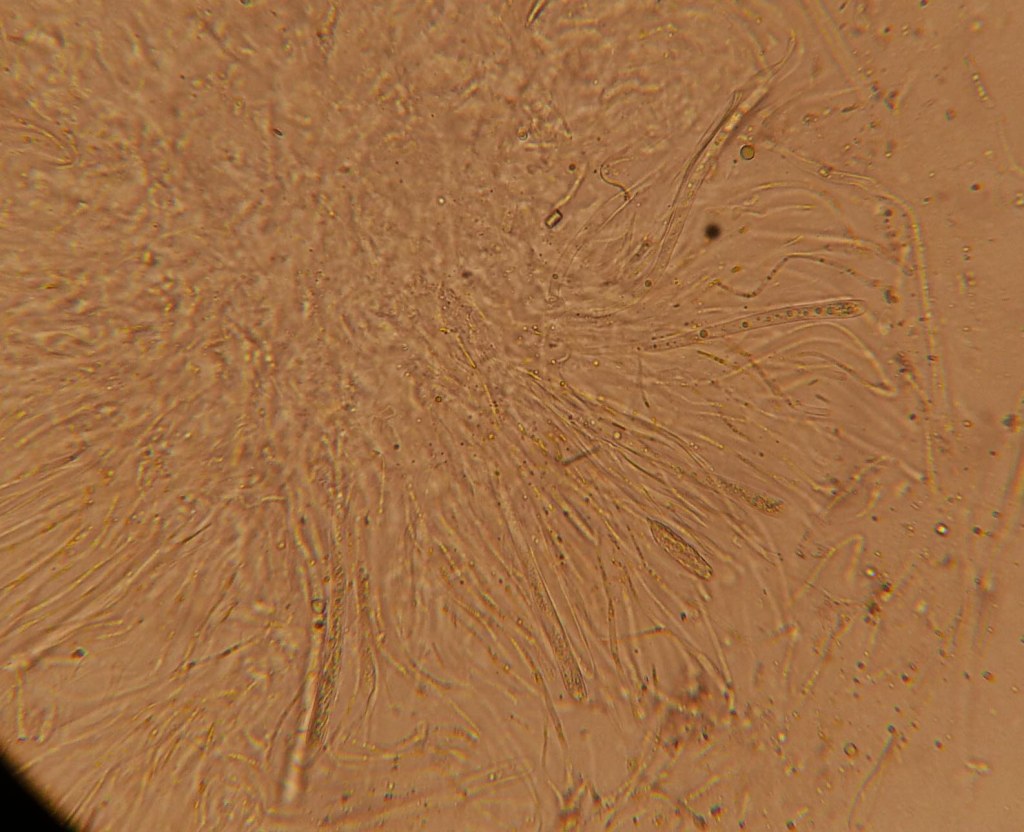
In this picture the spores will eventually be produced in the long, club-shaped cells called ‘asci.’Each ascus contains only one, diploid nucleus which resulted from the fusion of two haploid nuclei in a specialized c ell that supports each ascus. The narrow filaments surrounding the asci, ‘paraphyses,’ are sterile; they provide support and protection for the asci.
Fungi are haploid organisms. This is in contrast to other eukaryotic organisms, including humans and plants, that are diploid. That is, in humans, chromosomes derived from each parent are present in each cell: those cells are diploid. Whereas in fungi, each cell only has the chromosomes from one or the other parent: those cells are haploid. The diploid phase of a fungus is very brief, comprising only one diploid nucleus in each of the fertile cells, and that nucleus quickly undergoes meiosis (reduction division where genetic recombination occurs) to produce, once again, haploid progeny, typically 8 nuclei. A spore forms around each of the 8 haploid nuclei; the spore germinates to produce its thallus, known as a mycelium — narrow filaments that colonize the substratum and bring in nutrients.
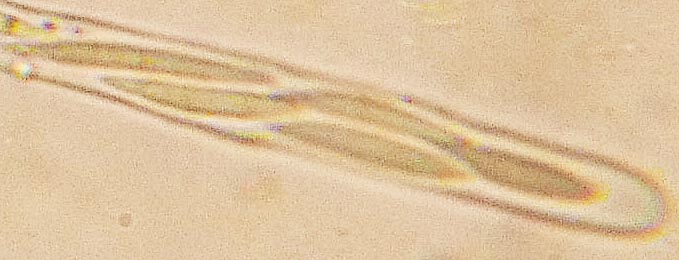
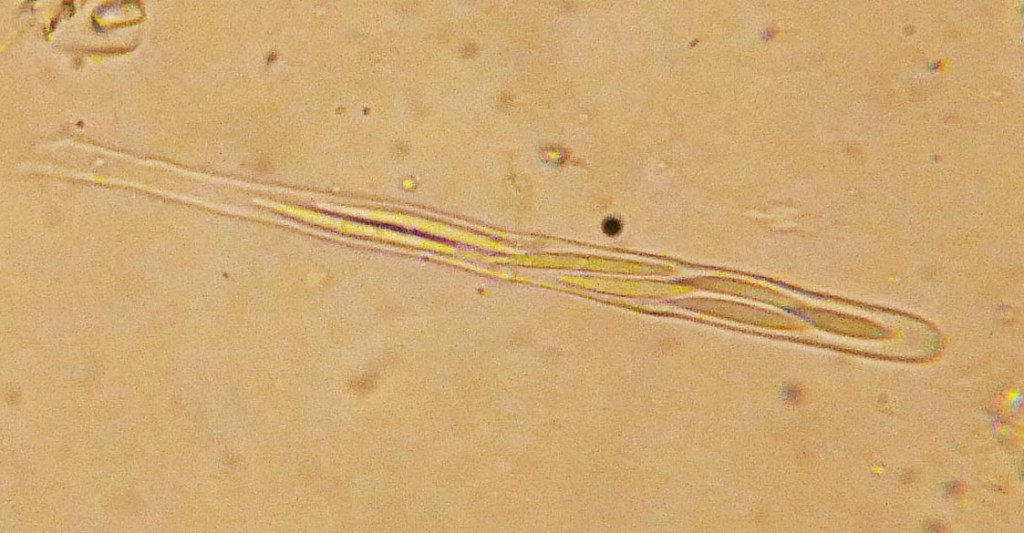
On the right an ascus with 8 ascospores in an asucs. On the left a closer image of the sexual spores within an ascus.
Lichens can reproduce through the formation of asexual propagules of various sorts. These are formed of mixed algal and fungal material and can reconstitute the lichen symbiosis. The spores, however, are not dispersed with algal material. The germinating spore must find a compatible algal cell in order to reconstitute the lichen.
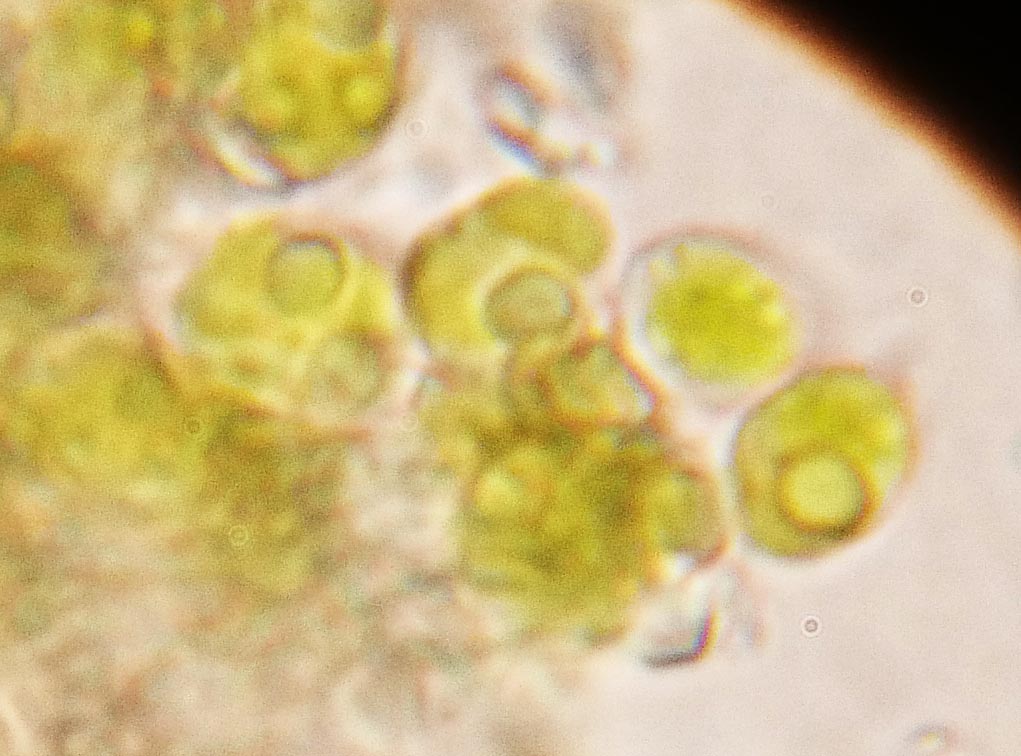
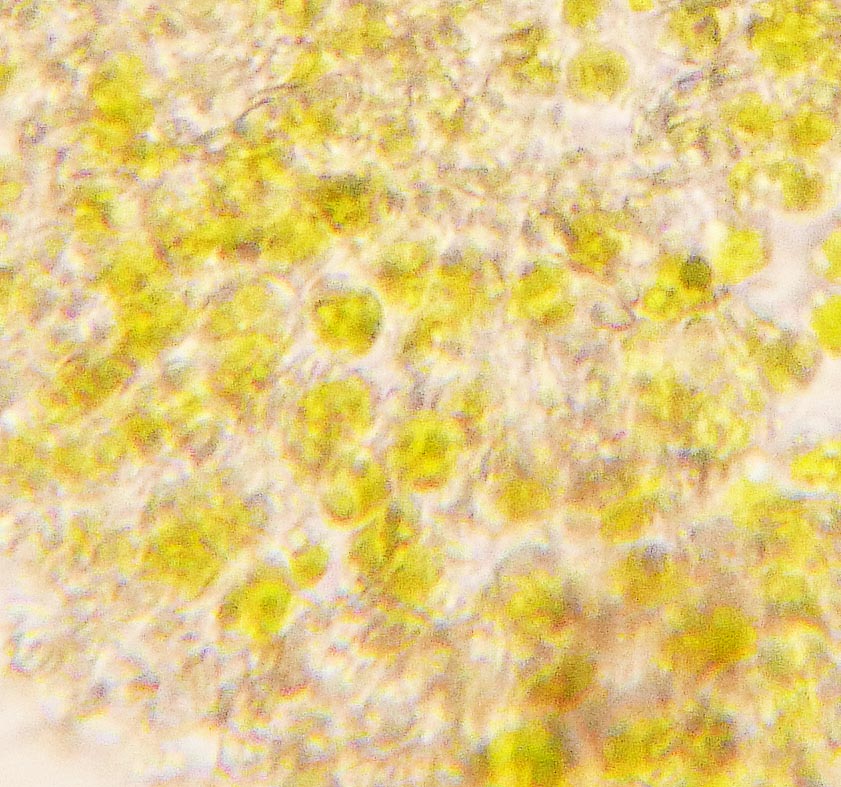
The photobiont of Pink Earth Lichen is a green alga in the genus Coccomyxa. It is single-celled, but masses of cells loosely adhere to each other to form the crustose thallus of the lichen.
The green in this picture is the crust of cells of the Coccomyxa photobiont
The picture on the right shows masses of green, photosynthesizing Coccomyxa cells. The picture on the left shows four individual Coccomyxa cells, each with what is probably a large lipid drop.
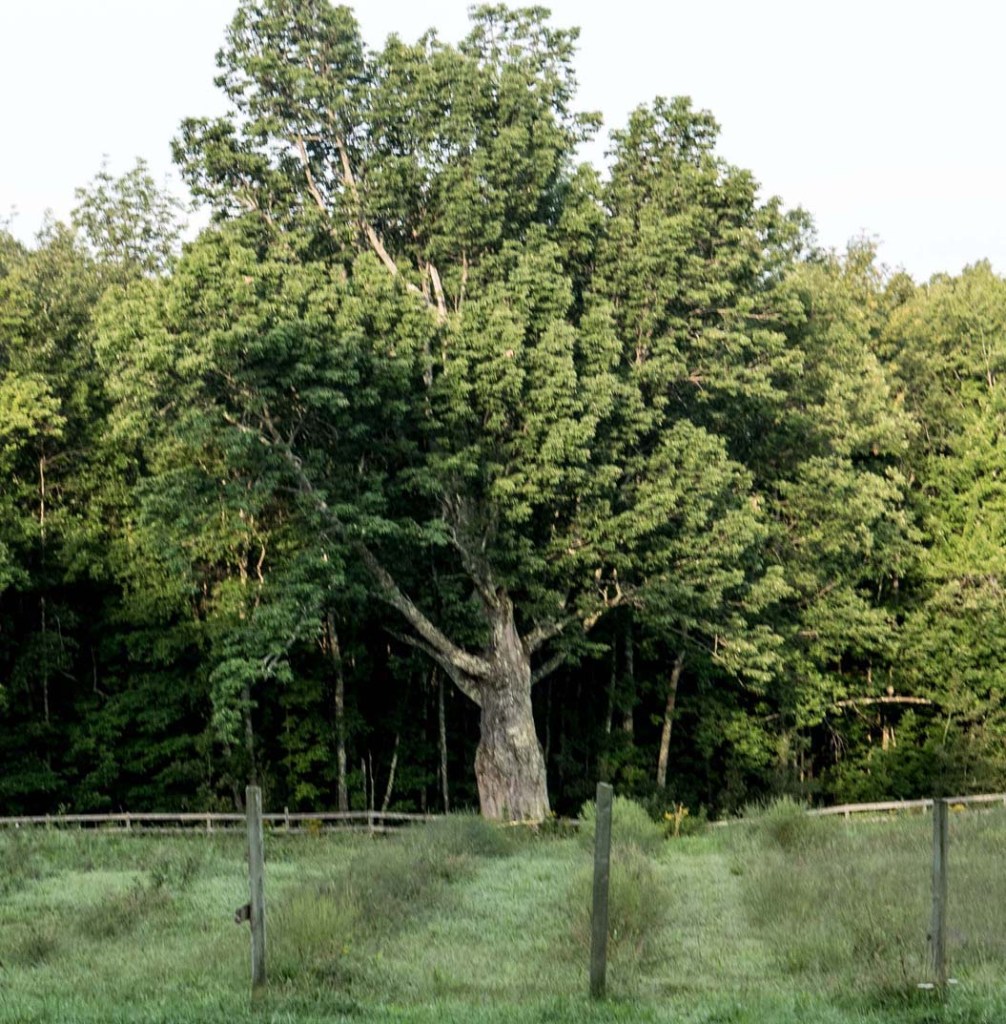
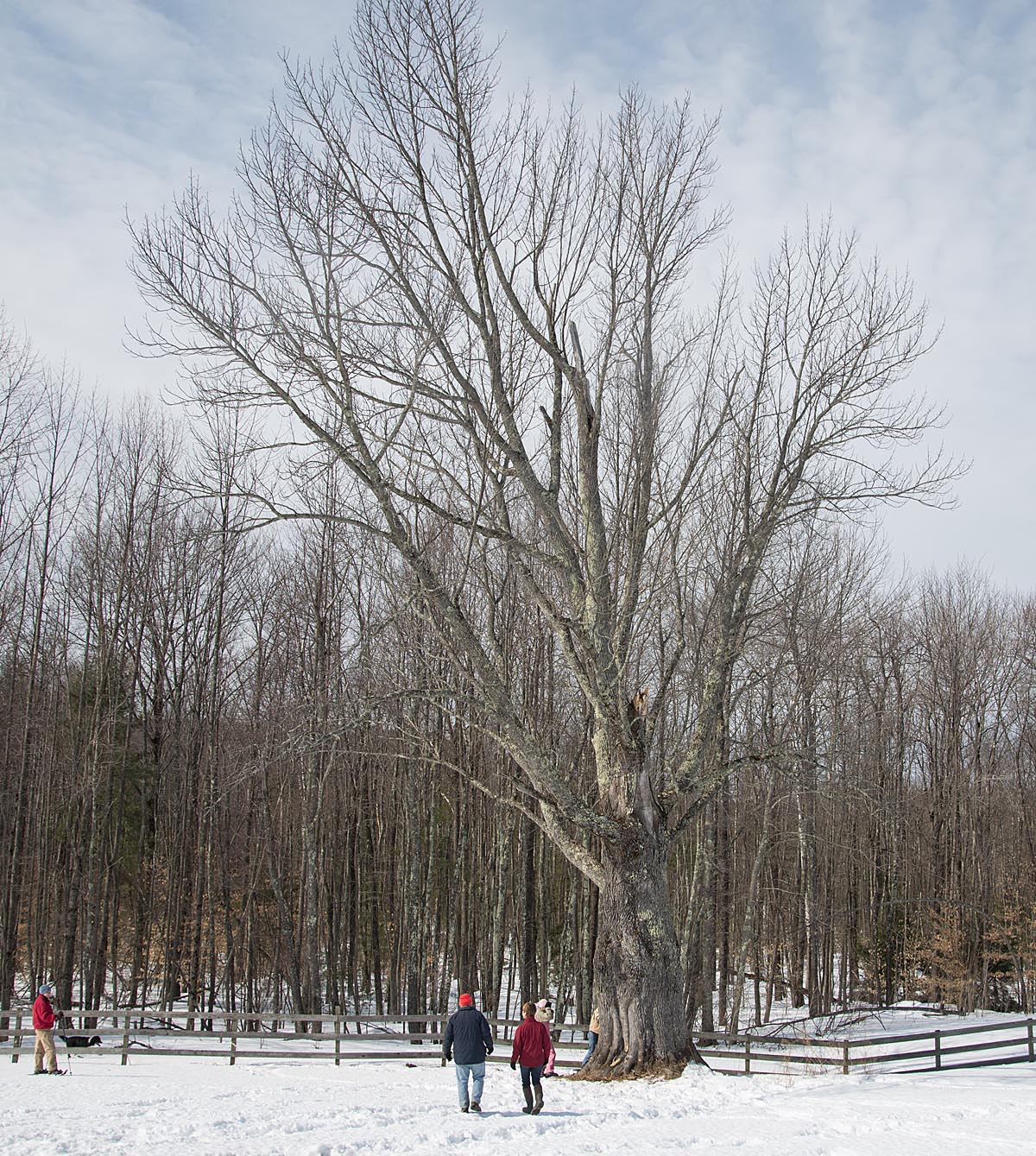
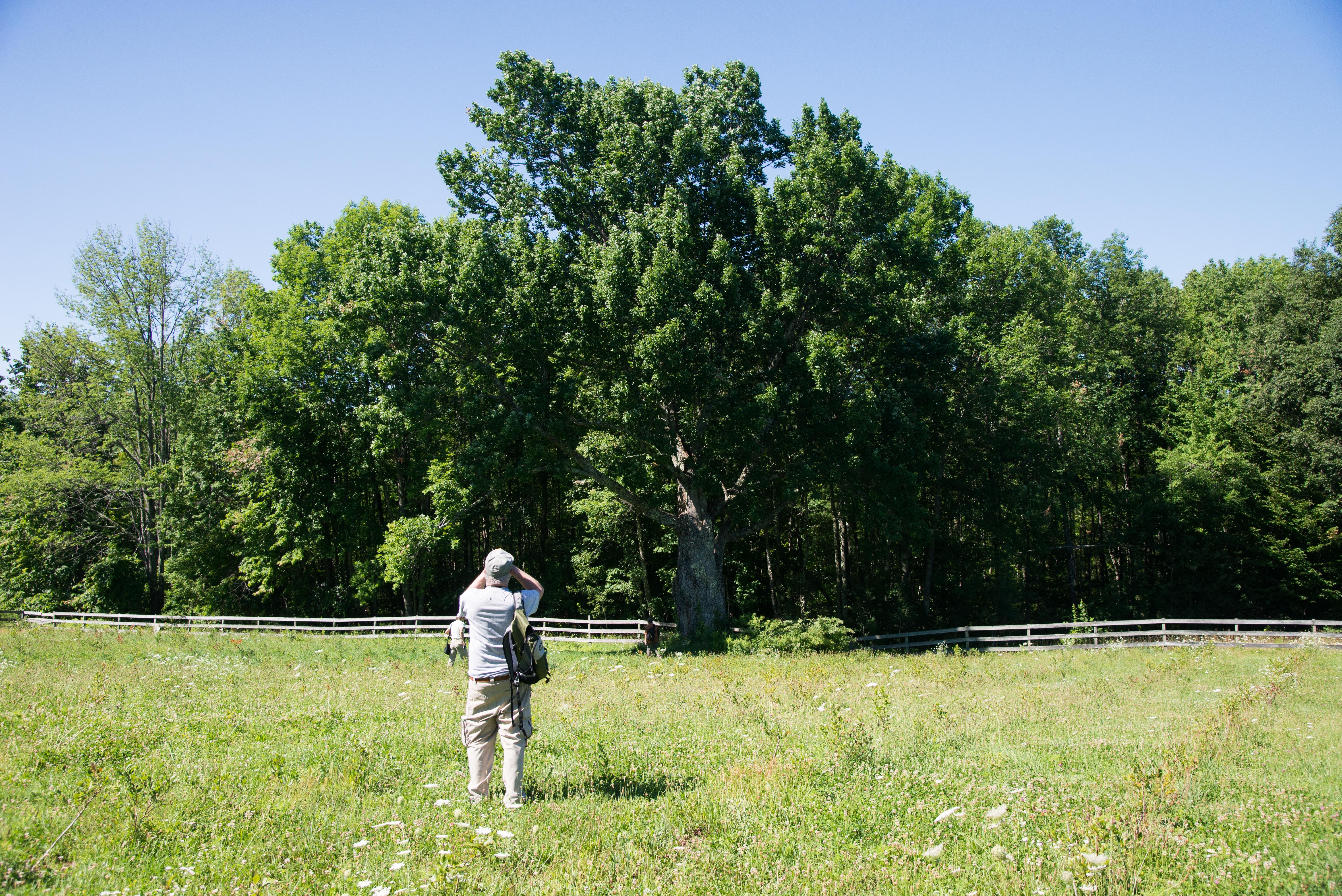
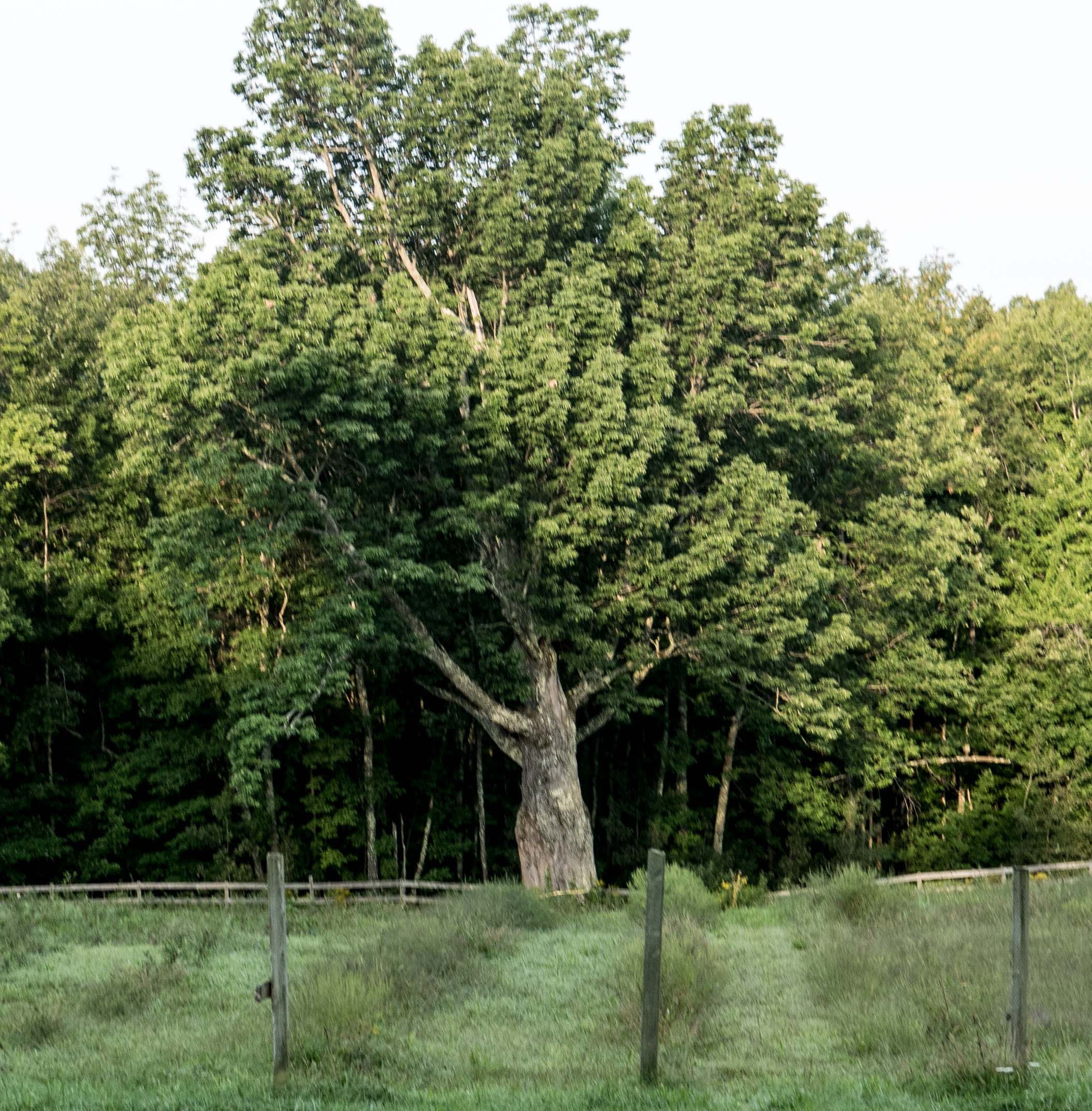
Ann Bicknell’s White Ash Tree began its life an estimated three hundred-sixty-odd years ago on what was once known as the Poor Farm, on Old County Road. The tree is surely among, if not THE, oldest residents of our town this wonderful tree has stood at what is now the edge of a field of blueberries on Old County Road. Before the blueberries the field was a horse pasture and before that … this was the Poor Farm that is marked on the 1858 map of Deering. And before that?
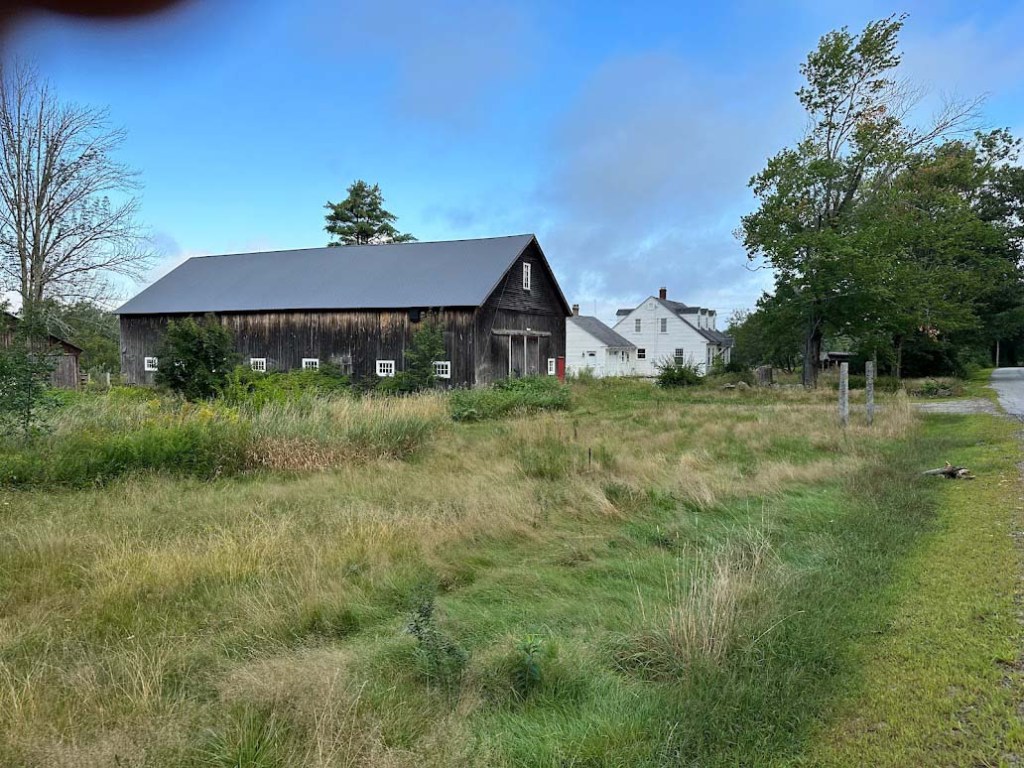
The 19th Century Deering Poor Farm from Old County Road
Mark and Ann Bicknell took up residence with this old tree in 2015. She came from an urban life. The farm on Old County Road was the fulfillment of Ann’s dream of a place to have horses. She had found the perfect place. Horses gamboled in the pasture and eyed me suspiciously as I made my (not quite) daily morning walk past them. My first recollection of Ann and Mark was when they brought us Christmas cookies in their horse-drawn sleigh, crossing the fields and open land that separated our two houses.
Mike Margulies, resident on Old County Road since he was a teen in 1954, used to walk along the road each morning too. An outgoing guy, he stopped to talk to the newcomer Mark Bicknell and in the course of their conversation Mike learned that Mark was a Bicknell and that Mike and Mark’s father had worked together as short-order cooks some time earlier. Small world? We call it ‘Deering Magic.” Mike and his wife Bette brought up their family on Old County road, not more than a quarter mile from the Bicknell White Ash. They were the doyennes of our little group.
Mike was a man of many many interests. For nearly forty years he taught 6th through 8th grades in Bennington and Hillsborough until he retired in 2002. He taught model rocketry and hunter safety to kids in town. For several years he kept a sled dog kennel and raced teams around New England. He was a musician, playing bass in local classic rock bands. Mike Margulies was the true Renaissance Gentleman and a great friend.
Not long after Mark and Ann settled in Deering Ann was diagnosed with a brain tumor that would prove fatal. Ann loved her white ash tree. She understood that this very big and very old tree was special, and knowing that I was keeping a list of our town’s biggest trees, urged me to add her tree to the list.
The original Big Tree list for Deering was compiled in 1980 with an update in 1985. I inherited the list, an unruly pile of bits of paper, around 2012 or 2013. Somehow the original compilers of the list missed obvious trees, including this wonderful ash tree. Clearly visible from Old County Road (although I note that Old County Road at that time was unpaved and did not carry as much traffic as it does now that it has been paved), I do not know how nobody included it in the list. Ann was passionate about having this tree recognized.
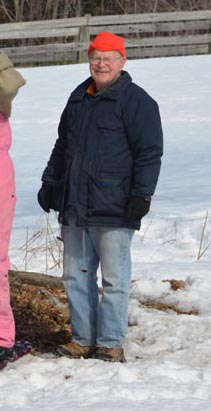
One Sunday morning in mid March of 2015 a small team set out to measure the tree. Ann and Mark Bicknell, Mike Margulies, neighbor and friend Kay Hartnett, my wife Patty and me. First, we breakfasted on pancakes with maple syrup and coffee in Ann and Marks kitchen, a most convivial affair. Then we put on our snow shoes and crossed the field to the tree, measuring tape in my pocket.
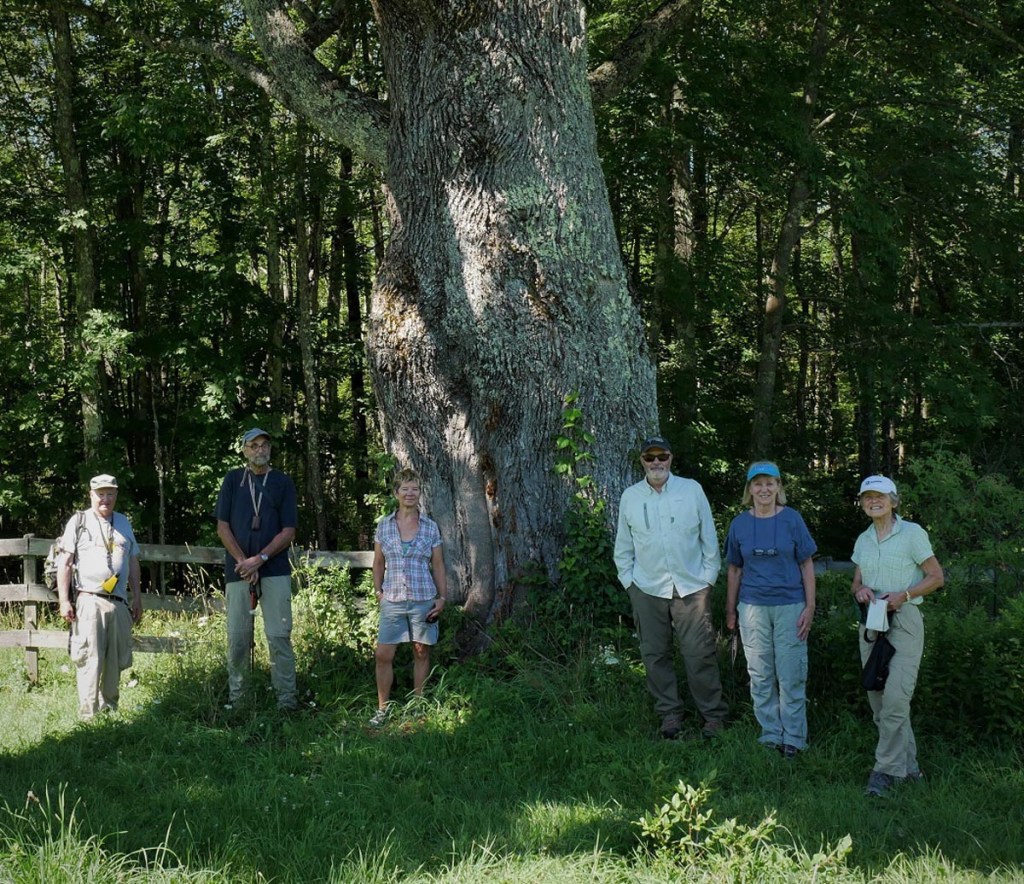
Image on the right, from the left: Kay , Ann, Mark, Patty and Mike
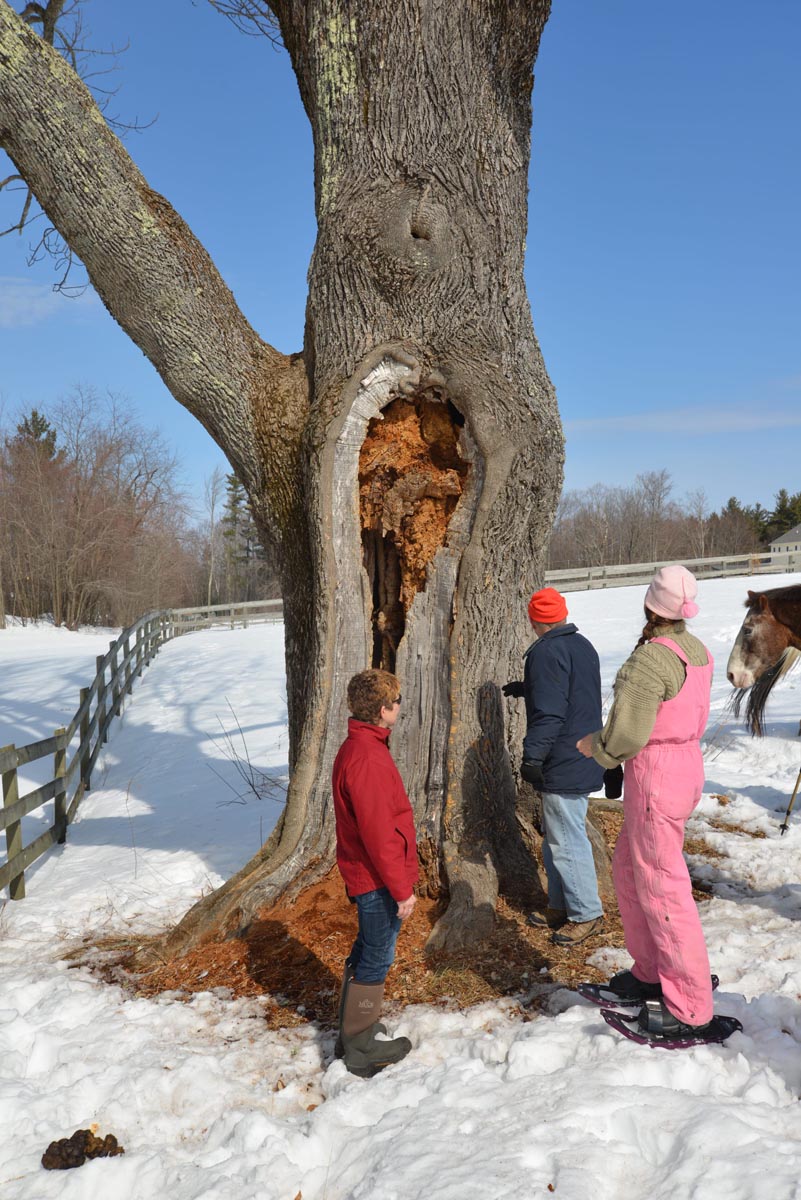
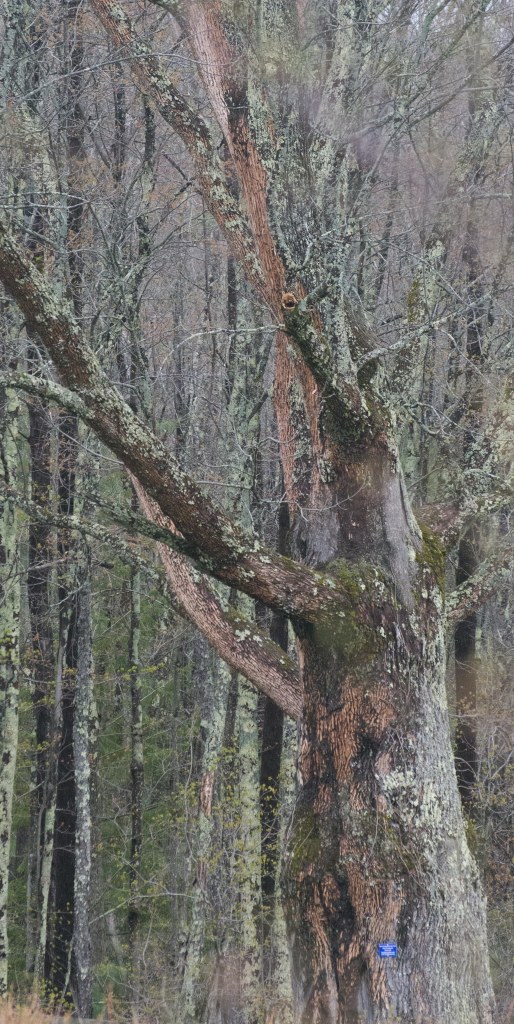
I had not been up close to the tree before this Sunday. The deep gulch of a heart rot hollowed the trunk, but the surrounding sapwood was thick and strong. Strong enough to support the massive branches and spreading canopy. Mike recalled the time when a large branch broke away from the tree, but now despite the heart rot and hollowed trunk, the tree seemed to be doing well.
This beautiful tree was big! It took all of us to bring the measuring tape around the trunk at a height of 4 feet. It appeared to me that this white ash was bigger than any of those that were included in the UNH Big Tree List. My nomination lead to the arrival of an official measuring team of the UNH Big Tree Project. They measured height and canopy spread in addition to the circumference of the trunk and found that it was indeed a big white ash tree!
In 2020, Fraxinus americana Tree Number 1079, the Bicknell White Ash, was named the State Champion White Ash with a height of 81 ft, crown spread of 68 ft, and circumference of 234 inches. Today the tree is recognized as a National Co-champion White Ash Tree, sharing the honor with a tree in Madbury (https://extension.unh.edu/natural-resources/forests-trees/trees/nh-big-trees).
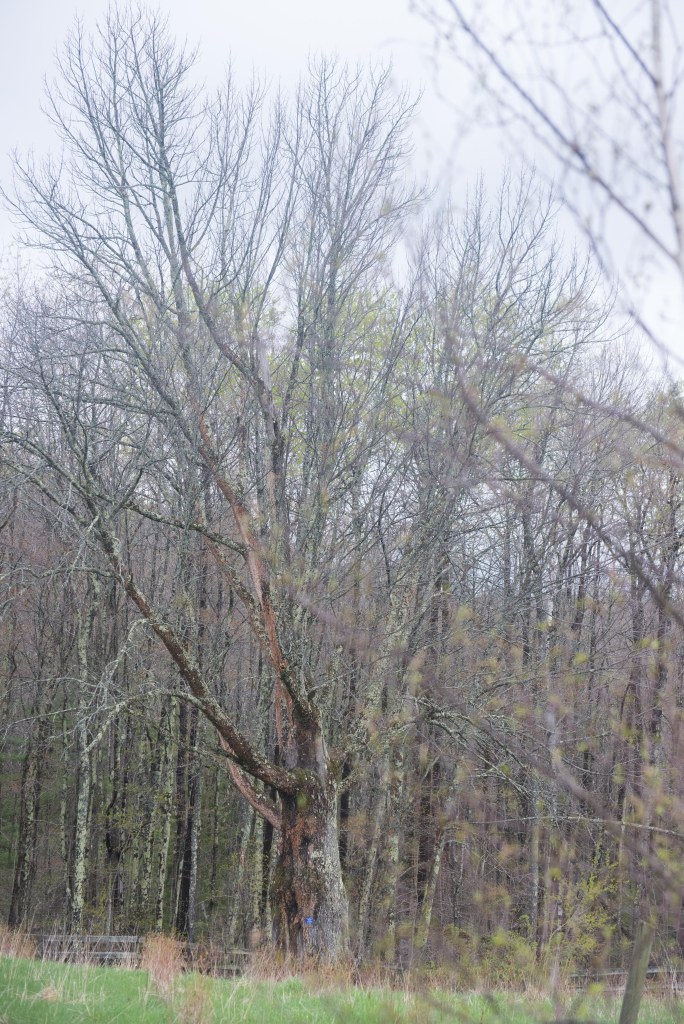
Emerald Ash Borer was first noticed in New Hampshire, in the Concord area, in 2013 and it was first recorded for Deering four years later, in 2017. The effect of the disease is notable around town, with many trees having been removed, but the Bicknell Ash seemed immune. Younger trees surrounding it, maybe its children, looked unhealthy, but this old tree continued to produce a dense dark green canopy of leaves. Until this year.
Infected, 100-year-old ash trees at the Spinner Farm on Old County Road
In March of this year signs of Emerald Ash Borer showed up in our Old County/Hedgehog Mountain Road neighborhood. A row of roughly 100-year-old ash trees at the Spinner Farm, next to the Bicknell Farm, was entirely infected. At the same time the Bicknell’s White Ash tree, which had so far seemed immune, was obviously badly infected. Blonding of the bark, the white flecks of bark the result of woodpeckers pecking away the bark to get to the beetle’s larvae, was visible throughout the sad looking tree.
As the season progressed the canopy of this grant being had only a sparse production of leaves.
Peeling the bark away reveals the serpentine larval feeding galleries. They disrupt the sapwood of the tree, preventing the transport of water from the roots to the crown.
At this point the only thing to do is remove affected trees in the likely vain hope of limiting spread of the beetle.
This might not be the last year for Deering’s own magnificent National co-champion White Ash tree. It might hang on a while longer, producing fewer leaves each year if its new owner, a child of Mark Bicknell, does not have it cut out.
But the death of this champion is only a part of the tragedy of the Bicknell White Ash.
Ann Bicknell did not live to see her White Ash crowned a champion. She knew it was a champion none the less. Her stewardship of this wonderful arboreal companion ended in April of 2015, just short of her 50th birthday. Her husband Mark, a melancholy man, could not adjust to life without Ann. He died in 2022, short of his 60th birthday. Their ashes are placed at the base of the tree. Mike Margulies, a gentleman and a scholar in every good sense, passed away at 80 years in 2020. Good friends all.
We are a small, rural town. A lot of our area is forested. Big trees share the Deering space with us. They provide seed for our forests; they shelter other residents in their broad canopies and in the soil below them. They provide comfort, physical and emotional, for us as needed. They hold the climatic history of our town over centuries in their trunks. They were here long before us. Is Ann’s ash cognizant of us? I don’t know, but I, like Ann, cherish this tree and am saddened by (personal pronoun) passing.
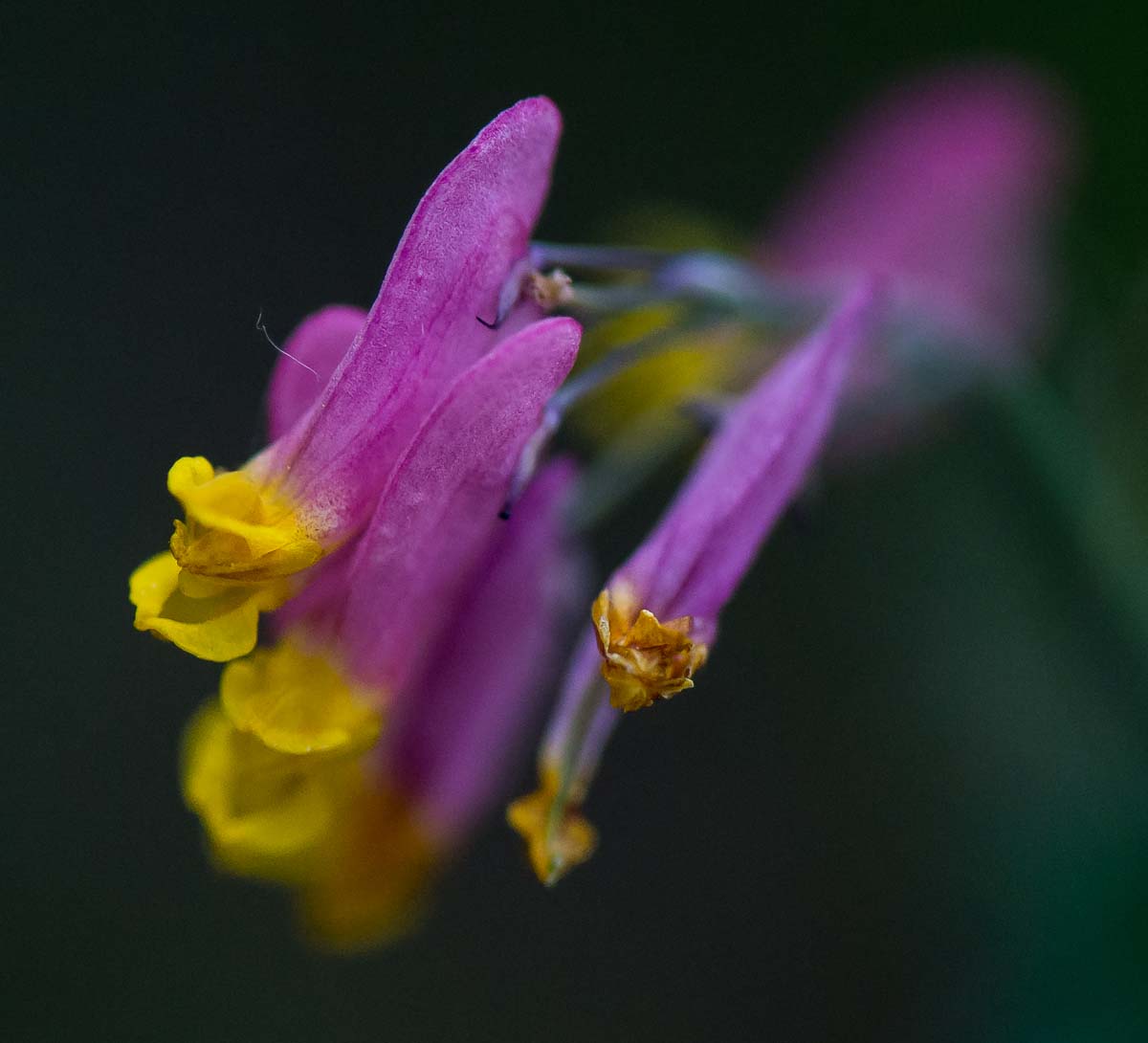
Rock harlequin, Capnoides sempervirens, appeared in the garden late in May, a first. I had previously only seen this fire adapted native wildflower in Deering at two closes by spots on Hedgehog Mountain. The plant itself, a bit tall and scraggly, doesn’t have much to recommend it, apart from its greyish green leaves, as a garden feature. But rock harlequin’s flower is so unusual and alluring — whimsical even — that I could not resist posting pictures of it … for a second time (there is an earlier post about rock harlequin on this site).
Pollinators of this poppy relative include bumble bees and skipper butterflies. I suppose the bulk of these insects is needed to force open the flower as they land on the flower’s protruding lower lip to reveal pollen. Seeds, born in long pods, are dispersed by ants and by wind, and some consider the plant to be mildly invasive. There are certainly more problematic — and far less appealing — invaders than rock harlequin.
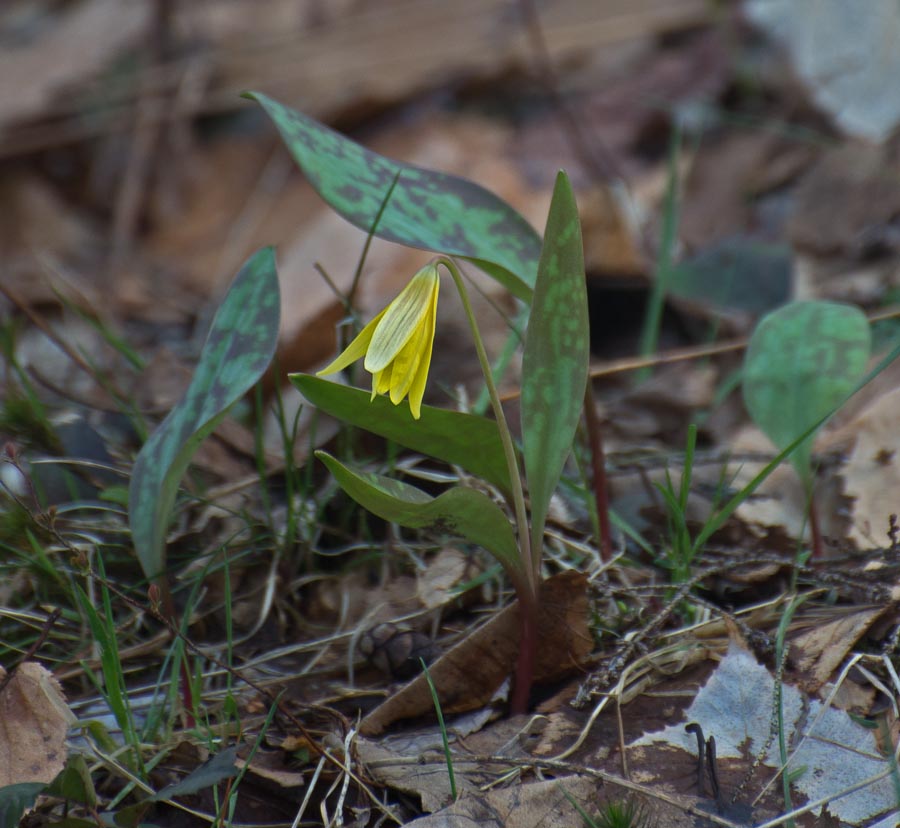
Trout lily, an early spring native wildflower, is rare in Deering.
I started documenting the wildflowers and flowering shrubs native to Deering when I first moved here in 2011. In 2023 my list includes about 300 species, most of which are plants typical of the northeast. One component of the northeastern flora that is mostly missing or, at best, poorly represented, are the earliest spring flowers. Skunk cabbage, which is exothermic and can melt its way through snow, seems to be missing. I have not seen any anemones or hepaticas either. Marsh marigold is represented by a single plant in a brook next to the Carew house, although I have not seen it for the past two years. I had not seen our earliest lily until wo years ago when trout lily appeared here at my home on Hedgehog Mountain. I don’t know where this trout lily came from, but it has come up reliably for what is now the third year. With that persistence, I am happy list trout lily as occurring naturally in Deering: I welcome it as one of few early iconic early spring flowers to flower in our town.
Trout Lily, Erythronium americanum, a member of the lily family, is found in moist places in deciduous forests. It is a small plant, 8 inches or less in height, characterized by its mottled leaves and a unique, yellow lily-like flower perched at the tip of a delicate stalk. Trout lily is one of the earliest of our native wildflowers and is certainly the first of our lilies, blooming at the same time and habitats as bloodroot, spring beauty, marsh mallow and others. The species has many other common names, but the best known of them is dog tooth violet. ‘Trout’ lily refers to the purple-brownish mottled leaves that suggest the fish, and also the plant flowers at the opening of trout season in New Hampshire. This mottling lead to the appellation ‘adder’s tongue,’ because of a perceived similarity of the leaves to snake skin. An early botanist objected to such a name for so pretty a flower and he proposed ‘fawn lily,’ supposing the mottling was more favorably compared to a young fawn. The very old name ‘dog-tooth violet’ comes from an Eurasian variety that has violet flowers and toothlike roots.
Trout lily is a North American native plant, distributed throughout the eastern states and provinces of the USA and Canada. It is closely related to Canada may flower, Mianthemum canadense, which is common in our area but blooms later and in the same places, in May and June, and tulip. The genus Erythronium includes about thirty-two species, most of which are native to the Central and Western states and provinces. A few species are found in Asia and Europe, respectively. Pink and white varieties occur in other states. Trout lily is the only eastern species, and I have only seen this pretty species at one location in Deering, here on Hedgehog Mountain.
Trout lily can reproduce sexually and produce seed. Pollinators include long-tongued insects, which can reach the nectaries that are located deep within the flower. The chief pollinators are blow-flies, mining bees and queen bumble bees. More commonly, trout Lily reproduces asexually by budding of perennial corms, and colonies 100 years old are known. Crickets and carabid beetles disperse the seed. White tailed deer sometimes nip off the buds and bears dig up the corms.
Young plants only produce one leaf. The don’t produce two leaves, and are then capable of flowering, until the bulb reaches sufficient size and has worked its way deeply into the soil (as much as 8 – 10 “). The leaves appear to be growing at ground level, but actually they emerge from a subterranean stem that lies several inches above the bulb. The plants do not flower until they are four to seven years old.
The roots of trout lily scavenge phosphorous from the spring run-off. The phosphorous is translocated to the leaves and is then returned to the soil when the leaves die back. Thus, trout lily performs an important environmental service. The ability of trout lily to accumulate phosphorous is thanks to mycorrhizal fungi. Once established, the roots of some plants are colonized by mycorrhizal fungi. The fungi sustain themselves through the winter with carbohydrates produced by the plant’s bulbs. This inhibits growth of the plants during the first season, but with the arrival of spring, fungi in roots of the infected plants enable them to absorb nutrients. This results in growth rates double that of ‘uninfected’ plants.
The young leaves and corms may be boiled and eaten, but in some people the concoction is emetic. Lore has it that a tea made from the leaves joins umpteen other teas as a cure for hiccups. Plants are also known to produce an antibiotic that is effective against gram-negative and gram-positive bacteria.
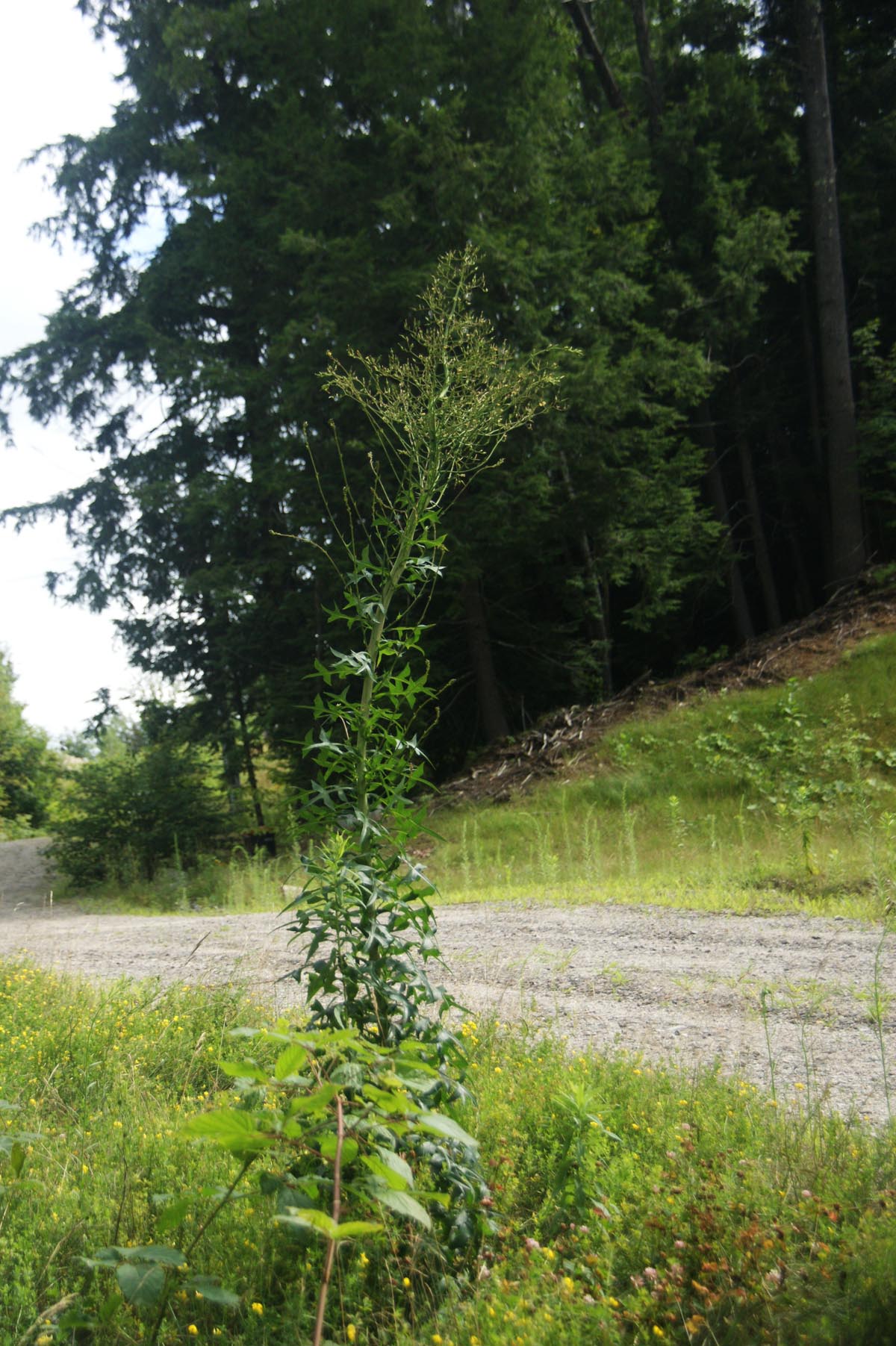
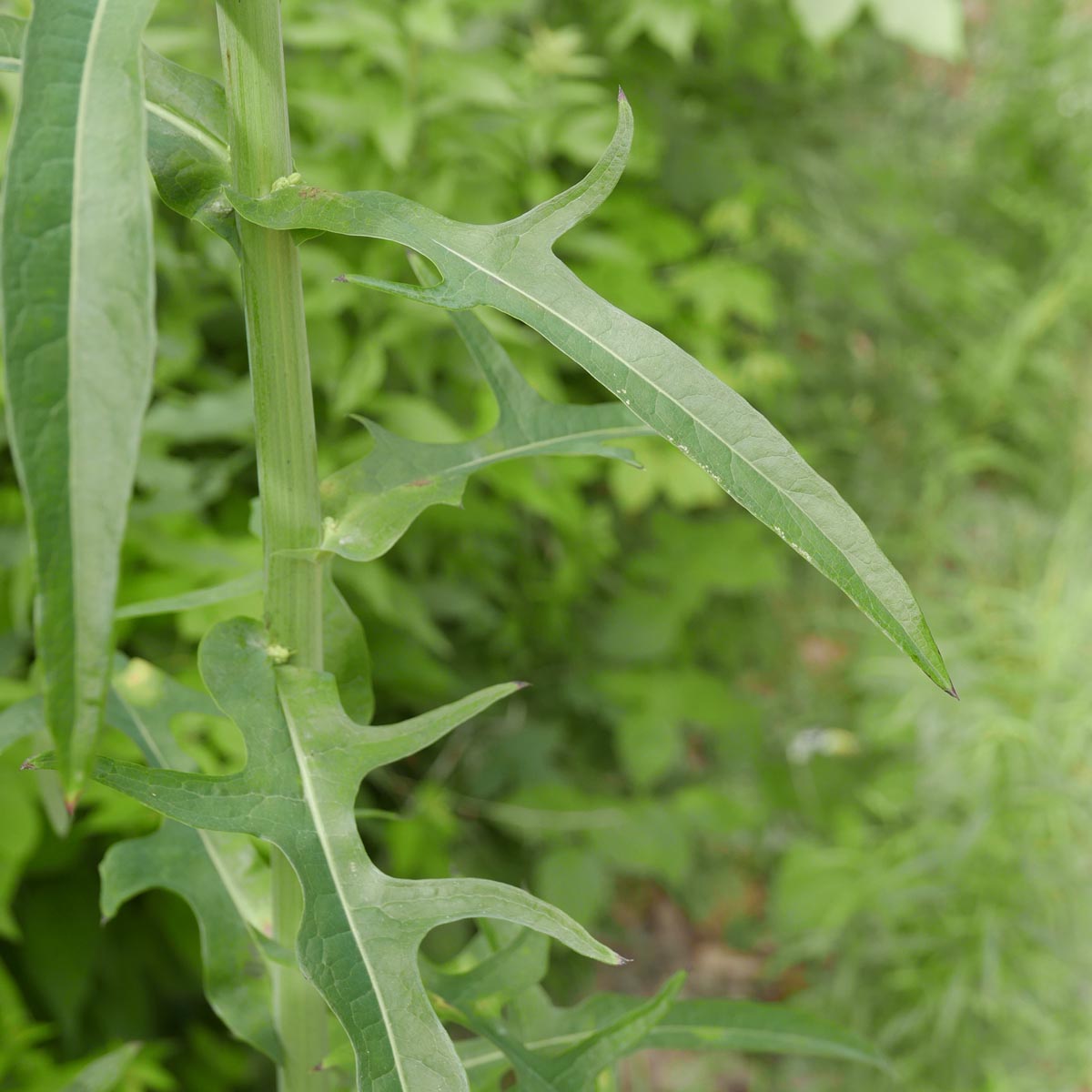
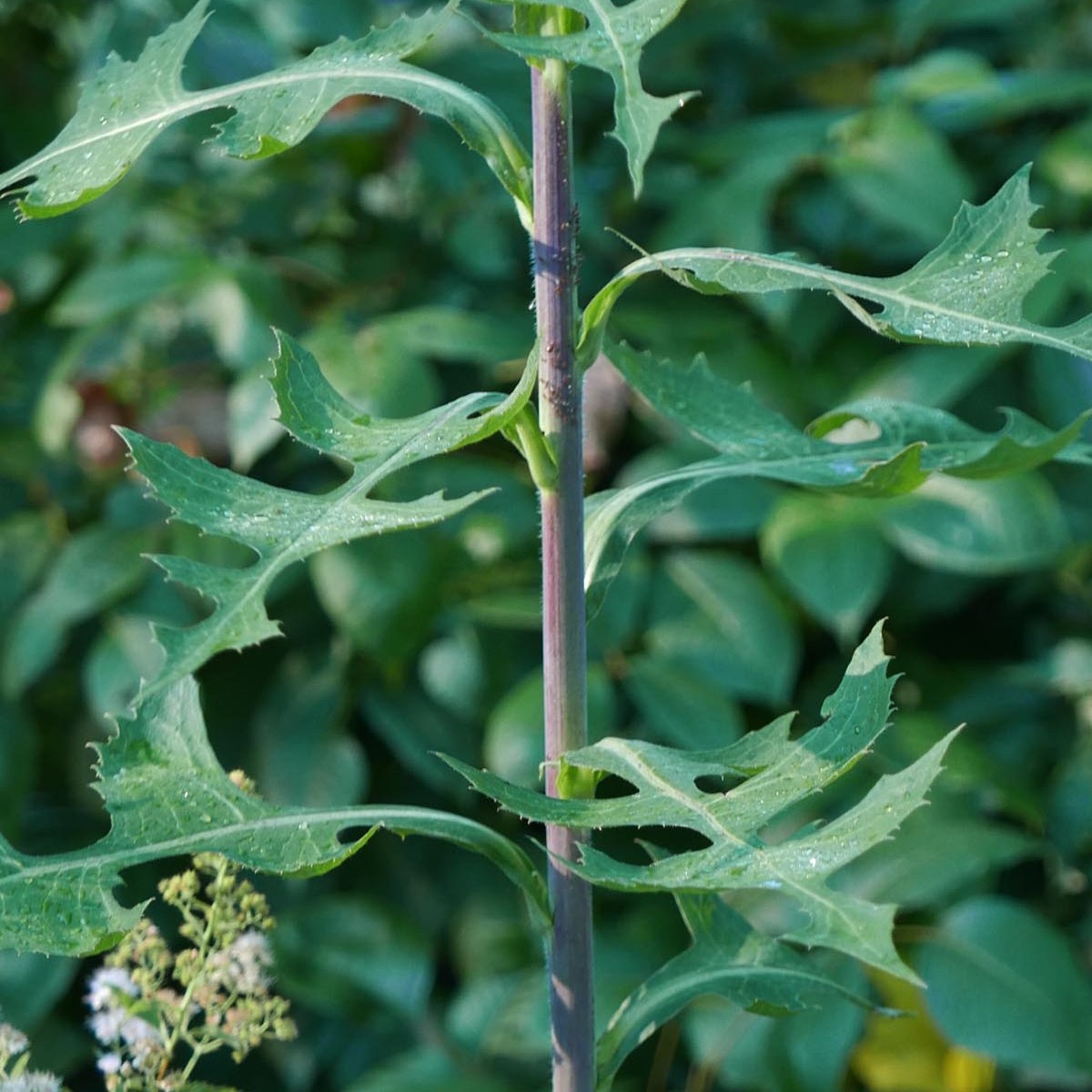
My daily (ok, frequent) walk leads along a diet road at the edge of forested land. Late last year I noticed large rosettes of deeply lobbed leaves. The leaves looked like dandelion, the tips of the lobes being acute — pointed, but these were much larger than dandelion leaves, more than a foot long and correspondingly broader. I did not know what they were. Winter ended and I began to see tall-stalked plants with the same oddly shaped leaves. As the season progressed, the stalks, elongated, ultimately reaching one or two meters in height. Flowers formed from elongated, openly branched clusters at the tip of the stalk and from the axils (where the leave departs from the stem) of the upper leaves. I realized that there were two, different but closely similar species of plants. When the species flowered, the first early in July and the much more common second a month later, I could confirm the two tall plants to be species of wild lettuce.
These were not cute or pretty wildflowers – – one might call them ‘weeds!’
L:actuca canadensis
Canada lettuce is a native of North America, widespread in Eastern N. America – Nova Scotia to British Columbia, south to Georgia and Colorado. It grows in part to full shade, usually in disturbed sites in thickets, woodland borders and clearings, and moist open places in a wade range of soils.
Lactuca canadensis is biennial, which means that each plant lives for two years. Seeds germinate in late summer to fall, producing a rosette of leaves and i the second year long stalks arise from the leaves. Flowers and, ultimately the seeds form at the tip. That plant then dies. The genus name Lactuca implies a milky exudate that flows from the stem when the plant is wounded. In Canada lettuce the latex is light brown or white. The sticky sap can cause a skin rash in some people. The sap contains ‘lactucarium’, which is used in medicine for its anodyne, antispasmodic, digestive, diuretic, hypnotic, narcotic and sedative properties. The sap s sometimes collected commercially.
The plant should be used with caution, and never without the supervision of a skilled practitioner.
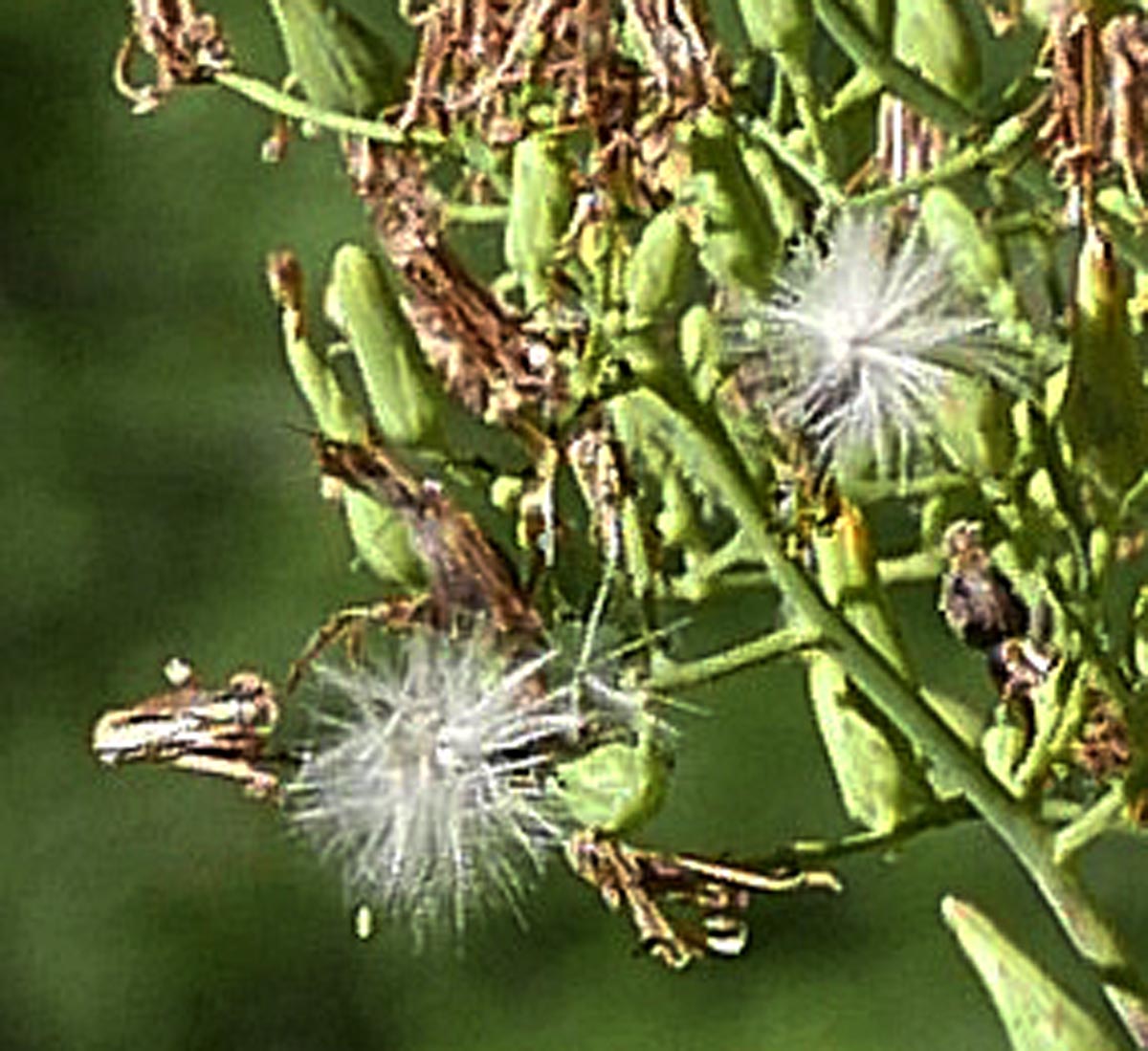
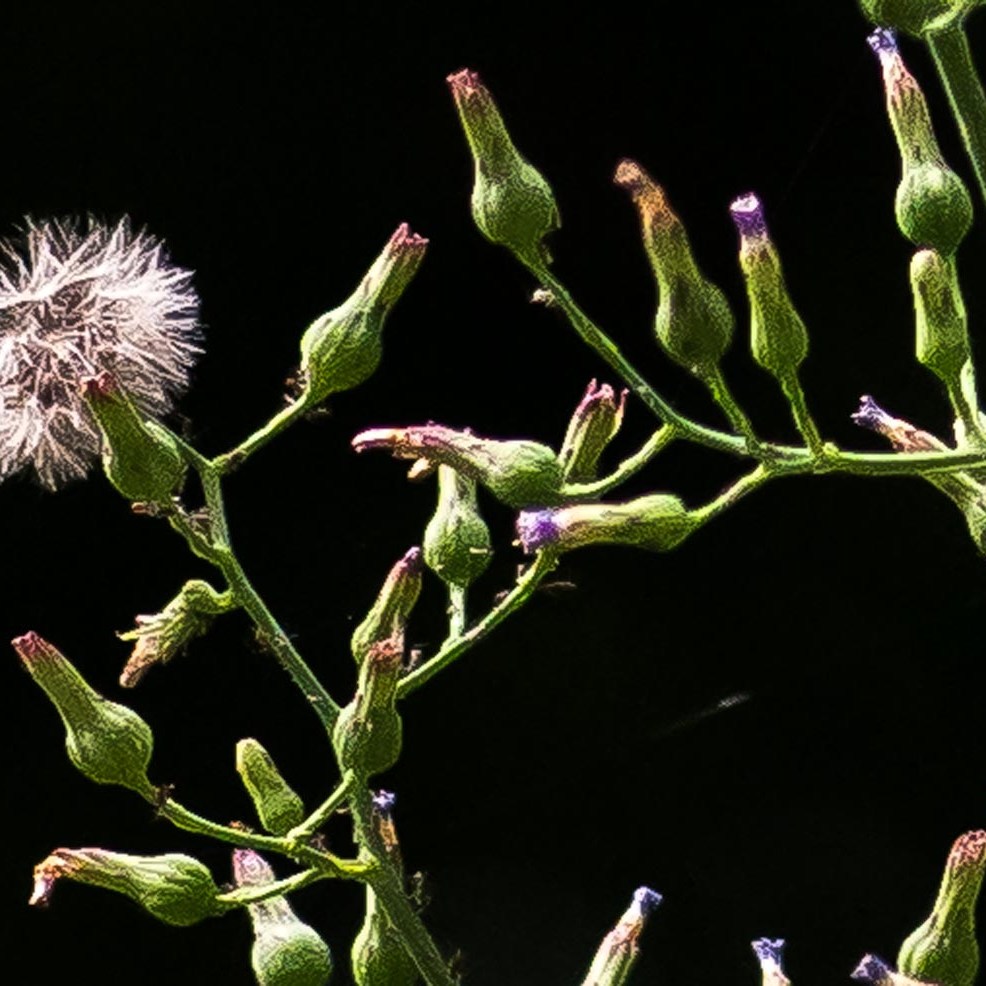
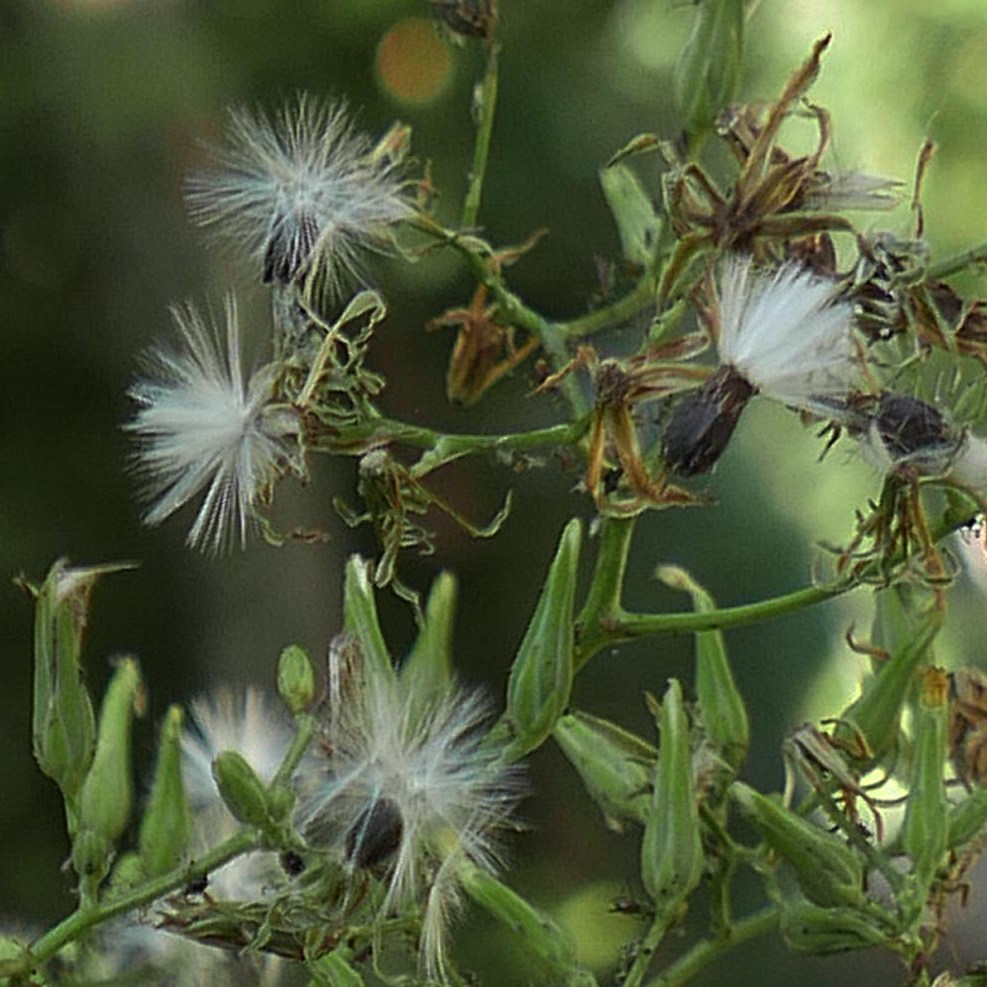
Small dandelion-like yellow flowers, each about 1/4 inch in diameter, occur in a narrow panicle up to 2″ long at the apex of the plant. The flowers are replaced by dark brown seeds – – achenes – – with tufts of white hair, which are attached together by thread-like beaks. Various bees pollinate Canada lettuce.
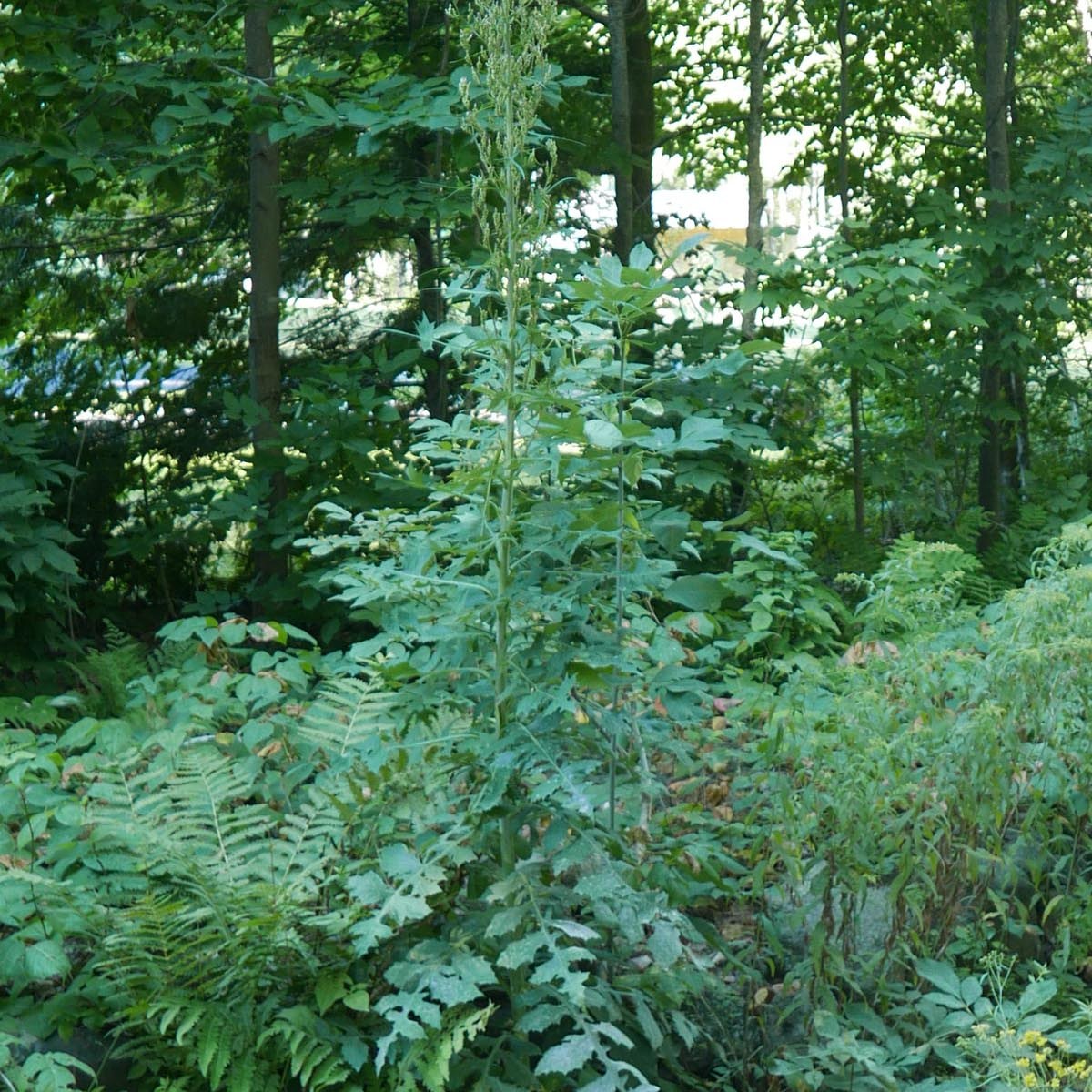
Lactuca biennis
2022 was the first year that I have seen this wild lettuce on my road — and it is difficult to overlook a seven-foot tall flower stalk! But this year several plants of this species are spread for a distance of about 50 meters along the shaded road.
Lactuca biennis, tall blue lettuce or wood lettuce, is native to North America. It is widespread across much of the United States and Canada, ranging from Alaska and Yukon south as far as California, New Mexico, and Georgia. The biennial plant is very similar to that of L. canadensis, and the two can be found growing together in disturbed sites, forest edges, meadows and fields. However, leaves of L. biennis are longer and broader and it’s little daisy-like flowers are blue. The plants can reach two meters in height. Various species of bumble bee have been recorded as pollinators of tall blue lettuce.
Like dandelion, leaves of L. biennis can be eaten in salads when young, but become bitter with age. Various medicinal uses have been attributed to tall blue lettuce including treatment of pain, vomiting, diarrhea, and heart trouble.
Patty had two dreams. One was to acquire and protect as much land asd she could afford. The second was to develop a garden in which there were blooming flowers bloomed for as much of the year as flowers can bloom here in New England.
It did not take her any time to persuade me to share her dreams.
Patty found 85 acres of forested land in southern New Hampshire in one of those supermarket real estate advertising magazines. The land had been recently, respectfully, logged, and a pretty brook ran through the oak/hemlock woods for nearly the entire 2200 ft length of the lot.
Deering, Hedgehog Mountain, is where we decided to call home, and where we built our timberpeg home (another of Patty’s dreams) in 2011.
And Patty started gardening as soon as we moved in.
Now, a bit over 10 years later, her dream of a glorious garden is being realized. A progression of flowers, early spring to late autumn has responded to near constant care: weeding, watering, thinning, dividing, moving about, and so on.
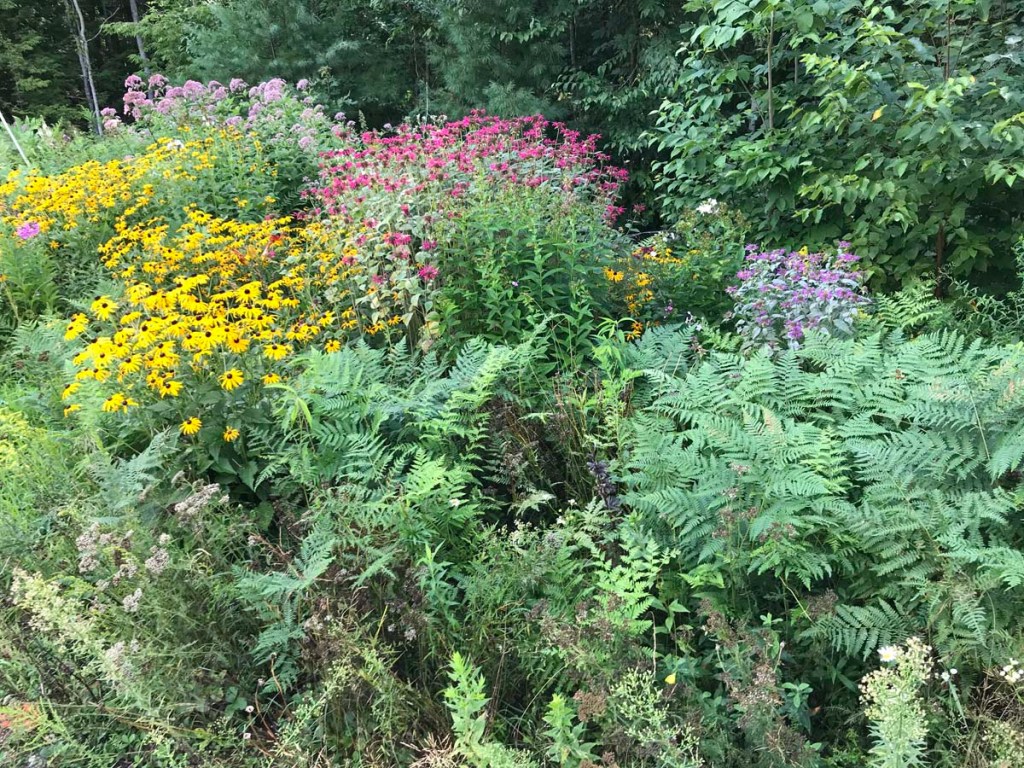
The collateral effects of the garden include apart from, of course, the pure beauty, a refugium from an otherwise pretty crappy world, a whole bunch of pollinating insects and ruby throated hummingbirds. Butterflies, bees of all sorts, and the hummingbirds dip and zoom around the flowers finding pollen and nectar among the echinacea, lavender, bee balm, Joe Pye weed … and St John’s Worts and evening primrose and lupins … the list just goes on! Caterpillars such as those of the glorious monarch butterfly find a good home here in all the untouched milkweed.
Pollinator’s delight in Patty’s ggarden!
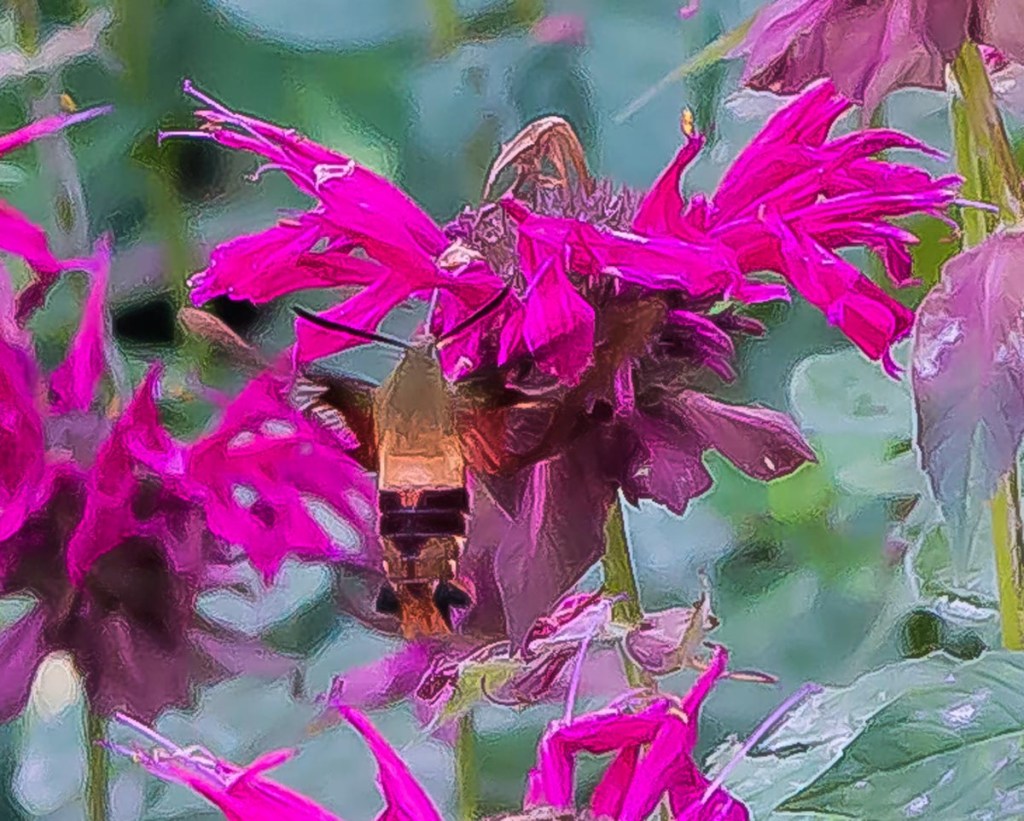
Among the most interesting of the insect visitors to garden has been the Hummingbird Clearwing moth, Hemaris thysbe.
The Hummingbird Clearwing, a sphinx, or hawkmoth, is active on warm, sunny summer days. It is maybe a quarter the size (wingspan 1.5 – 2 “) of a ruby throated hummingbird, but its super rapidly beating wings give the same humming sound as the bird as it dashes from flower to flower, never alighting for more than the briefest of moments. Like the hummingbird, the clearwing hawkmoth can hover over prospective nectar sources. I have read that wings of the clearwing beat at 85 beats per second, while those of the hummingbird barely chug along at a mere 50 bps. Of course, its ability to hover enables to clearwing to suck nectar from flowers through it long proboscis — a superb example of coevolution. Hovering also makes sense for this heavy insect because delicate flowers do not provide feeding ledges for their pollinators — a serious revolutionary oversight! Moreover, remaining airborne gives the insect a head start should it need to escape a hungry predator. Males hawkmoths have a flared tail, again like the hummingbird, and their long straw-like proboscis unfurls to reach the nectar deep within flowers.
Hummingbird clearwing moth drawing nectar from monarda flowers
Despite the wide range of lowers and flower colors in Patty’s garden, we have only seen the clearwing on the red monarda. It apparently doesn’t even visit the nearby purple monarda. In fact, this clearwing is known to show preference for red and purple flowers.
Four species of hummingbird moths occur in North America. Hemaris thysbe is most abundant in eastern North America, but it ranges widely in North America.
Caterpillars of the clearwing hawkmoth feed on cherry trees, European cranberry bush, hawthorns, honeysuckle, and snowberry. The insect overwinters in the soil as brown, hard-shelled pupae. In the late spring, it emerges as an adult moth.





















 DEERING'S NATURAL HISTORY