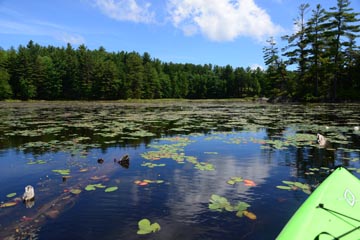
The Tom Rush Forest, in central Deering, was formed in 2002 when the popular singer Tom Rush sold several lots to the Society for the Protection of New Hampshire Forests. Tom Rush Forest is the largest conservation easement in Deering, comprising 300 acres of forest and meadows. Abutting the Rush Forest the SPNHF holds the conservation easement on 40 forested acres that are privately owned and called the Rush Farm Tract. Abutting the Rush Farm Tract, on the Deering Center Road, is the ‘Gregg Hill Lot,’ also known as ‘the library lot.’ This town-owned lot is, in part, the steep meadow that can be seen from Deering Center Road, to the left of the Carew House and essentially opposite the town garage. There are many possibilities for recreation, walking and winter sports. in the Tom Rush Forest and land that surrounds it.
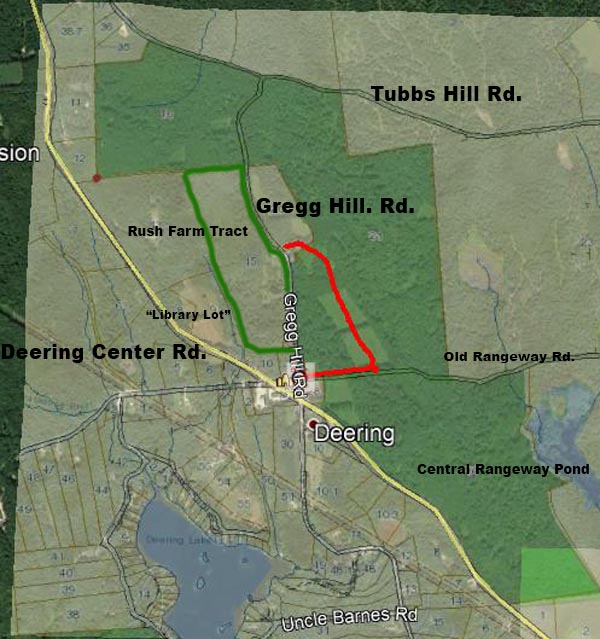
Early in the 19th Century several families lived around what is now the Tom Rush Forest, on Gregg Hill Road, Tubbs Hill Road, and Old Rangeway Road and today’s forest was all meadow – – known in part as ‘East Meadow,’ and ‘Berry field.’ Large meadows inside the Tom Rush Forest have been maintained along the east side of Gregg Hill Road, and those meadows feature in a walk (shown in red on the map) of about 1/2 mile from the Town Common, on Deering Center Rd, to the Lachance residence at the top Gregg Hill Road. We call that walk the Tom Rush Meadow Walk.
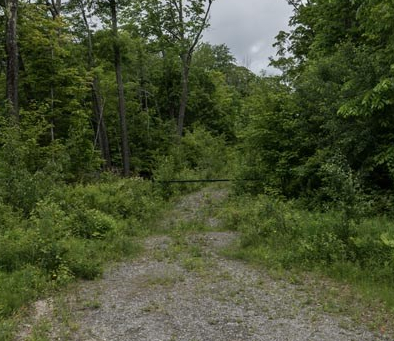
Beginning at the gate across Old Rangeway Road, near the Town Common and the Deering, follow Old Rangeway Road uphill for a little less than 1/4 mile. From the top of the hill the trail leads left and immediately enters the first meadow. The way through the meadows is mown irregularly to make a more or less clear path for about 1/4 mile to return to Gregg Hill Rd. The last third of the walk passes through open forest.
The slope from the gate at Gregg Hill Road to the top of the hill is moderately steep and follows along a rutted dirt road. From the top of the hill the path through the meadows back to Gregg Hill Road is level easily traversed – – even with a perambulator. There are no vistas from the meadows.
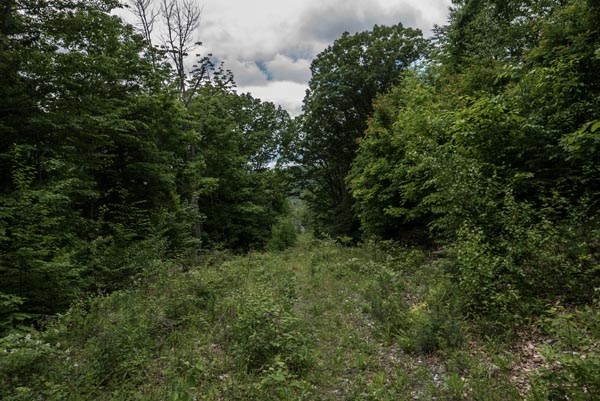
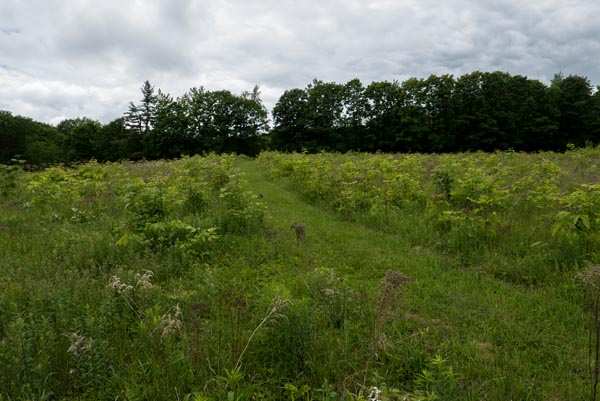
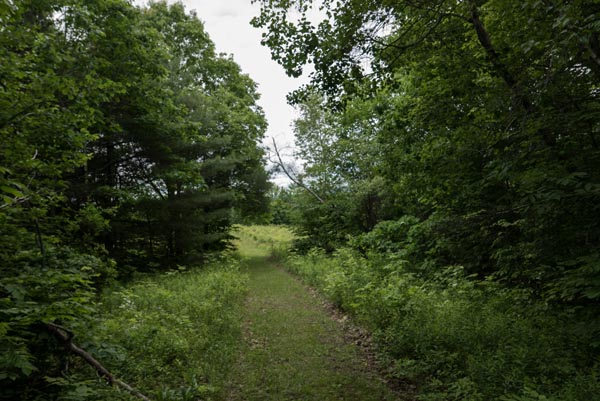

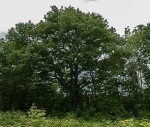
The meadows harbor a nice diversity of flowers. When I walked it in early June a stunningly blue introduced Veronica, V. austriaca saw-leaved speed-well, was in bloom. There were a lot of blackberries and dewberry, a close relative of blackberry that scrambles along the ground. Dewberry fruits before blackberry. Its fruit look like fruit of blackberry and can be just as sweet. The dewberry plant is thorny/hairy, so the biggest challenge might to be in collecting the fruit without getting scratched. There were also pale violet fleabanes forming large colonies in the grass. Milkweed plants were conspicuous and I saw a monarch butterfly, which feeds exclusively on milkweed. I was very happy to see a lot of ash seedlings but not so happy to see a large colony of the invasive black swallow-wort (Cynanchium louisiae). I am sure there will be a succession of flowers through the season. At the edge of one of the meadows there is an impressive wonderfully branched red oak tree.


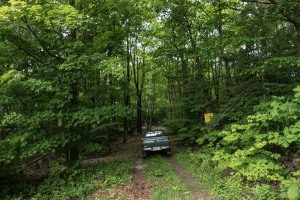
It is possible to park at the top of Gregg Hill Road but please remember that there is a private residence there. The owner has requested that people not park in the bays. Gregg Hill Road is a Class VI road and there is room to park on the side of the road beyond the residence. Please do not block Gregg Hill Road.
The Tom Rush Meadow Walk would make for a good trail for families. It is short, only 1/2 mile each direction, and you could post a car at each end. The trail is easy to follow; it is open and there is a diversity of things to see. With some effort you could push a perambulator along. It would be fun for winter’s snowshoeing or cross country skiing at least at the level top through the meadows.
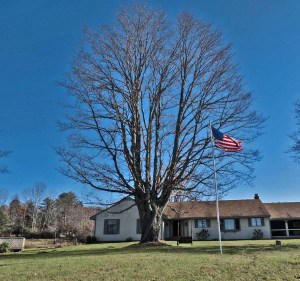

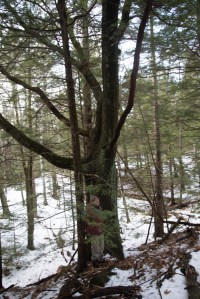
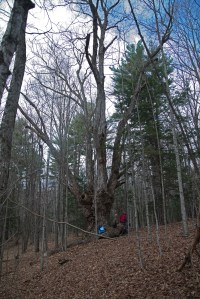
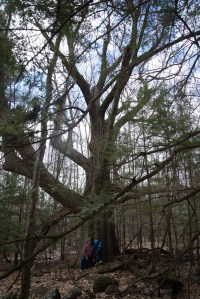
 These old sugar maples are all that remain of a population of several on the Baldwin property off Reservoir Rd. They were noted in the 1980 census of big trees but today they show signs of weariness, age. In their day one can imagine that they provided a good lot of New Hampshire maple syrup to their happy humans. The tree on the right was a champion nearly 40 years ago but today is a dignified but hollowed trunk. A reminder of what once grew in this part of the forest.
 e
e 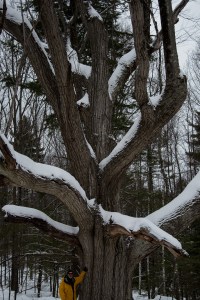 This old maple speaks of the profane, of earth, of spirits present and past. At once a fierce monument to survival, remembering that 150 years ago this tree likely stood in a sheep meadow, now a projection of a forest community, a wise statesman to whom we should pay close attention.
 one are close by, although there are two large ash trees in front of the house on the road. Maybe this is the parent to them.
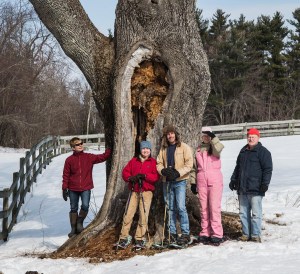 much else seems wrong or fleeting they remain close to us. They can enfold and protect us. It’s proven that just walking in a forest can improve our mood, influenced by ‘vapourscoming from trees. This ash was loved by a woman whose spirit persists. This ash will always remind of her and a wonderful day with friends. No doubt this ash has been loved before, and when we are long gone, this ash will be loved by others.
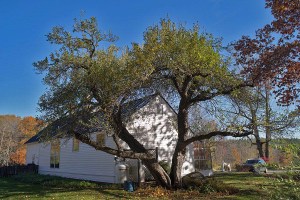 ings of our town. They donated land for the first cemetery, on Old County Rd, and the Wilkins House has stood since the end of the 18th Century.It has been the home of the Walmsley family since the mid 1960’s. This apple tree was there when they moved in. Actually, this apple tree has been giving green apples since at least 1920. A very long time for an apple!


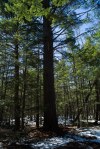
 were not taken in logging because even though the wood is very hard, it tends to rot. Bark in old trees is very thick, distinctive for being deeply ridged. Their thick bark makes the trees fire fire resistant.







 Painted Ladies to occur in our area in a lifetime. This past weekend, over a dozen were observed nectaring on zinnias in our flower garden. This phenomena isn’t just happening in Deering, but is being reported throughout New England and elsewhere across the continent. If fact, this year the migration has been large enough to register on the National Weather Service’s radar imagery. I hope you enjoy the flash of orange and black wings in your gardens as we have.