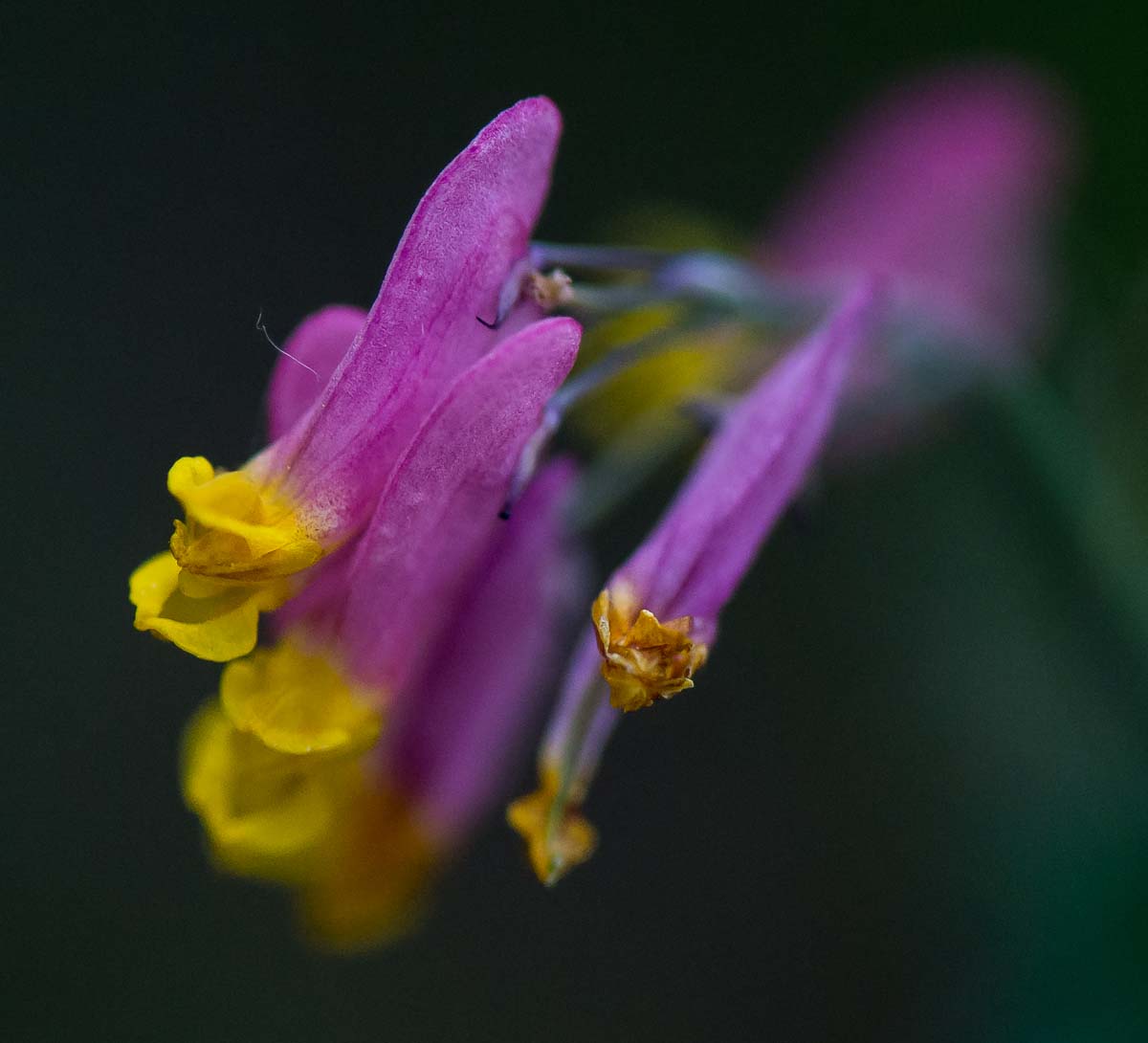
Rock harlequin, Capnoides sempervirens, appeared in the garden late in May, a first. I had previously only seen this fire adapted native wildflower in Deering at two closes by spots on Hedgehog Mountain. The plant itself, a bit tall and scraggly, doesn’t have much to recommend it, apart from its greyish green leaves, as a garden feature. But rock harlequin’s flower is so unusual and alluring — whimsical even — that I could not resist posting pictures of it … for a second time (there is an earlier post about rock harlequin on this site).
Pollinators of this poppy relative include bumble bees and skipper butterflies. I suppose the bulk of these insects is needed to force open the flower as they land on the flower’s protruding lower lip to reveal pollen. Seeds, born in long pods, are dispersed by ants and by wind, and some consider the plant to be mildly invasive. There are certainly more problematic — and far less appealing — invaders than rock harlequin.
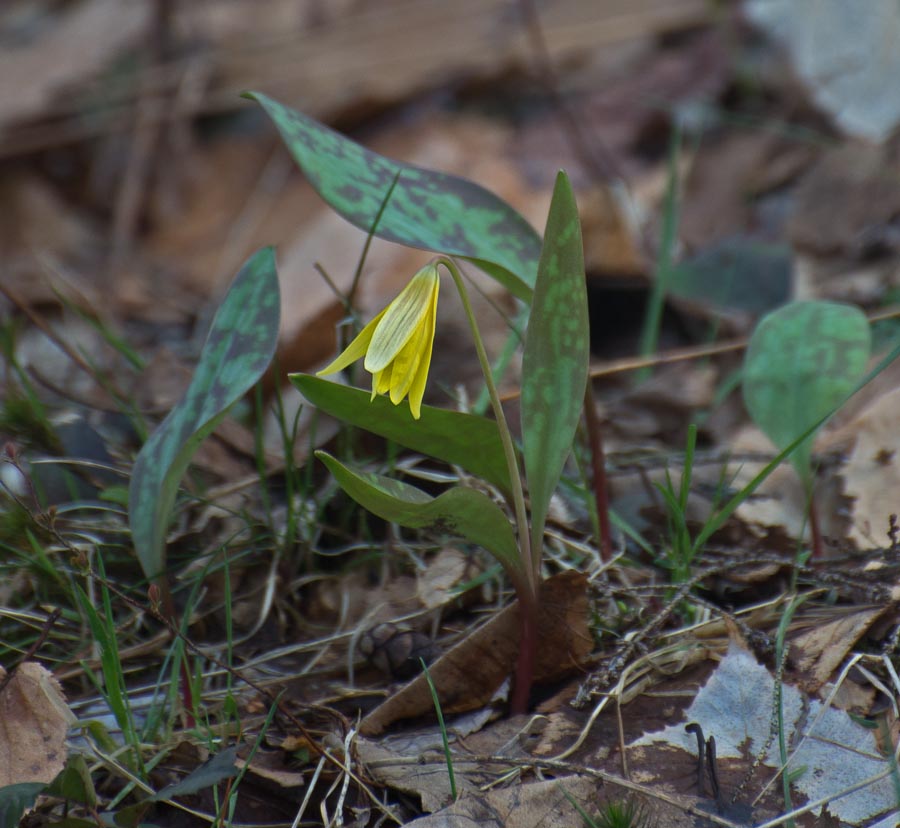
Trout lily, an early spring native wildflower, is rare in Deering.
I started documenting the wildflowers and flowering shrubs native to Deering when I first moved here in 2011. In 2023 my list includes about 300 species, most of which are plants typical of the northeast. One component of the northeastern flora that is mostly missing or, at best, poorly represented, are the earliest spring flowers. Skunk cabbage, which is exothermic and can melt its way through snow, seems to be missing. I have not seen any anemones or hepaticas either. Marsh marigold is represented by a single plant in a brook next to the Carew house, although I have not seen it for the past two years. I had not seen our earliest lily until wo years ago when trout lily appeared here at my home on Hedgehog Mountain. I don’t know where this trout lily came from, but it has come up reliably for what is now the third year. With that persistence, I am happy list trout lily as occurring naturally in Deering: I welcome it as one of few early iconic early spring flowers to flower in our town.
Trout Lily, Erythronium americanum, a member of the lily family, is found in moist places in deciduous forests. It is a small plant, 8 inches or less in height, characterized by its mottled leaves and a unique, yellow lily-like flower perched at the tip of a delicate stalk. Trout lily is one of the earliest of our native wildflowers and is certainly the first of our lilies, blooming at the same time and habitats as bloodroot, spring beauty, marsh mallow and others. The species has many other common names, but the best known of them is dog tooth violet. ‘Trout’ lily refers to the purple-brownish mottled leaves that suggest the fish, and also the plant flowers at the opening of trout season in New Hampshire. This mottling lead to the appellation ‘adder’s tongue,’ because of a perceived similarity of the leaves to snake skin. An early botanist objected to such a name for so pretty a flower and he proposed ‘fawn lily,’ supposing the mottling was more favorably compared to a young fawn. The very old name ‘dog-tooth violet’ comes from an Eurasian variety that has violet flowers and toothlike roots.
Trout lily is a North American native plant, distributed throughout the eastern states and provinces of the USA and Canada. It is closely related to Canada may flower, Mianthemum canadense, which is common in our area but blooms later and in the same places, in May and June, and tulip. The genus Erythronium includes about thirty-two species, most of which are native to the Central and Western states and provinces. A few species are found in Asia and Europe, respectively. Pink and white varieties occur in other states. Trout lily is the only eastern species, and I have only seen this pretty species at one location in Deering, here on Hedgehog Mountain.
Trout lily can reproduce sexually and produce seed. Pollinators include long-tongued insects, which can reach the nectaries that are located deep within the flower. The chief pollinators are blow-flies, mining bees and queen bumble bees. More commonly, trout Lily reproduces asexually by budding of perennial corms, and colonies 100 years old are known. Crickets and carabid beetles disperse the seed. White tailed deer sometimes nip off the buds and bears dig up the corms.
Young plants only produce one leaf. The don’t produce two leaves, and are then capable of flowering, until the bulb reaches sufficient size and has worked its way deeply into the soil (as much as 8 – 10 “). The leaves appear to be growing at ground level, but actually they emerge from a subterranean stem that lies several inches above the bulb. The plants do not flower until they are four to seven years old.
The roots of trout lily scavenge phosphorous from the spring run-off. The phosphorous is translocated to the leaves and is then returned to the soil when the leaves die back. Thus, trout lily performs an important environmental service. The ability of trout lily to accumulate phosphorous is thanks to mycorrhizal fungi. Once established, the roots of some plants are colonized by mycorrhizal fungi. The fungi sustain themselves through the winter with carbohydrates produced by the plant’s bulbs. This inhibits growth of the plants during the first season, but with the arrival of spring, fungi in roots of the infected plants enable them to absorb nutrients. This results in growth rates double that of ‘uninfected’ plants.
The young leaves and corms may be boiled and eaten, but in some people the concoction is emetic. Lore has it that a tea made from the leaves joins umpteen other teas as a cure for hiccups. Plants are also known to produce an antibiotic that is effective against gram-negative and gram-positive bacteria.
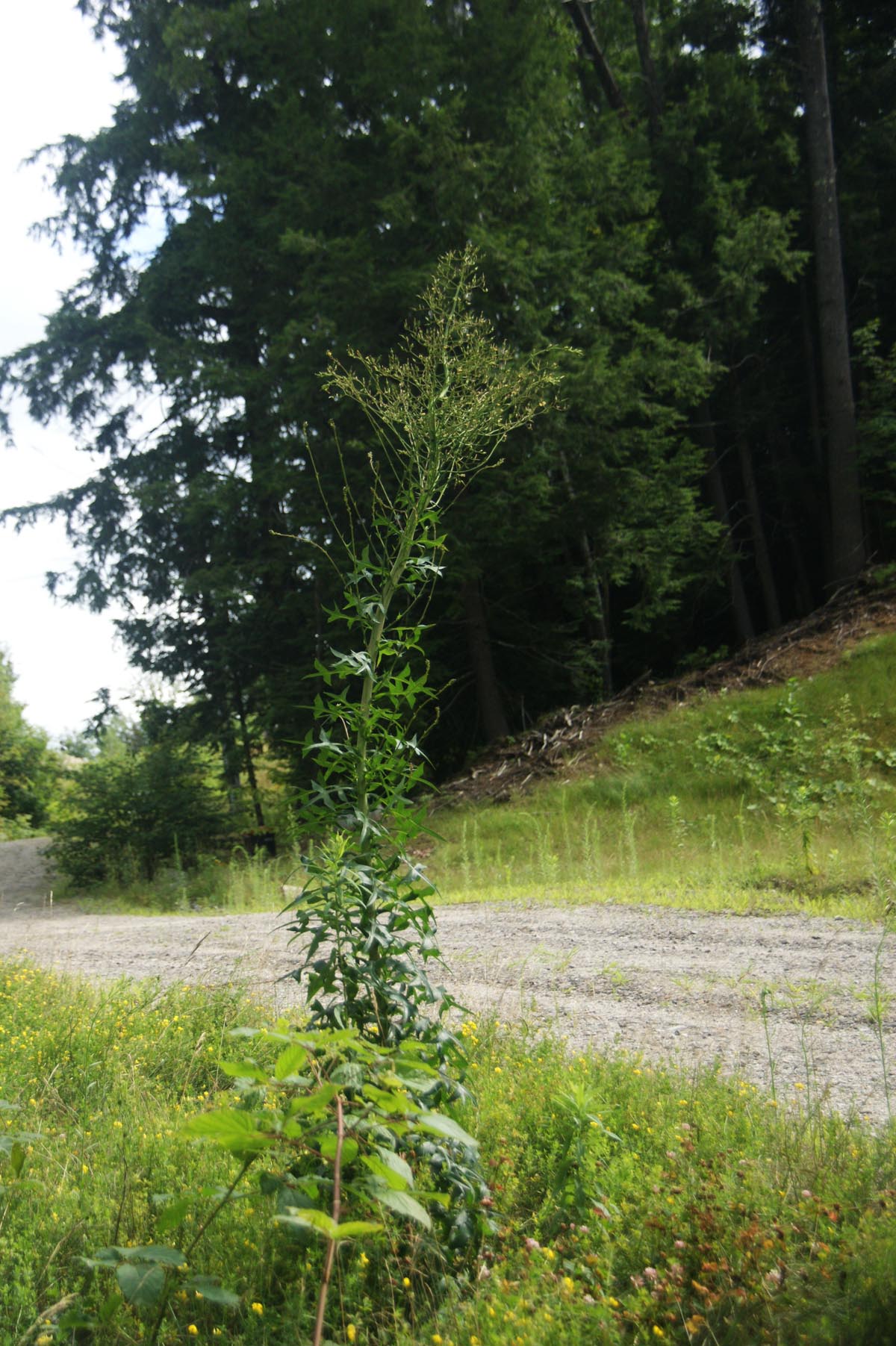
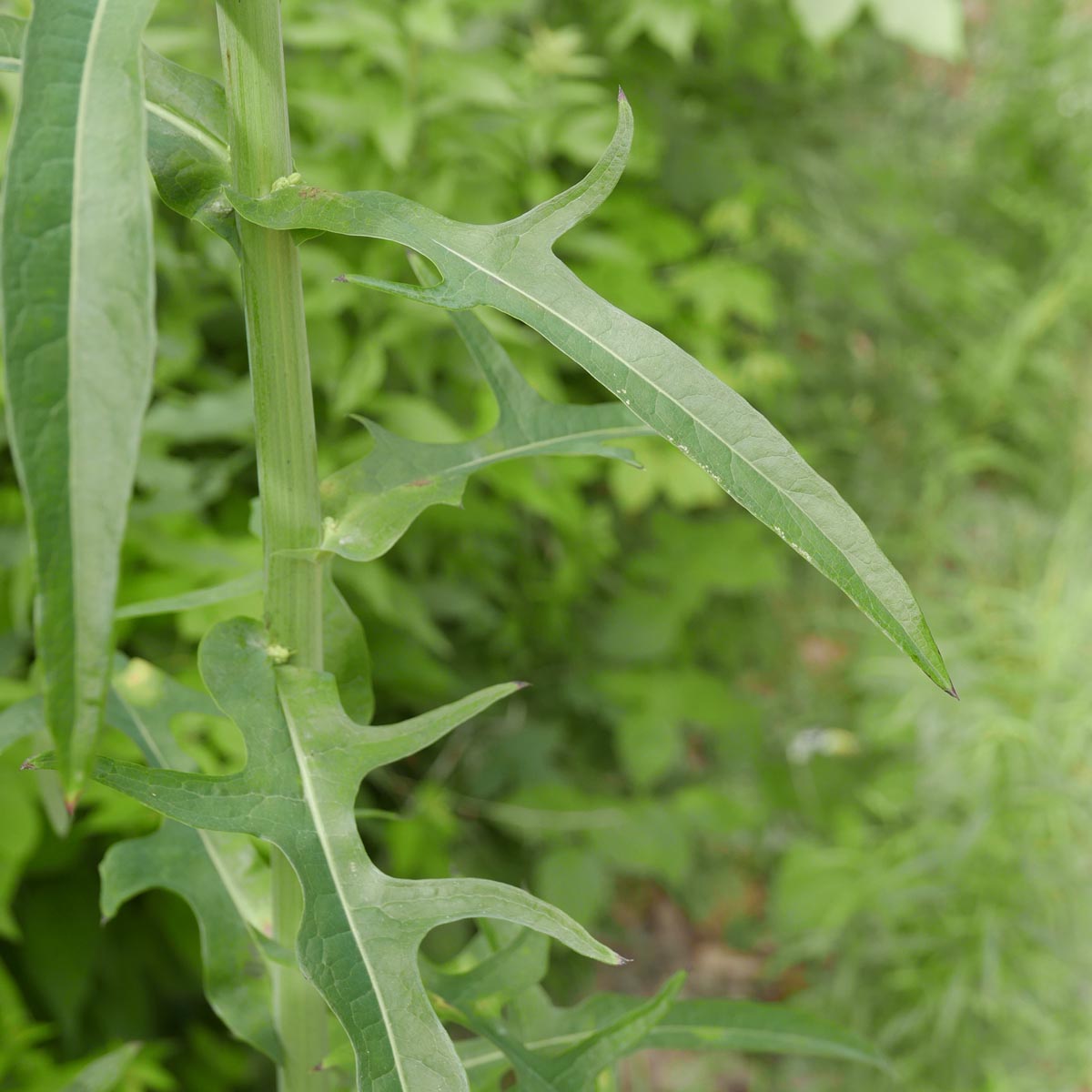
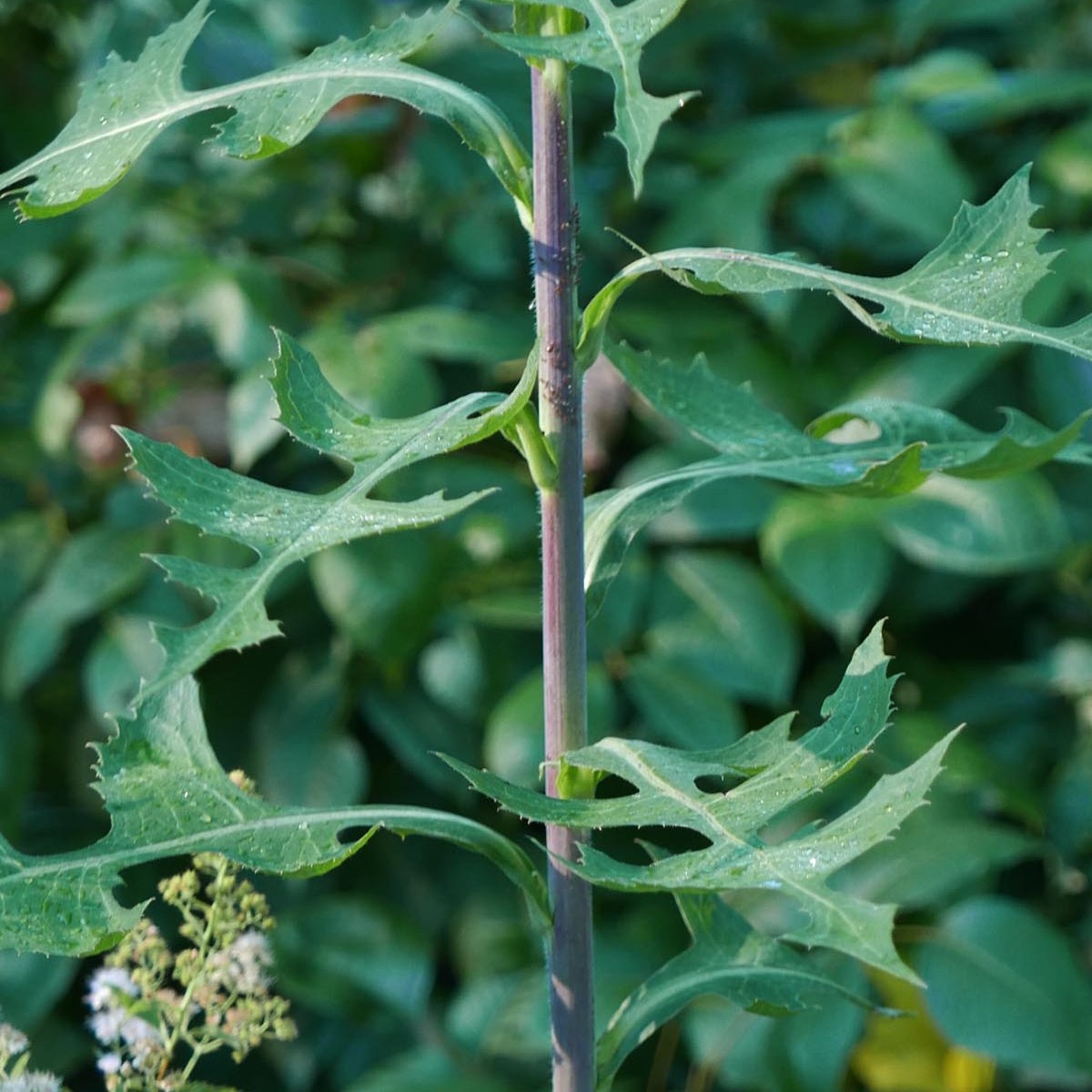
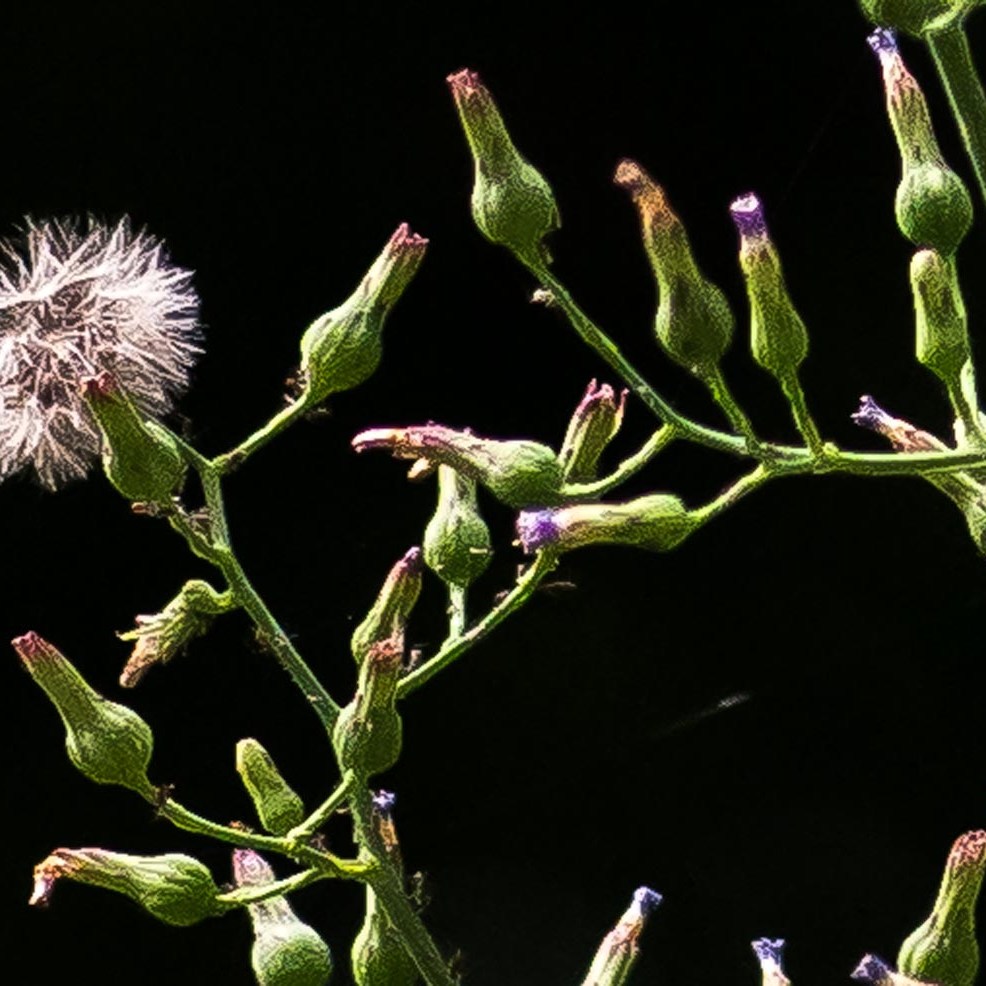
My daily (ok, frequent) walk leads along a diet road at the edge of forested land. Late last year I noticed large rosettes of deeply lobbed leaves. The leaves looked like dandelion, the tips of the lobes being acute — pointed, but these were much larger than dandelion leaves, more than a foot long and correspondingly broader. I did not know what they were. Winter ended and I began to see tall-stalked plants with the same oddly shaped leaves. As the season progressed, the stalks, elongated, ultimately reaching one or two meters in height. Flowers formed from elongated, openly branched clusters at the tip of the stalk and from the axils (where the leave departs from the stem) of the upper leaves. I realized that there were two, different but closely similar species of plants. When the species flowered, the first early in July and the much more common second a month later, I could confirm the two tall plants to be species of wild lettuce.
These were not cute or pretty wildflowers – – one might call them ‘weeds!’
L:actuca canadensis
Canada lettuce is a native of North America, widespread in Eastern N. America – Nova Scotia to British Columbia, south to Georgia and Colorado. It grows in part to full shade, usually in disturbed sites in thickets, woodland borders and clearings, and moist open places in a wade range of soils.
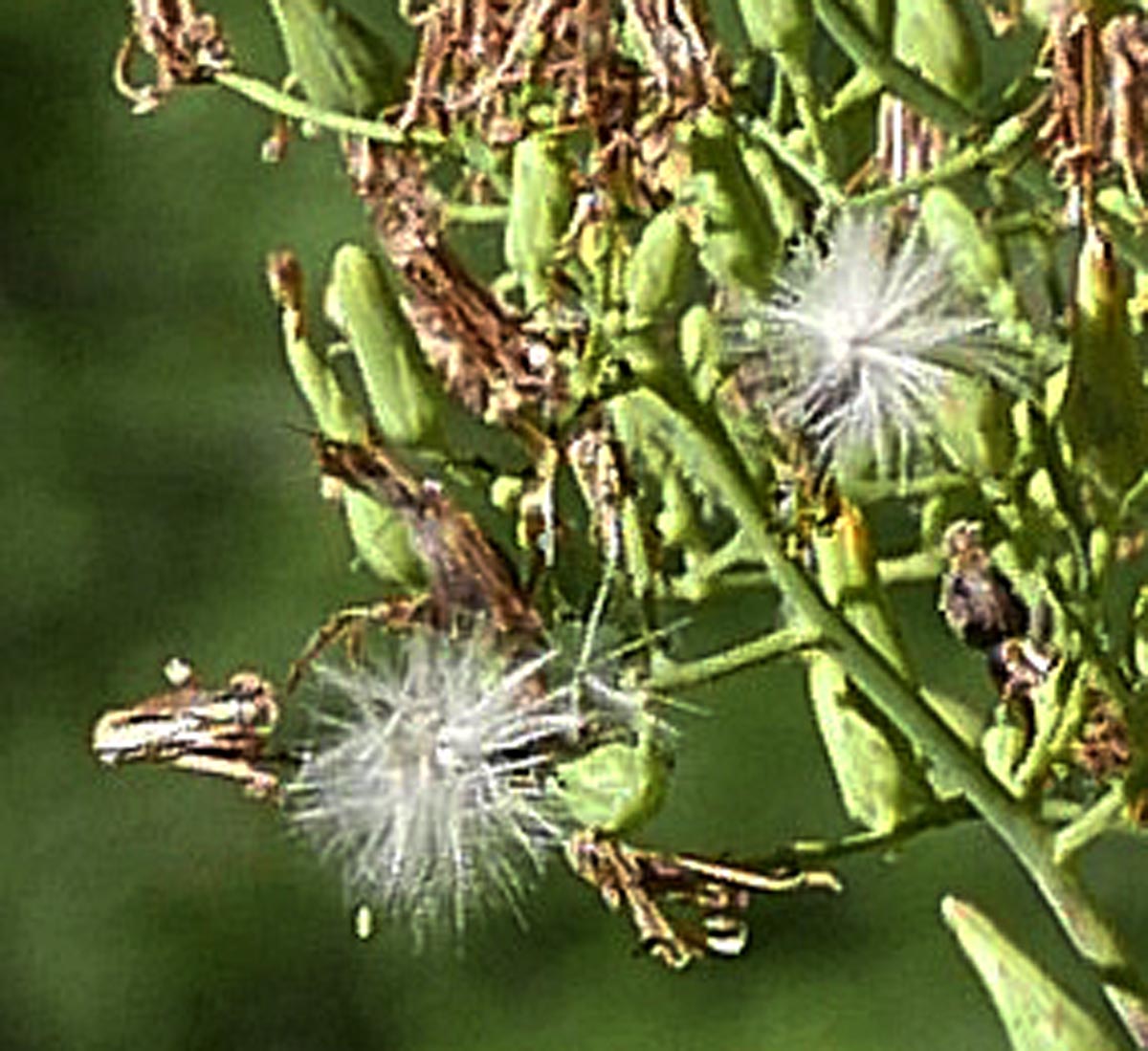
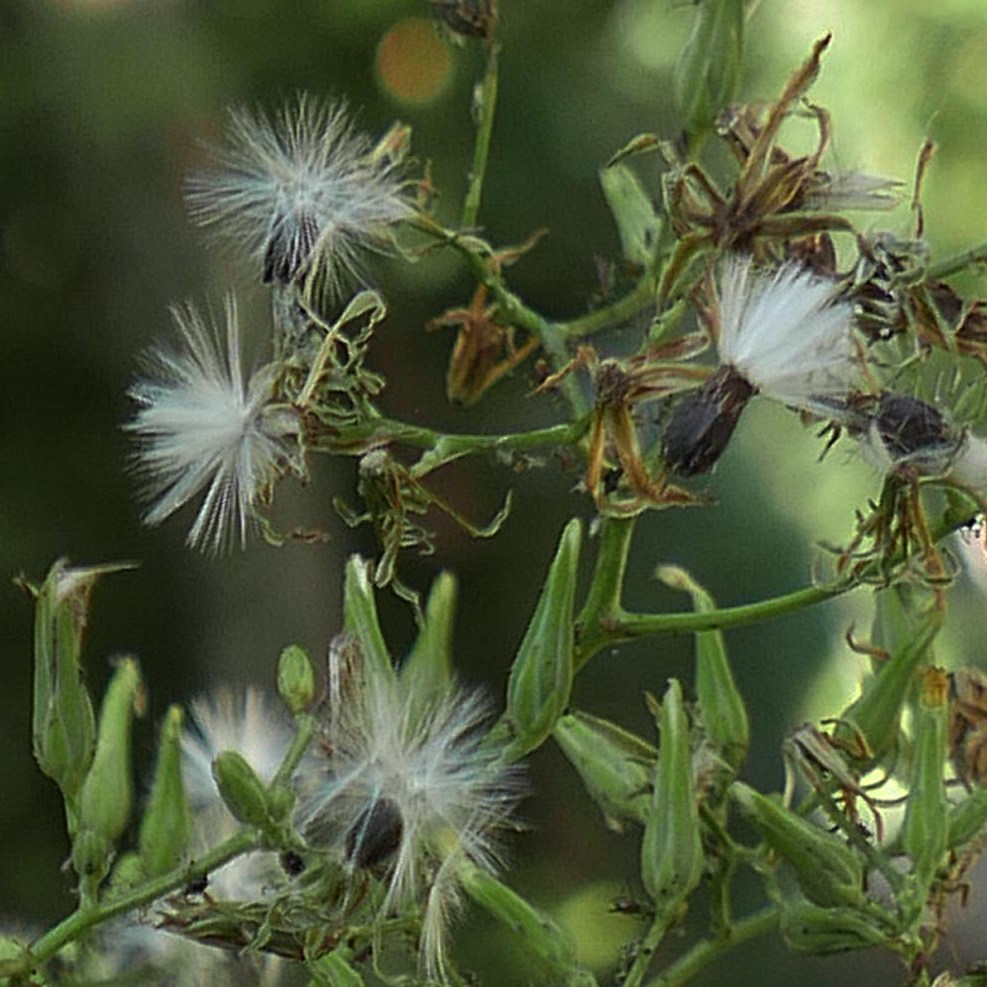
Lactuca canadensis is biennial, which means that each plant lives for two years. Seeds germinate in late summer to fall, producing a rosette of leaves and i the second year long stalks arise from the leaves. Flowers and, ultimately the seeds form at the tip. That plant then dies. The genus name Lactuca implies a milky exudate that flows from the stem when the plant is wounded. In Canada lettuce the latex is light brown or white. The sticky sap can cause a skin rash in some people. The sap contains ‘lactucarium’, which is used in medicine for its anodyne, antispasmodic, digestive, diuretic, hypnotic, narcotic and sedative properties. The sap s sometimes collected commercially.
The plant should be used with caution, and never without the supervision of a skilled practitioner.
Small dandelion-like yellow flowers, each about 1/4 inch in diameter, occur in a narrow panicle up to 2″ long at the apex of the plant. The flowers are replaced by dark brown seeds – – achenes – – with tufts of white hair, which are attached together by thread-like beaks. Various bees pollinate Canada lettuce.
Lactuca biennis
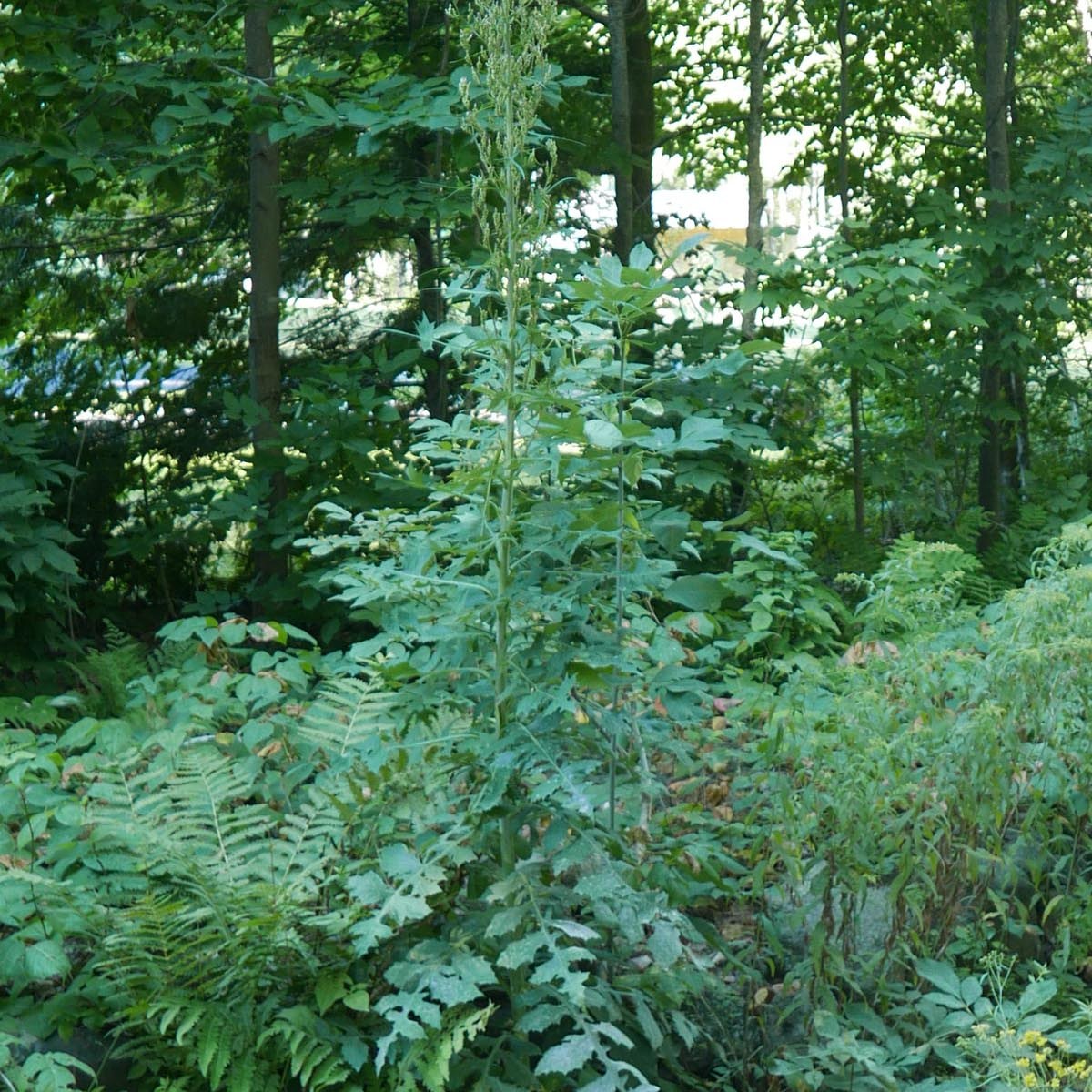
2022 was the first year that I have seen this wild lettuce on my road — and it is difficult to overlook a seven-foot tall flower stalk! But this year several plants of this species are spread for a distance of about 50 meters along the shaded road.
Lactuca biennis, tall blue lettuce or wood lettuce, is native to North America. It is widespread across much of the United States and Canada, ranging from Alaska and Yukon south as far as California, New Mexico, and Georgia. The biennial plant is very similar to that of L. canadensis, and the two can be found growing together in disturbed sites, forest edges, meadows and fields. However, leaves of L. biennis are longer and broader and it’s little daisy-like flowers are blue. The plants can reach two meters in height. Various species of bumble bee have been recorded as pollinators of tall blue lettuce.
Like dandelion, leaves of L. biennis can be eaten in salads when young, but become bitter with age. Various medicinal uses have been attributed to tall blue lettuce including treatment of pain, vomiting, diarrhea, and heart trouble.
Patty had two dreams. One was to acquire and protect as much land asd she could afford. The second was to develop a garden in which there were blooming flowers bloomed for as much of the year as flowers can bloom here in New England.
It did not take her any time to persuade me to share her dreams.
Patty found 85 acres of forested land in southern New Hampshire in one of those supermarket real estate advertising magazines. The land had been recently, respectfully, logged, and a pretty brook ran through the oak/hemlock woods for nearly the entire 2200 ft length of the lot.
Deering, Hedgehog Mountain, is where we decided to call home, and where we built our timberpeg home (another of Patty’s dreams) in 2011.
And Patty started gardening as soon as we moved in.
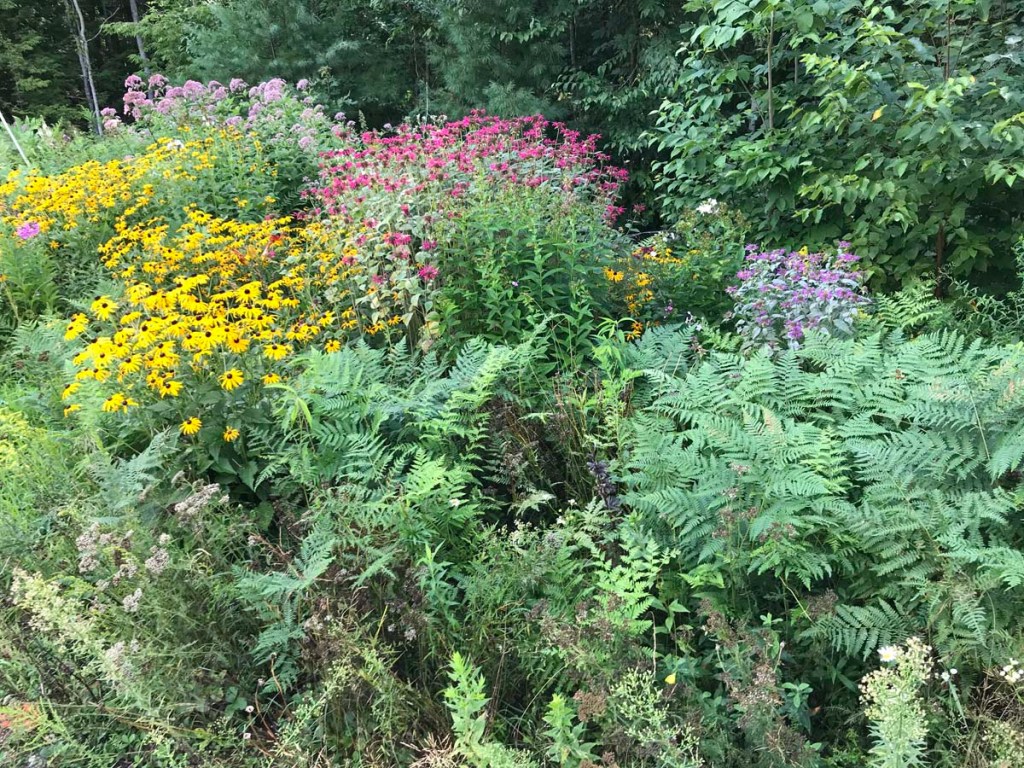
Now, a bit over 10 years later, her dream of a glorious garden is being realized. A progression of flowers, early spring to late autumn has responded to near constant care: weeding, watering, thinning, dividing, moving about, and so on.
The collateral effects of the garden include apart from, of course, the pure beauty, a refugium from an otherwise pretty crappy world, a whole bunch of pollinating insects and ruby throated hummingbirds. Butterflies, bees of all sorts, and the hummingbirds dip and zoom around the flowers finding pollen and nectar among the echinacea, lavender, bee balm, Joe Pye weed … and St John’s Worts and evening primrose and lupins … the list just goes on! Caterpillars such as those of the glorious monarch butterfly find a good home here in all the untouched milkweed.
Pollinator’s delight in Patty’s ggarden!
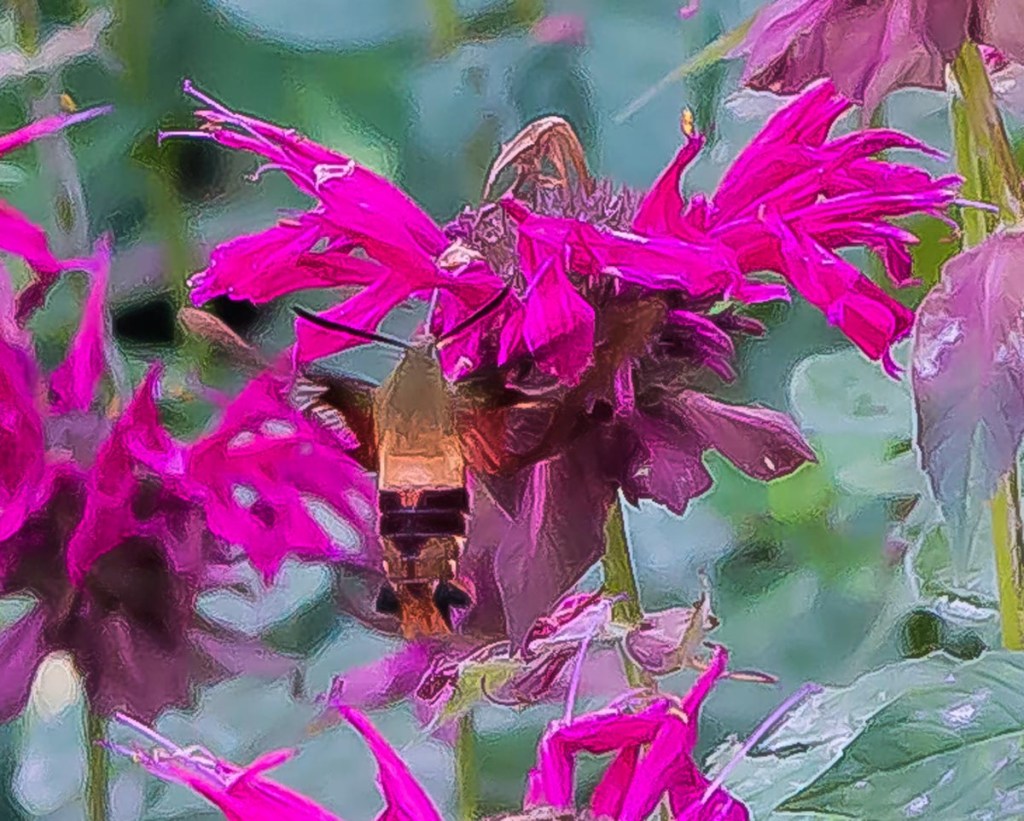
Among the most interesting of the insect visitors to garden has been the Hummingbird Clearwing moth, Hemaris thysbe.
The Hummingbird Clearwing, a sphinx, or hawkmoth, is active on warm, sunny summer days. It is maybe a quarter the size (wingspan 1.5 – 2 “) of a ruby throated hummingbird, but its super rapidly beating wings give the same humming sound as the bird as it dashes from flower to flower, never alighting for more than the briefest of moments. Like the hummingbird, the clearwing hawkmoth can hover over prospective nectar sources. I have read that wings of the clearwing beat at 85 beats per second, while those of the hummingbird barely chug along at a mere 50 bps. Of course, its ability to hover enables to clearwing to suck nectar from flowers through it long proboscis — a superb example of coevolution. Hovering also makes sense for this heavy insect because delicate flowers do not provide feeding ledges for their pollinators — a serious revolutionary oversight! Moreover, remaining airborne gives the insect a head start should it need to escape a hungry predator. Males hawkmoths have a flared tail, again like the hummingbird, and their long straw-like proboscis unfurls to reach the nectar deep within flowers.
Hummingbird clearwing moth drawing nectar from monarda flowers
Despite the wide range of lowers and flower colors in Patty’s garden, we have only seen the clearwing on the red monarda. It apparently doesn’t even visit the nearby purple monarda. In fact, this clearwing is known to show preference for red and purple flowers.
Four species of hummingbird moths occur in North America. Hemaris thysbe is most abundant in eastern North America, but it ranges widely in North America.
Caterpillars of the clearwing hawkmoth feed on cherry trees, European cranberry bush, hawthorns, honeysuckle, and snowberry. The insect overwinters in the soil as brown, hard-shelled pupae. In the late spring, it emerges as an adult moth.
A lot of plants having yellow flowers bloom late in June in what some would call their lawn. We don’t do anything to encourage a grassy expanse of lawn, so what we get is probably anathema to most home owners.
Well, one price they pay for that lush green-ness is that they don’t get to see much of a variety of wildflowers. Woe betide the not-grass that appears in the ‘well-manicured’ lawn.
OK, sermon ended.
Currently four species of hawkweed, at least two species of cinquefoil and a small St John’s wort are blooming in great profusion around town. All have yellow flowers. But, so do goldenrod, evening primroses and larger St. John’s wort, whose plants are up but not yet flowering. We have passed from the spring, when white and green flowers were effective in attracting wild bees and other insect pollinators maybe more by odor than plant color? But, now we are full on bee time and yellow is the dominant flower color of the day.
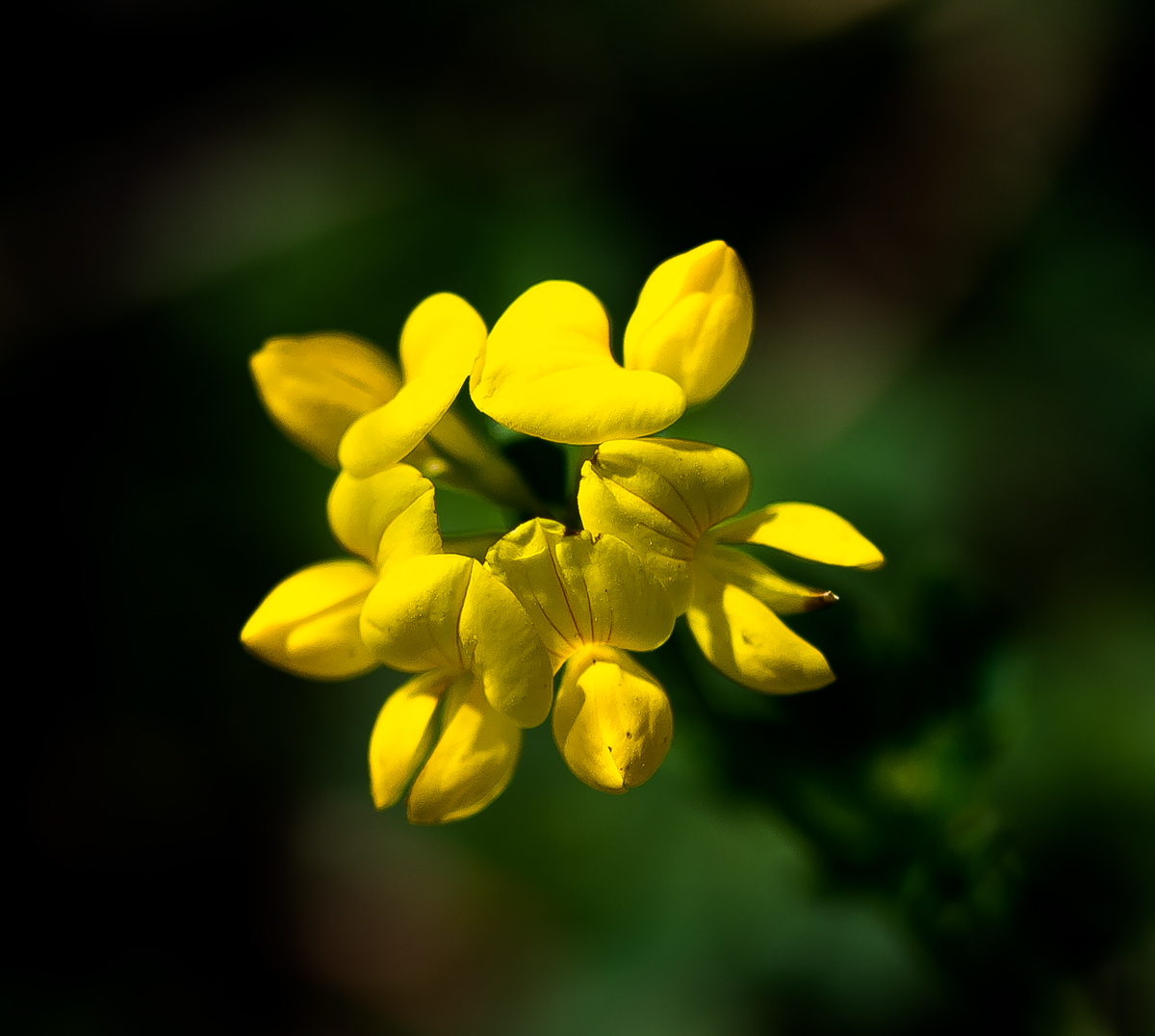
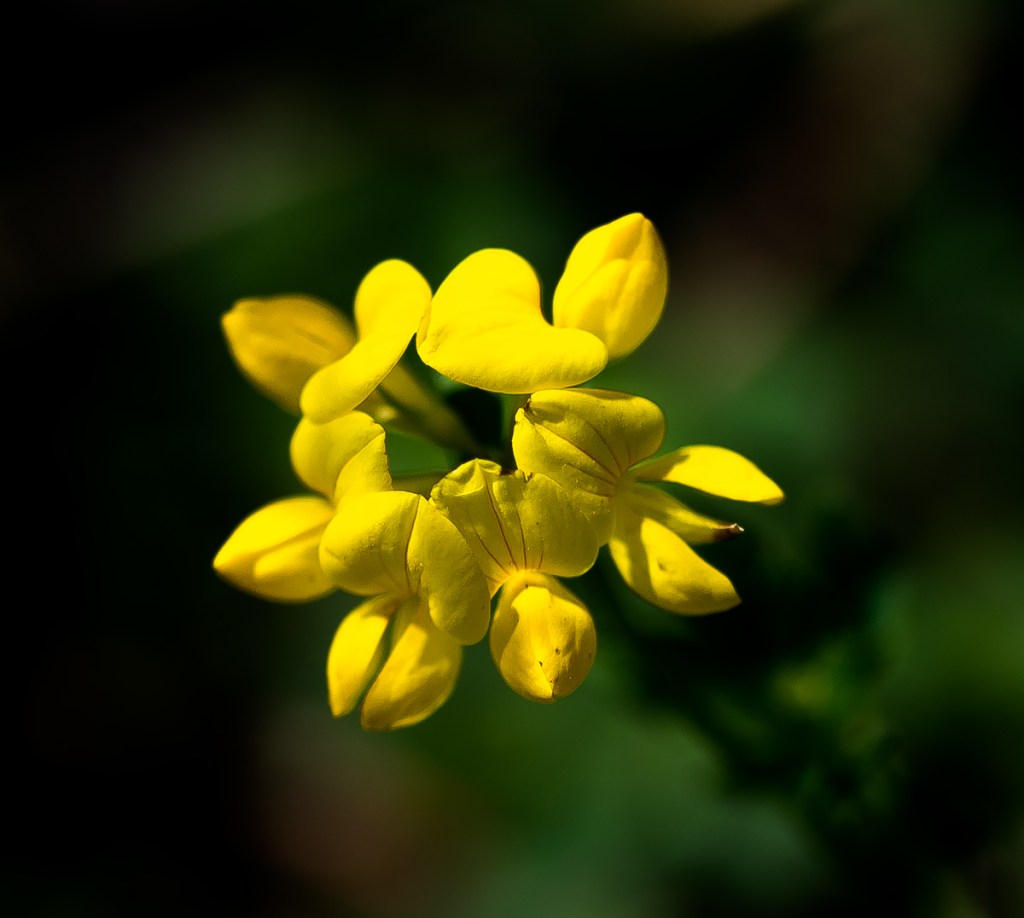
Scouting around our ‘garden’ a few days ago I noticed scattered plants of bird’s-foot-trefoil . I had not previously seen this species in Deering. It’s common enough. Certainly I have overlooked it.
Bird’s-foot-trefoil , Lotus corniculatus, is a member of the pea family. It’s low, sprawling herbaceous plants have 3 clover like leaflets (actually 5, with 2 opposite leaflets at the base of the ‘trefoil’ or triple leaflets. This is the only legume with 5 leaflets). The plants can stand up to 2 ft tall and flowering branches terminate in a head, or floret, of pea-like yellow flowers. The fruit is a pod about one inch long. One brown to purple seed pod is produced per flower situated at right angles to the flower stalk and thus the 5-6 splayed pods resemble a bird’s foot.
Bird’s-foot-trefoil is a perennial, native to Eurasia but now widely distributed in North America after having been introduced around 1900. It is a “long-day “plant, requiring sixteen hours of sunlight to flower, just right now for the end of June. In some parts of North America and Australia the plant is considered a bothersome invasive while elsewhere it is planted for erosion control, because of its deep tap root, and as a forage legume on poor soil because of its nodulated roots that fix nitrogen. Several cultivars are available for agricultural use.
Flowers of bird’s-foot-trefoil flowers occur in florets of 4-8. Each floret is bisexual, thus can self pollinate although the plant has a self-incompatibility mechanism that prevents self-seeding. Most pollination is effected between plants by insects. Pollen in the plant matures before the flower opens. Filaments push the loose pollen forward into the closed tip of the united lower petals (keel), and pollination occurs when an insect’s weight on the keel forces a ribbon-like mass of pollen from the keel opening, some of it adhering to the insect’s underside. Further pressure as the insect seeks the nectaries causes the female stigma to slide into the same contact area, where it’s stickiness may pick up pollen from another plant that got stuck onto the insect. Like some other legumes, the bird’s-foot-trefoil produces highly nutritious pollen.
Honey bees and, especially, bumble bees are the principle pollinators of bird’s- foot-trefoil. Some bees became highly specialized on these plants; in fact, the decline of several bumble bee species has been linked to the reduced availability of clover, bird’s-foot-trefoil and other legumes. In Scotland, three of the scarcest bee species are believed to be completely dependent on bird’s-foot-trefoil’s pollen; the pine-wood mason bee, the mountain mason bee (Osmia inermis) and the wall mason bee (Osmia parietina).
But more importantly for the aspect of ecosystem services, the bird’s-foot-trefoil is a larval food plant for several butterflies and moths and a valuable nectar source for many other insects.
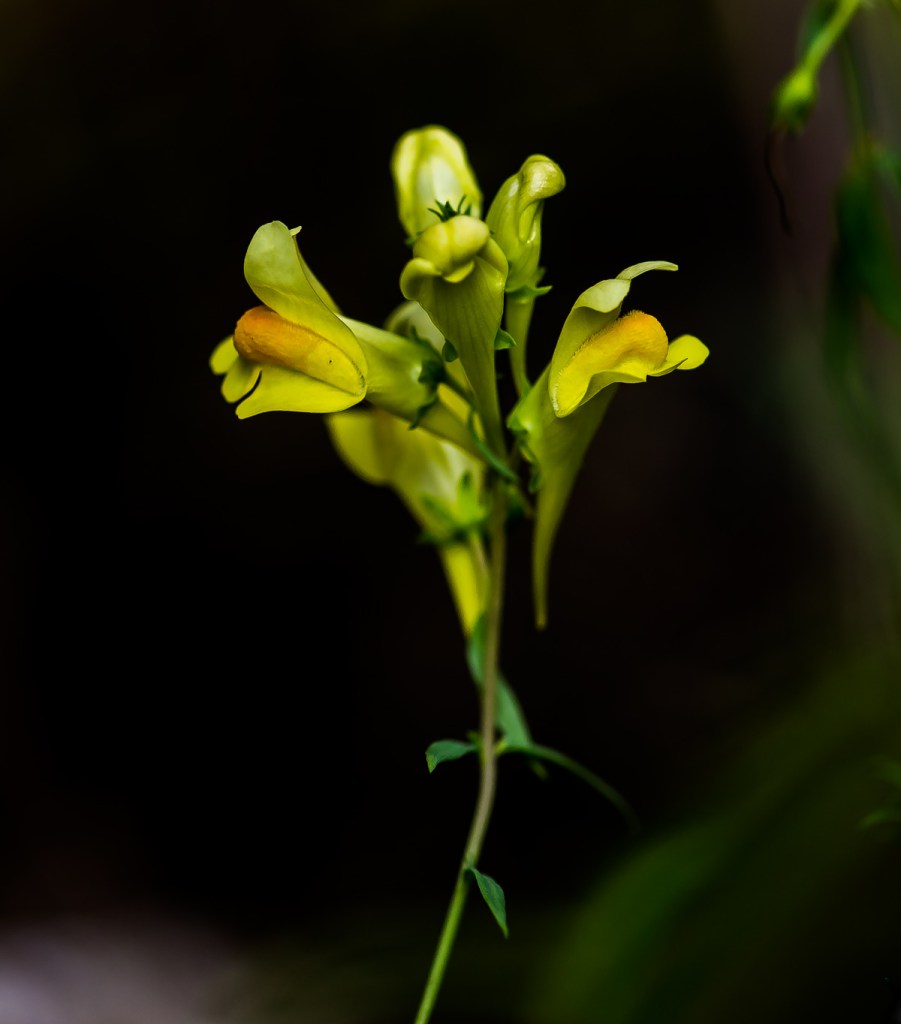
Bird’s-foot-trefoil can be confused with another yellow-flowered herb, butter-and-eggs, Linariavulgaris Butter-and-eggs, or common toadflax, occupies much the same habitat as bird’s-foot-trefoil but flowers much later in the season. Butter-and-eggs can be problematic because through its vigorous growth it can out-compete other pasture natives and form dense mats that prevent the establishment of desired species. The plant is mildly toxic to livestock.
Butter-and-eggs
Butter-and-eggs
(In writing this post I relied heavily on The Book of Field and Roadside. Open-Country Weeds, Trees, and Wildflowers of Eastern North America by John Eastman. 2003. Stackpole books. It is one of three similar books by the same author. I am not sure that they are still in print. I found mine on E Bay).
Native bees take advantage of pollen produced by Pussy Willow soon after snow disappears in this New Hampshire town.
This past winter’s snow is all but gone now. Just a few resistant, dirty lumps of the stuff persist in very deeply shaded spots here on Hedgehog Mountain.
Can’t say I miss it. The winter seemed long and very very dark to me. Nope. Don’t miss the snow and cold at all!
I’ve been thinking about looking for early wildflowers. We have not yet found skunk cabbage here in Deering. It should be the earliest of the spring wildflowers. Skunk cabbage does occur a few miles down the road in Francestown. Why not Deering?
Last weekend I was out with friends Mike, Kay & Stephen, and Staci & Andrew placing bird boxes on the Gregg Hill lot.
The Gregg Hill Lot, and Greg Hill, is located in the center of ‘downtown’ Deering. This 14 acre lot is the home site of some of Deering’s earliest settlers who arrived late in the 18th Century. The Gregg Family built its home atop a 1,300 ft hill, one of the highest spots in town. That hill is now known as Gregg Hill. A succession of owners occupied the Gregg Hill Lot, which is just below the summit of Gregg Hill, and for several years — 1924 to about 1960 — one of New Hampshire’s earliest skiing rope tows was located on this steep slope.
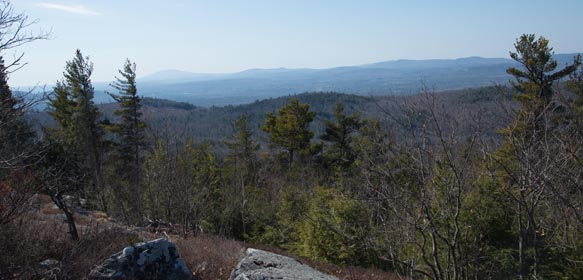
Currently the Gregg Hill lot is owned by the Town of Deering, and the town Conservation Commission is in the process of developing pollinator gardens there, while donating a conservation easement to the Piscataquog Land Conservancy. The ultimate aim is for a trail to lead from Deering Center Road, through the meadow and pollinator gardens, to a spectacular view at the summit.
Gregg Hill lot from Deering Town Hall
View from the top of the Gregg HIll lot over Deering Town Hall and Deering Lake. Rose Mountain is in the distance, center.
While we were putting out the bird boxes on Gregg Hill, we noticed that the willows at the bottom of the slope, are Pussy Willows. And now they are flowering! A first Spring (wild) flower!
Pussy Willow — Salix discolor — is a North American native plant. Native Pussy Willow has a wide northern distribution and there are many horticultural varieties of this popular species.
Mike reminded us that Pussy Willow is dioecious: individual plants are unisexual, female or male. Indeed, we found both on the site. The flowers are botanically known as ‘catkins.’ The male catkins are at first enclosed in downy silver hairs. and so might be what one usually think of when one thinks of Pussy Willow. Male catkins are showier than the female. The yellow stamens develop from within the silvery down and produce prodigious amounts of pollen. The female catkins have many carpels with yellow styles that are divided at the tips. Both sexes have nectar glands to attract pollinators.
Various insects are attracted to Pussy Willow flowers. These include, among others, flies, beetles, wasps and bees. Native bees are important pollinators of these early flowers. We observed several native bees, maybe Mining Bees, working the male and female catkins.
In addition to Pussy Willow being a super candidates for pollinator gardens, its leaves provide a banquet for several butterfly caterpillars.
Pussy willow plants
Young male catkins with a silver down.
Young female catkins
Bee on a female catkin.
Bee on a female catkin.
Bee on a male catkin. Stamens just emerging from the silvery down.



















 DEERING'S NATURAL HISTORY