Except for when the ground is covered with snow, partridgeberry (Michella repens) is a conspicuous element of the forest floor. Its little leaves, each about the size of a dime, remain green all year. Other species such as trailing arbutus and wintergreen occupy the same mesic or wet habitat, but leaves of partridgeberry are easily recognized by the white line that runs down the middle of each glossy leaf.
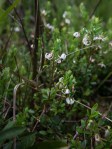
Partridgeberry flowers now, late in spring/early in summer. As I write this flowers are abundant in some forested sites in Deering. The plants form a carpet within which there are many little white flowers. The display is really very charming.
Flowers of partridgberry are paired, joined at the base and opening widely to 4 petals above a cylindrical corolla. The buds are pale pink but the open flowers are mostly white with only a little pink remaining in the corolla. The insides of the petals bear numerous very fine hairs. The flowers are pollinated by bumblebees. The bases of the flowers fuse. Nominally each flower produces 4 seeds, but because the ovaries are fused, each fruit is vaguely 2-lobed and contains 8 seeds. Pollen from different plants is required for fertilization
Partridgeberry is widespread throughout eastern USA and Canada as far west as the Mississippi River and even into Texas. It mostly occurs on dry-ish sites but can also be found in wet sites. The red berries are edible but really don’t have any flavor. Ruffed grouse, bobwhite quail, wild turkey, skunks, and white-footed mice consume partridge berries, but even with that partridgeberries can be found almost all year round.
Partridgeberry is distinctive throughout the year because of the evergreen leaves, each with a white line.
Partridgebrry bud fused at the base.
Note the cylindrical corolla and the fine hairs inside the petals.
The partridgeberry fruit has two lobes. Note that the leaves arise at right angles to each other.
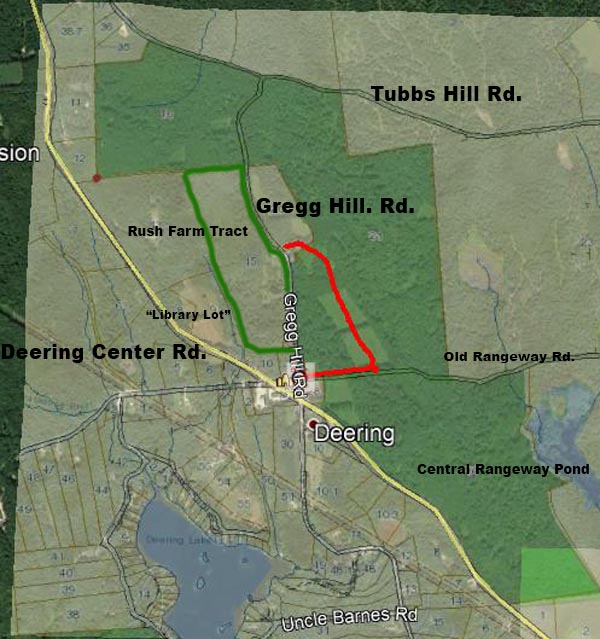
The Tom Rush Forest, in central Deering, was formed in 2002 when the popular singer Tom Rush sold several lots to the Society for the Protection of New Hampshire Forests. Tom Rush Forest is the largest conservation easement in Deering, comprising 300 acres of forest and meadows. Abutting the Rush Forest the SPNHF holds the conservation easement on 40 forested acres that are privately owned and called the Rush Farm Tract. Abutting the Rush Farm Tract, on the Deering Center Road, is the ‘Gregg Hill Lot,’ also known as ‘the library lot.’ This town-owned lot is, in part, the steep meadow that can be seen from Deering Center Road, to the left of the Carew House and essentially opposite the town garage. There are many possibilities for recreation, walking and winter sports. in the Tom Rush Forest and land that surrounds it.
Early in the 19th Century several families lived around what is now the Tom Rush Forest, on Gregg Hill Road, Tubbs Hill Road, and Old Rangeway Road and today’s forest was all meadow – – known in part as ‘East Meadow,’ and ‘Berry field.’ Large meadows inside the Tom Rush Forest have been maintained along the east side of Gregg Hill Road, and those meadows feature in a walk (shown in red on the map) of about 1/2 mile from the Town Common, on Deering Center Rd, to the Lachance residence at the top Gregg Hill Road. We call that walk the Tom Rush Meadow Walk.
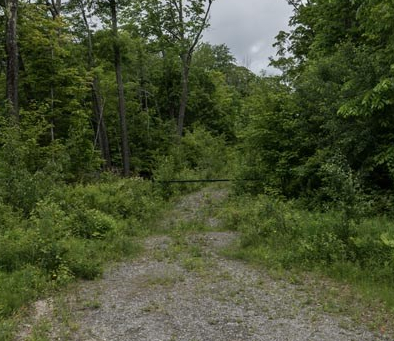
Gate across Old Rangeway Rd at Gregg Hill Road, near the Town Common
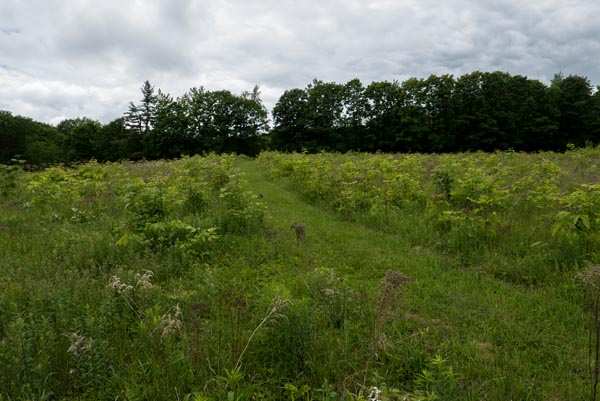
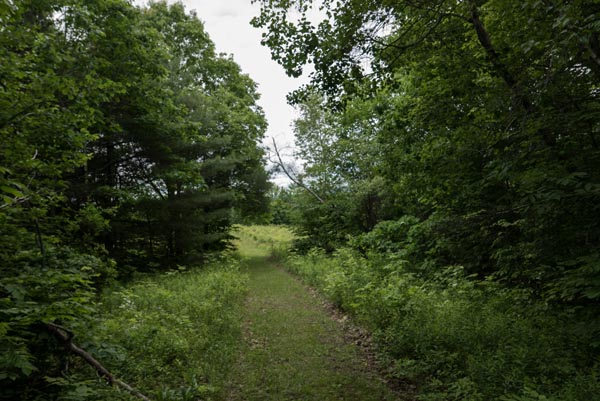
Beginning at the gate across Old Rangeway Road, near the Town Common and the Deering, follow Old Rangeway Road uphill for a little less than 1/4 mile. From the top of the hill the trail leads left and immediately enters the first meadow. The way through the meadows is mown irregularly to make a more or less clear path for about 1/4 mile to return to Gregg Hill Rd. The last third of the walk passes through open forest.
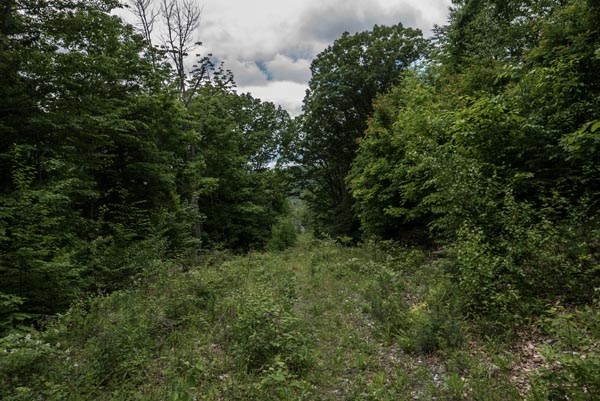
The slope from the gate at Gregg Hill Road to the top of the hill is moderately steep and follows along a rutted dirt road. From the top of the hill the path through the meadows back to Gregg Hill Road is level easily traversed – – even with a perambulator. There are no vistas from the meadows.
Lookiing down Old Rangeway Road toward Deering CenterMown path through a meadow in the Tom Rush ForestPath through open forest.Entrance to the Tom Rush Meadow path from a private residence at the top of Gregg Hill Road.
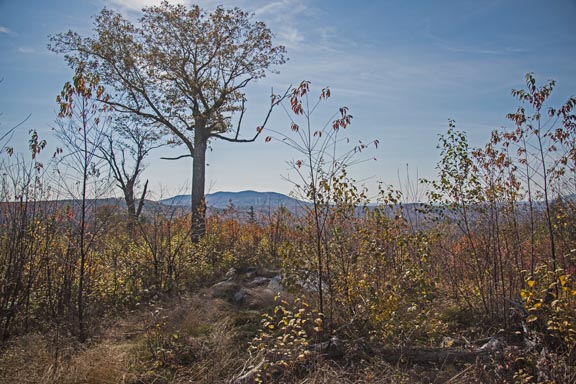
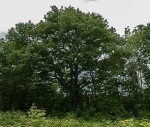
The meadows harbor a nice diversity of flowers. When I walked it in early June a stunningly blue introduced Veronica, V. austriaca saw-leaved speed-well, was in bloom. There were a lot of blackberries and dewberry, a close relative of blackberry that scrambles along the ground. Dewberry fruits before blackberry. Its fruit look like fruit of blackberry and can be just as sweet. The dewberry plant is thorny/hairy, so the biggest challenge might to be in collecting the fruit without getting scratched. There were also pale violet fleabanes forming large colonies in the grass. Milkweed plants were conspicuous and I saw a monarch butterfly, which feeds exclusively on milkweed. I was very happy to see a lot of ash seedlings but not so happy to see a large colony of the invasive black swallow-wort (Cynanchium louisiae). I am sure there will be a succession of flowers through the season. At the edge of one of the meadows there is an impressive wonderfully branched red oak tree.
Black swallow-wort, an invasive plant that crowds out other vegetation.
blackberries with Veronica austriaca
Dewberries scrambling over the ground.
Fleabane with pale violet flowers.
Orange hawkweed, HIeracium aurantiacum, in the middle of the path.
Veronica austriaca, an introduced speed-well
An old, much branched oak at the edge of a meadow in the Tom Rush Forest
Parking on Class VI Gregg HIll Road beyond the private residence
It is possible to park at the top of Gregg Hill Road but please remember that there is a private residence there. The owner has requested that people not park in the bays. Gregg Hill Road is a Class VI road and there is room to park on the side of the road beyond the residence. Please do not block Gregg Hill Road.
The Tom Rush Meadow Walk would make for a good trail for families. It is short, only 1/2 mile each direction, and you could post a car at each end. The trail is easy to follow; it is open and there is a diversity of things to see. With some effort you could push a perambulator along. It would be fun for winter’s snowshoeing or cross country skiing at least at the level top through the meadows.
Which Invasive Upland Plant Species occur in our town?
There are easily 5 or 6 plant species which have escaped managed landscape environments and are becoming a nuisance in both the natural and urban environments of Antrim. The invading plants are Japanese Barberry, Oriental Bittersweet, Autumn Olive, Japanese Knotweed, Glossy and Common Buckthorn and Burning Bush. Once you know what to look for you will see just how common and widespread they are.
It is the same story here in Deering.
How to find out more about New Hampshire’s Invasive Upland Plant Species?
Save the Date because on April 4, 2018, Douglas Cygan, Invasive Species Coordinator from the NH Department of Agriculture will provide a presentation at 7pm at Antrim Town Hall. His presentation will take an in-depth look at upland invasive plant species in NH. Attendees will learn about the various issues invasive species present to natural and managed environments, NH rules and regulations regarding invasive species, identifying features and characteristics of invasive species and best management control measures of some of the most aggressive non-native plants in the Granite State. This presentation is co-sponsored by the Antrim Parks and Recreation Commission, the Antrim Grange and the Antrim Conservation Commission.
Most plants produce their own food by taking carbon dioxide from the air and transforming it, via chlorophyll and photosynthesis, into sugar. Some plants lack chlorophyll and the ability to produce their own food. They need to get nourishment from somewhere, so they parasitize other organisms, including plants and fungi. They form specialized structures that enter the roots of their plant hosts and steal nutrients. Still other plants have both a parasitic and a photosynthetic ability. They have chlorophyll and can make some food, but they still need to get nutrients from other plants. These plants are called ‘hemiparasities.’
Two native plants that are common in Deering are members of a whole family of plants that are parasites on roots of trees: narrow-leaved cow-wheat and beech-drops.
Cow-wheat plant
Cow-wheat flowers
Cow-wheat flower. Long-tongued bees pollinate the tubular flowers
Melampyrum lineare, also known as narrow-leaved cow-wheat, is a hemiparasite because it has chlorophyll, but still it enters their roots and parasitizes several species of pine, poplar, sugar maple, red oak and low-bush blueberry. This small, native, woodland annual has flowers that resemble a snakes head. The small yellow flowers are more or less tubular and are pollinated by long-tongued bees. Cow-wheat is found in man-made or disturbed habitats, cliffs, balds, or ledges, forests, grassland, meadows and fields, sand plains and barrens, woodlands. In Deering I have found it growing in an exposed spot along the Hedgehog Ridge Trail and in meadow along the trail through the Wilkins-Campbell Forest. Certainly it grows elsewhere in town. Our cow-wheat is native to North America. The plant occurs in most of the eastern states as far west as Illinois and Wisconsin, south to Georgia, and across Canada; it also is found in Montana, Idaho and Washington. The name Melampyrum (dark seed) refers to the black seed that is produced by some species and this seed can sometimes get into harvested grain, thus ‘cow-wheat.’ An European species of cow-wheat, M. pratense, also parasitizes roots of pine trees. One study found that these cow-wheat plants were much healthier when parasitizing trees that had associations with some fungi (mushroom species) through their roots than when parasitizing trees that lacked these ‘mycorrhizal’ associations. The conclusion was that the mycorrhizal fungus enables the tree to produce more nutrients than the unassociated trees, and these nutrients are transported to the parasitic cow-wheat plant.
Beech-drops plants under beech tree
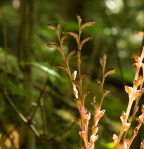
Beech-drops flowers
Beech-drops flowers, unopened cleistogamous flowers are below the open flowers
Epifagus virginiana, beech-drops, a relative of cow-wheat, is an annual herb that depends on getting its nourishment from the roots of beech trees. Thus it is a host-specific parasite. In Deering you can find beech-drops everywhere beech trees are found. It appears as leafless (the leaves are reduced to scales), brown plants growing up from around beech trees. Plants of beech-drops occur singly or in clusters and are often densely disposed around the tree; typically 8 – 12” tall, they can get as tall as 18”. Flowering occurs late in the year, August through October. Flowers are small and trumpet-shaped, striped in red and purple. They arise singly along the stalk. Toward the base of the stalk there are flowers that do not open. These ‘cleistogamous’ (hidden gametes) flowers are capable of self-pollination. At the end of the season the whole plant becomes brown and brittle. One study found that the plant is pollinated by various insects but the most common species observed in that study was Prenolepis imparis, winter ant. The winter ant avoids competition with other ants by only becoming active when temperatures fall and other ants are less active …. and beech-drops is flowering.
Approximate entry to Pinnacle Trail from the upper end
Entry to Pinnacle Trail at the upper end
Entry to Pinnacle Trail a Glen Rd.
Pinnacle Trail early autumn
Pinnacle trail near picnic area and overlook, September
Pinnacle trail, March
Canada mayflower in fruit in September
Pinnacle Trail, March
Picnic table in the Margaret Wood Memorial, Pinnacle Trail
Common rock polypody fern in September
Pinnacle Trail, Moose eating tree.
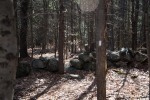
Rock wall on the Pinnacle Trail
Ledge view loop on Pinnacle Trail. This loop is not blazed.
A young fly agaric, Amanita muscaria. Don’t even think of eating this one!
View to the northeast from the Pinnacle Trail in March
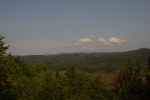
View to the north over Dudley Brook from the Pinnacle trail in September
View to the north over Dudley from the Pinnacle Trail in March
The Margaret Wood Memorial is a 20 acre conservation easement in East Deering, at the top of Peter Wood Hill Rd. The land is privately owned but the conservation easement on the Margaret Wood Memorial has been held by the Society for the Protection of New Hampshire Forests since 1970.
Margaret Wood was the wife of Peter Wood. In 1917 the Woods purchased a large farm on what is now Peter Wood Hill where they raised cattle and grew potatoes. Part of this farm is now the Margaret Wood Memorial.
Margaret Wood was a founding member of the Deering Community Club. The members of Deering Community Club were originally all women. Among other good deeds, the women of the Club were responsible for arranging running water in Deering Town Hall in the mid 1920’s. Many men in town contributed their labor to this project. The men impressed the ladies of the Deering Community Club so much that in 1927 men were admitted to membership in the club. Soon thereafter town hall was extended to what we know today.
Margaret and Peter Wood were grandparents of several generations of current and former Deering Residents including Tom Coppadis, the owner of the land on which the Margaret Wood Memorial is found.
How to get there: Please contact me if you would like to download the Pinnacle Trail map. From the Hillsborough end of Deering Center Rd. (NH Rt 149) turn on to Clement Hill Rd. Follow Clement Hill until it turns sharply right (about 1.5 mi). North Rd continues straight at this point. Follow North Rd to a T at Pond Rd (about 1 1/4 mi). North Rd continues to the right. Follow North Rd, turning sharply left at Clement Hill Rd to become Peter Wood Hill (approx. 1 1/4 mi). Continue a short distance to a small parking area on the left (approx. 300 yds). The trail head is about 20 yds downhill from the parking, on the left. From points to the east pass through Weare on NH rt. 149 to Cross Rd., at the Wilds. Follow Cross Rd to a T at E. Deering Rd. (about 3/4 mi). Turn Right on East Deering Rd. and follow, turning sharply left at Gove Rd. (about 3/4 mi) and following to a T (approx. 1 mi) at Peter Wood Hill Rd. Turn left on Peter Wood Hill Rd and continue approx. 0.6 mi, passing Glen Rd. on the left and where the road becomes dirt, to the parking area on the right at the crest of the hill.
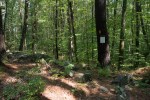
The Pinnacle trail is a loop that begins and ends on Peter Wood Hill. The lower end is opposite the point where Glen Rd meets Peter Wood Hill and the upper part is about 500 ft further uphill. There is a pull off large enough for 1 or 2 vehicles at the upper end, where Peter Wood Hill turns left. The entrance to the trail is slightly downhill on Peter Wood Hill from that point and is marked by a sign.
What’s the trail like? The Pinnacle Trail loop is about 1 mile in length. The trail is reasonably well marked with white blazes on trees (but the blazes could use renewal as I write this in 2017). The trail has been well trodden over the years and is easy to follow. The trail is even underfoot, so walking is easy. For the most part the trail is level with little gain or loss in elevation however at the Glen Rd end there is a slightly steepish slope over maybe 50 yards. An option to returning to parking from Glen Rd is simply to walk through the woods, parallel to the road. Near the midpoint and the picnic table there is a side trail to ledge with an overlook however I did not see blazes on this overlook trail. Nonetheless, it would not be possible to miss the overlook or to become lost as the loop is very short and the edge of the ledge with overlook obvious. A log bench has been placed at a view-worthy spot near the picnic area, and vegetation has been kept at bay to allow for the view.
What’s the payoff? The forest in the Margaret Wood Memorial is a mixture of pine, oak and maple. The forest is very open, with little undergrowth. This makes the Pinnacle Trail a pleasant ramble through non-threatening woods. The two views are to the north and northeast, and this includes a good view of Dudley Brook and the hills beyond Henniker. There is a rustic picnic table at the highest point in the Memorial providing a great place for picnicking while taking in the views. The open forest gives lots of room for kids to run around. In early days Peter Wood Hill was known for winter sports. Today the Pinnacle Trail is a good place for snowshoeing or cross country skiing.
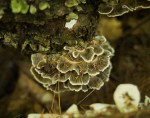
Trametes versicolor, turkey tail fungus on a rotting log
Bridge over Smith Brook
Amanita virosa, death angel
Please contact me if you would like a downloadable map of Smith Brook Trail to.
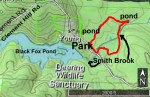
To Get There. The Audubon Preserve is located in Deering on Clement Hill Rd. From Deering Center Rd (NH Rt. 149) follow Clement Hill Rd., turning sharply right where North Rd goes straight (approx. 1.5 mi) and past the first marked parking area, on the right, then downhill past two private homes and down a steep dirt road to the bottom of the hill (approx. 09 mi), opposite Tree Frog Pond on the left. There is parking area on the right. You can reach Black Fox Pond from this parking area.
Smith Brook drains Black Fox Pond to the Piscatquog River through Dudley Brook. Pick up Smith Brook Trail directly opposite the parking area, across Clement Hill Rd. The trail is marked with yellow blazes and the entire loop is a little over 1 mile. The trail passes through a mixture of forest types, pine at first and the mixed hardwood. The trail is level, with no gain or loss in elevation, and smooth with the exception of one short stretch that crosses the drainage of a small pond. It is an easy trail.
The first part of Smith Brook Trail, the western edge, follows Tree Frog Pond. This is a nesting site for wood ducks and wood duck nesting boxes have been placed on the pond. Great blue heron also nest on the pond. Both of these species are sensitive to noise, so if you want to see them you should go quietly. On June nights you will hear the tree frogs singing. Some interesting plants along the trail are the orchids slender ladies’ tresses (Spiranthes lacera) and checkered rattlesnake plantain (Goodyeara pubescens), and pipsissewa (Chimaphila umbellata) and a Pyrola species for which I have not yet seen flowers. The Spiranthes and Pyrola should flower in July or August. In September 2017 I found a beautiful, but deadly destroying angel mushroom (Amanita virosa) at the bridge across Smith Brook.
The trail follows along Smith Brook to a bridge and then follows the brook back past a beaver marsh, returning to Clement Hill Rd at Smith Brook, where you turn right along the road for about ¼ mile to return to the parking area.
You probably know that plants are green because of chlorophyll in their leaves. It’s the chlorophyll that enables plants to convert carbon dioxide into food using the light of the sun. A conceptually wonderful, simple plan that keeps our crops growing and evergreens ever green. It all works pretty well until one foolish species – Homo sapiens aka you and me – starts dumping more carbon dioxide into the atmosphere than the plants on Earth, including all those little ones in the ocean, can cope with. Then there is overload and the unabsorbed carbon dioxide forms a sheath around the planet, and that really messes with the climate.
But, that’s another story….
Green plants are autotrophs, which means that they produce their own food.
Some plants are not green. They’re called heterotrophs. They are bona fide plants, it’s just that they cannot produce their own food because they lack chlorophyll. So, how do they cope with this whole nutrient gathering thing?
Epifagus virginiana, beech drops or boom-rape parasitizes beech roots
Some of them parasitize the roots green plants. A common example in Deering is beech-drops, Epifagus virginiana¸ which parasitizes roots of beech trees. The Epifagus draws its nutrients directly from the roots of the beech. There are other less conspicuous examples of such plants in Deering.
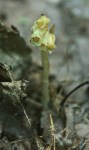
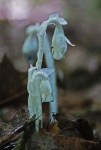
Other heterotrophs get their nourishment indirectly from green plants through the intermediary of a fungus. These plants are mycoheterotrophs (myco = fungus). Monotropa uniflora, known as Indian pipe or ghost flower and Hypopitys monotropa, pinesap, are two mycoheterotrophs found in Deering. They parasitize mushrooms that have beneficial connections to trees. Appearances notwithstanding, both Monotropa and Hypopitys are related to blueberries.
Monotropa uniflora, Indian pipe or ghost plant
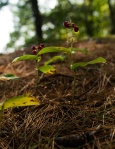
Hypopitys monotropa, pinesap
Some plants, such as orchids, produce chlorophyll — so they can photosynthesize — but they also depend at least in part on being associated somehow, as parasites or some sort of mutualistic relationship, with mushrooms and mushroom relatives. But, that is also another story.
Both Indian pipe and pinesap grow in dark, rich forests. Indian pipe is far more common in Deering than pinesap. Both are parasitic on mushrooms but to appreciate this, you have to understand a little of mushroom biology.
Mushroom biology 101. The mushroom you see is only one part of the body of the mushroom. The mushroom you see is the result of sexual reproduction and is thus the part of the mushroom that holds the spores (which are roughly equivalent to seeds, but only roughly). You will never see most of the ‘mushroom’ because the real body of a mushroom consists of fine filaments that grow through the earth or decaying wood and other plant material. This part of the mushroom, the fine filaments, is called the mycelium. The mycelium of many mushrooms form associations with the roots of trees. These associations are called mycorrhizae (myco = fungus and rhiza = root). The mycorrhizae are essential for tree growth because the fungus, as it scavenges in the litter, brings carbon nourishment to the tree. The tree sends beneficial goodies back to the fungus. So, it’s a mutually beneficial relationship for the two partners. Mycoheterotrophs, the Monotropa and Hypopitys, are interlopers that take and give nothing in return!
Monotropa uniflora is known as Indian pipe because initially the single white flower sits atop a white stalk opens downwardly, thus giving the plant the appearance of being a pipe. This plant is also are known as ghost flowers – or even corpse flowers – because of their translucent white color. One could well imagine the white stalks springing from some unspeakably horrible ‘thing’ in the earth.
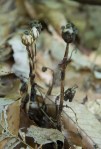
Flowering of Indian pipe begins in spring and continues into the autumn. As the season progresses, the single nodding flower gradually turns upright. Pollination is effected by bees. Gradually the leaves turn black and eventually the whole plant becomes brown and dry. The old plants are common. Seeds produced in the capsule are wind dispersed when the capsule cracks.
Monotropa uniflora flower
Monotropa uniflora, seed capsule now upright
Monotropa uniflora, seed capsule and leaves turning black and stamens
Monotropa uniflora, older plant turning black
Monotropa uniflora, dead plants
Hypopitys monotropa in fruit
The genus Monotropa differs from Hypopitys most conspicuously in the number of flowers produced by each plant, one in Monotropa and several in Hypopitys.
These mycoheterotrophs and partial mycoheterotrophic plants such as orchids, pinesap and Indian pipe, all produce very very small seeds, called ‘dust’ seeds. They are so small that, unlike larger seeds, have no or very little to provide the germling. After they are dispersed the seeds may lie in the environment for several years. During that time they may germinate, but germination rates are very low for these tiny seeds. While those that do germinate are developing they require a relationship with fungi to bring the germlings carbon nourishment. At first many fungi that live in the soil may be involved in this process, but over time there is more or less specialization with particular fungi. Thus Monotropa parasitizes members of the mushroom Russulaceae (Russula and Lactarius) while Hypopitys parasitizes members of the mushroom family Tricholomataceae. These mushrooms are all common fungi in Deering’s forests.
There is so much in the environment that we do not see. Amazing how life proceeds without our direct involvement. These processes are essential to cycling life. When we disturb some aspect of the environment, even a little, inconspicuous bit of it, we are messing with the cycle of life. The outcome is rarely good.
Take Routes 9 and 202 to Hillsboro Center/Route 149 exit and drive into Hillsboro. At the light in the center of town, turn south on to Route 149. Drive one mile; then turn left onto Clement Hill Road. After approximately 1.5 mile; Clement Hill Road makes a right turn. The year round parking area is 0.4 mile on the right. Further down Clement Hill Rd, at the bottom of a steepish hill, there is another parking area. Please note that winter and spring road conditions can make travel difficult on the last section of Clement Hill Road a challenge.
The Audubon Society of New Hampshire has preserved nearly 700 acres of land in this part of Deering. You can read about the history of these lands by following this link http://www.nhaudubon.org/deering-wildlife-sanctuary/.
Three trail loops constitute the Sanctuary’s trail system. Each trail is combined with portions of Clement Hill Road to form the loops. Clement Hill Road has summer maintenance only beyond the Smith Farm and is closed to vehicles from October through April. Dogs on a leash are allowed on the Patten Farm Trail only. You can download a trail map and a trail guide by following these links.
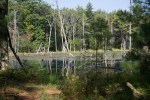
Black Fox pond is my favorite kayaking pond in Deering. Few visit the pond, giving a sense of solitude when on the water. Vegetation grows to the edge of the pond, and on the islands in the pond, enabling the kayaker to get close to flowers. There is a great profusion of flowers on Black Fox pond. These include the insecticolous plants floating bladderwort (Utricularia radiata, flowering July and August) and sundew (Drosera intermedia, flowering mid to late July), gaudy sheep laurel (Kalmia angustifolia, flowering in June) and the orchid Pogonia ophioglossoides (flowering late June, early July). There are also early spring bloomers high bush blueberry, Andromeda and male berry. Near the lower parking area there is a good population of corn lily (Clintonia borealis). Early in spring this plant bears small yellow flowers; the fruit, a deep blue berry, forms over the summer.
For kayaking park at the lower area, opposite Tree Frog Pond. It’s about 150 yards along a level trail from the parking area to the pond. Put in a short distance along the trail to the right when you reach the pond. The trail from the parking area is smooth, covered with pine needles and other leaf litter, thus making dragging a kayak a simple job.
The trail from the upper parking area is on a gentle slope; it’s level and is easy to follow. In spring you can find trillium and, later, lady’s slipper orchids. When the trail reaches the pond the vegetation changes, possibly in response to the low pH of the pond’s water. Blueberries, both high bush and low bush are thickly disposed along the sides of the trail. In June you will see a lot of Lady’s slippers here and, toward the dam, there are trailing arbutus, bunchberry and partridge berry. Unless you want to walk back up, either retracing the trail or continuing out to Clement Hill Rd, you might consider spotting cars at each end of the trail.
I have snowshoed on the pond in January when checking the several wood duck boxes that are located there. It was a cold and windy day, the snow was deep and crusty, and I was inexperienced with snow shoes. An experience I will not soon forget. But … give it a try!
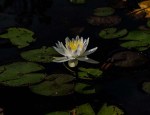
Water lilies are so romantic, aren’t they? The objects of paintings and poems. But, out among them on dreamy p
onds there lurks a seamy side of the pond: bladderworts. Dressed in deceptively pretty yellow flowers these plants spell trouble – for water fleas.
Utricularia radiata,floating bladderword at the Deering – Audubon Wildlife Preserve
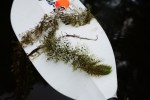
The small black grains are the bladders of Utricularia radiata
Bladderworts, Utricularia species, typically grow in open, acidic water where nutrients and CO2, an essential ingredient for photosynthesis, are in low concentrations. To supplement the low nutrients, the plants eat tiny aquatic animals: they’re carnivores. Bladderworts are the most diverse of the carnivorous plants, and twelve of the about 200 species world-wide are found in New England.
Our bladderworts typically have stalked, yellow, snapdragon-like flowers that are about the size of a quarter. The plants lack roots and are free-floating. One common species here, U., radiata, is distinctive for the radiating arms that sit on the surface of the water, keeping the plant upright. Bladderwort’s long branches extend downward into the water. Leaves form from the immersed stems and are finely dissected and fan-like, increasing their surface area and thus, enhancing the ability to absorb available nutrients.
Bladderworts take their name from the tiny dark – black or dark green — bladders, or utricles, that form from the leaves. Take a bladderwort plant from the water you will see the little bladders looking like tiny grains in the long mass of stems and leaves. The bladders are highly specialized traps. Fine hairs at the opening of the bladders sense passing animals such as water fleas and, when triggered, cause the bladder to suddenly inflate, creating a vacuum and sucking the hapless animals in, closing the door behind them — and all in less than a hundredth of a second. Digestive enzymes similar to papain, which helps break down meat fibers, make it a meal.
Bladderworts flower throughout most of the summer and die back in the fall. Lacking roots, they cannot be expected to survive the winter like other plants, but they develop dense masses, called turions, that include nearly fully formed leaves. These structures sink into muck at the bottom of the pond, and in spring the warming water causes the stem inside the turions to elongate and form a new plant.
Turions are heavy and not easily dispersed. Bladderworts can be dispersed by fragmentation, and U. inflata, native to southeastern states, has become invasive in Rhode Island, thought to have been introduced by humans. The plants do produce seeds. Bee pollinators are attracted by the yellow color of the flowers and nectar that is contained in a spur that projects forward from the flower. The flower is constructed so that bees can enter for the nectar and pollen but they cannot self-fertilize the flower.
A recent scientific study reported that the genome of one bladderwort has the smallest reliably sequenced plant genome. Despite the small size of the genome, it has more genes than well-known plants such as grape that has a much larger genome. Over the 10 to 20 million years that U. gibba has been around there has been considerable gene duplication and deletion. The genes that make up the genome have been pared down to essentially two sorts: those that define U. gibba as a plant, like genes for building cell walls, responding to light and producing flowers, and those that are essential for carnivory.
It is thought that carnivory was originally a defense mechanism to prevent predation by fungi and animals, much like caffeine protects coffee from herbivores. Bladderworts went a step further from prevention to predation. Evolution made of them stripped down killers, creating mayhem among our romantic waterlilies. Water fleas beware!
























 DEERING'S NATURAL HISTORY