Black Swallow wort: a nasty invasive in our zip code!

A bunch of invading plants that no walls can keep out are living in our town of Deering, a small rural community located in south central New Hampshire/the  Monadnock Region,.

We have been successful thanks to a Lake Hosts boat inspection program and an active group of Weed Watchers, in preventing the introduction of highly invasive Variable Milfoil into our lake, and — unlike most towns in our area — Japanese Knotweed is not a conspicuous feature of our roadsides because members of the Conservation Commission  cut the stuff back each year.

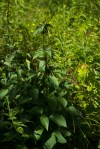
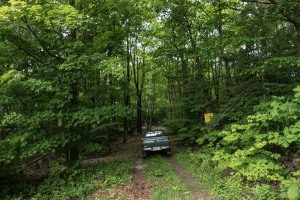
But this year I am noticing a whole lot of black swallow wort in town. This plant — Cynanchium louisiae — is disastrously invasive. It grows thickly on the ground and quickly covers everything, preventing the growth of other plants. Even covering street signs! Like all successful invasive species, black swallow wort has no local  parasites or browsers to limit its development. And, like milkweed, the seed come out of the pods in a fluff that is easily scattered by wind.

There is a dense growth of this invasive in the Tom Rush meadows, but few go up there to see it. Where it is most conspicuous is along roadsides, probably in front of your own home. Lurking in rock walls or around your mail box.

Black swallow wort is a native of Europe that was introduced into the United States, through Massachusetts, in the mid 19th Century. The plant is widely distributed in eastern USA and Canada but is not common west of the Mississippi River. A second swallow wort, Cynanchum rossicum, was introduced into New England from Europe as an ornamental late in the 19th Century. Its distribution is limited to the New England states. I have not seen it in Deering.

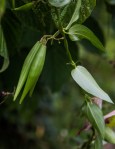
Black swallow wort is easily recognized. It’s a low growing herb with dark green leaves; the plant tends to vine. The leaves are paired, opposite each other on the stem, narrowly heart-shaped, and drawn to a fine point. The have a strongly developed central vein that causes the halves of the leaf blade to form a kind of V-shape down the length of the leaf. Flowers form at the tips of the vine and are small, dark purple. Kind of pretty actually. The fruit is a twin capsule. The roots are white and thick, forming a mat in the soil; there can be a tap root.

Apart from its invasive nature, black swallow wort and other swallow worts, which are related to milkweed, are toxic to Monarch butterflies, deer and cattle. The plants themselves contain the toxin, and they put toxins into the soil that prevents  growth of other plants.

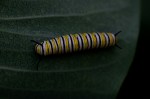
We all know by now that milkweed is the preferred medium for development of Monarch butterflies. The butterflies mate, most famously in Mexico, but in other western sites as well. They then migrate north and east looking for a place to lay their eggs. In March and April they lay their eggs on milkweed and, lamentably, black swallow wort .  About two days later the eggs hatch to the distinctive caterpillar, which feeds on milkweed.

However Monarch caterpillars that hatch on swallow worts are not able to feed. They avoid the toxin in the plants, and thus do not survive. From an ecological point of view, they are wasted.

After two weeks, the caterpillars on attach themselves to a stem or leaf of milkweed and begin the process of metamorphosis that leads to the beautiful Monarch butterfly.  The emergent butterfly will fly away to enjoy about two weeks of feeding on all sorts of flowers but, just before dying, they lay their eggs.


Clearly, black swallow wort is a bad actor. But you can help to control it.

Cutting it back is not good because that will only encourage more growth. Most of what I see in town along roadsides can maybe controlled by digging. You can dig it out, but dig deeply so as to get as much root as possible. You will have to return and dig out what you have missed but eventually . Glyphosate is effective.
TOM RUSH FOREST: MEADOW WALK

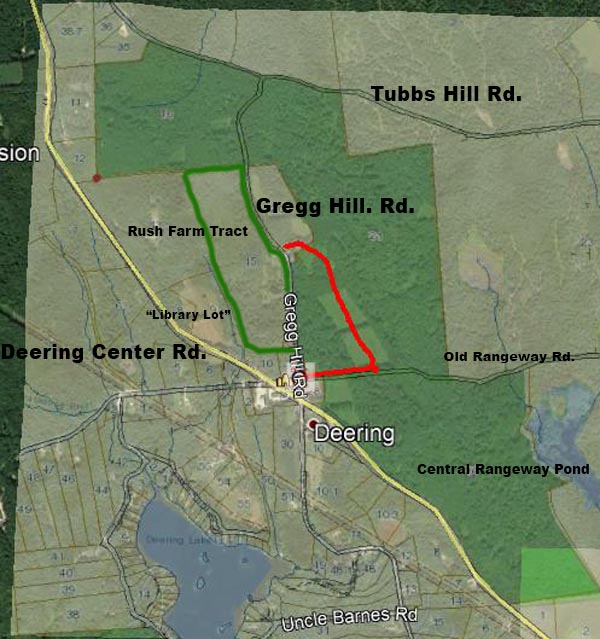
The Tom Rush Forest, in central Deering, was formed in 2002 when the popular singer Tom Rush sold several lots to the Society for the Protection of New Hampshire Forests. Tom Rush Forest is the largest conservation easement in Deering, comprising 300 acres of forest and meadows. Abutting the Rush Forest the SPNHF holds the conservation easement on 40 forested acres that are privately owned and called the Rush Farm Tract. Abutting the Rush Farm Tract, on the Deering Center Road, is the ‘Gregg Hill Lot,’ also known as ‘the library lot.’ This town-owned lot is, in part, the steep meadow that can be seen from Deering Center Road, to the left of the Carew House and essentially opposite the town garage. There are many possibilities for recreation, walking and winter sports. in the Tom Rush  Forest and land that surrounds it.

tom rush forest

Early in the 19th Century several families lived around what is now the Tom Rush Forest, on Gregg Hill Road, Tubbs Hill Road, and Old Rangeway Road and today’s forest was all meadow – –  known in part as ‘East Meadow,’ and ‘Berry field.’  Large meadows inside the Tom Rush Forest have been maintained along the east side of Gregg Hill Road, and those meadows feature in a walk (shown in red on the map)  of about 1/2 mile from the Town Common, on Deering Center Rd, to the Lachance residence at the top Gregg Hill Road. We call that walk the Tom Rush Meadow Walk.

tom rush gate at gregg hill rd P1000471
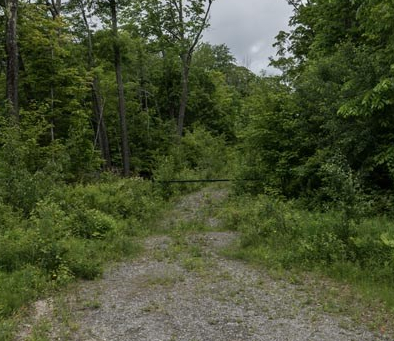
Gate across Old Rangeway Rd at Gregg Hill Road, near the Town Common

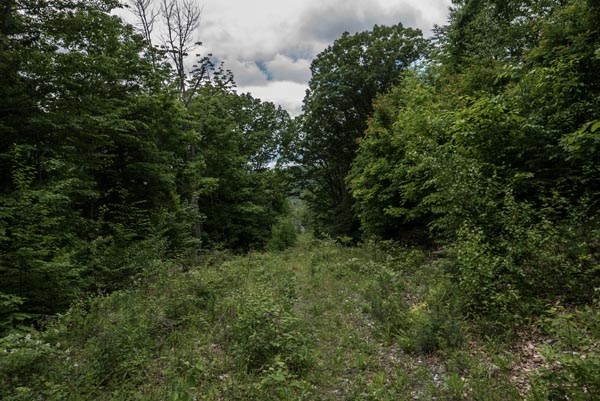
Beginning at the gate across Old Rangeway Road, near the Town Common and the Deering, follow Old Rangeway Road uphill  for a little less than 1/4 mile. From the top of the hill the trail leads left and immediately enters the first meadow. The way through the meadows is mown irregularly to make a more or less clear path for about 1/4 mile to return to Gregg Hill Rd. The last third of the walk passes through open forest.

The slope from the gate at Gregg Hill Road to the top of the hill is moderately steep and follows along a rutted dirt road. From the top of the hill the path through the meadows back to Gregg Hill Road is level easily traversed – – even with a perambulator. There are no vistas from the meadows.

tom rush meadow path at top of hill P1000468
Lookiing down Old Rangeway Road toward Deering Center
tom rush meadow path 1P1000467
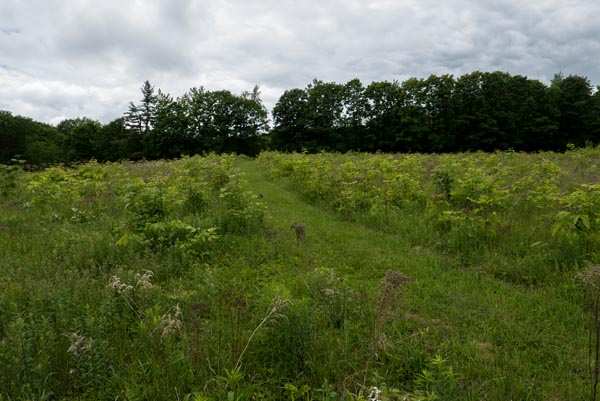
Mown path through a meadow in the Tom Rush Forest
tom rush meadow path 2 P1000480
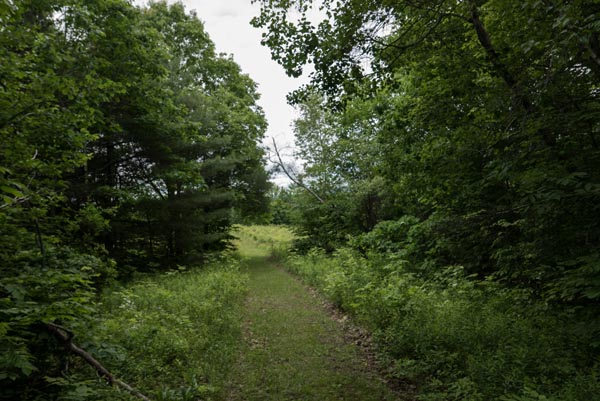
Path through open forest.
tom rush meadow path entry at lachance house P1000485
Entrance to the Tom Rush Meadow path from a private residence at the top of Gregg Hill Road.

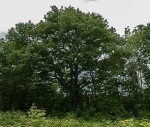
The meadows harbor a nice diversity of flowers. When I walked it in early June a stunningly blue introduced Veronica, V. austriaca saw-leaved speed-well, was in bloom. There were a lot of blackberries and dewberry, a close relative of blackberry that scrambles along the ground. Dewberry fruits before blackberry. Its fruit look like fruit of blackberry and can be just as sweet. The dewberry plant is thorny/hairy, so the biggest challenge might to be in collecting the fruit without getting scratched. There were also pale violet fleabanes forming large colonies in the grass. Milkweed plants were conspicuous and I saw a monarch butterfly, which feeds exclusively on milkweed. I was very happy to see a lot of ash seedlings but not so happy to see a large colony of the invasive black swallow-wort (Cynanchium louisiae). I am sure there will be a succession of flowers through the season. At the edge of one of the meadows there is an impressive wonderfully branched red oak tree.


Parking on Class VI Gregg HIll Road beyond the private residence

It is possible to park at the top of Gregg Hill Road but please remember that there is a private residence there. The owner has requested that people not park in the bays. Gregg Hill Road is a Class VI road and there is room to park on the side of the road beyond the residence. Please do not block Gregg Hill Road.

The Tom Rush Meadow Walk would make for a good trail for families. It is short, only 1/2 mile each direction, and you could post a car at each end. The trail is easy to follow; it is open and there is a diversity of things to see.  With some effort you could push a perambulator along. It would be fun for winter’s snowshoeing or cross country skiing at least at the level top through the meadows.


INVASIVE LAND PLANTS IN NEW HAMPSHIRE

Which Invasive Upland Plant Species occur in our town?  
There are easily 5 or 6 plant species which have escaped managed landscape environments and are becoming a nuisance in both the natural and urban environments of Antrim.  The invading plants are Japanese Barberry, Oriental Bittersweet, Autumn Olive, Japanese Knotweed, Glossy and Common Buckthorn and Burning Bush. Once you know what to look for you will see just how common and widespread they are.
It is the same story here in Deering.
How to find out more about New Hampshire’s Invasive Upland Plant Species? 
Save the Date because on April 4, 2018, Douglas Cygan, Invasive Species Coordinator from the NH Department of Agriculture will provide a presentation at 7pm at Antrim Town Hall. His presentation will take an in-depth look at upland invasive plant species in NH.  Attendees will learn about the various issues invasive species present to natural and managed environments, NH rules and regulations regarding invasive species, identifying features and characteristics of invasive species and best management control measures of some of the most aggressive non-native plants in the Granite State. This presentation is co-sponsored by the Antrim Parks and Recreation Commission, the Antrim Grange and the Antrim Conservation Commission.