HAWTHORN IN DEERING

Most roads in Deering are lined by trees. Sometimes homes are guarded by old sugar maples, singly or in a line in front, but mostly secondary forest is kept at bay behind ancient rock walls. Little spring flowering trees are common along disturbed roadsides and in wetlands. Shadbush, at first, then chokeberry, pin cherry and choke cherry bear clusters of pretty white flowers at the tips of branches, are common.

Hawthorns are not common, or at any rate I have seen only two widely separated trees in flower here in Deering. I might be wrong about the commonness of hawthorn because two wee volunteer seedlings have become well established in our garden on Hedgehog Mountain. Doubtless I have not seen all the hawthorns in town. .
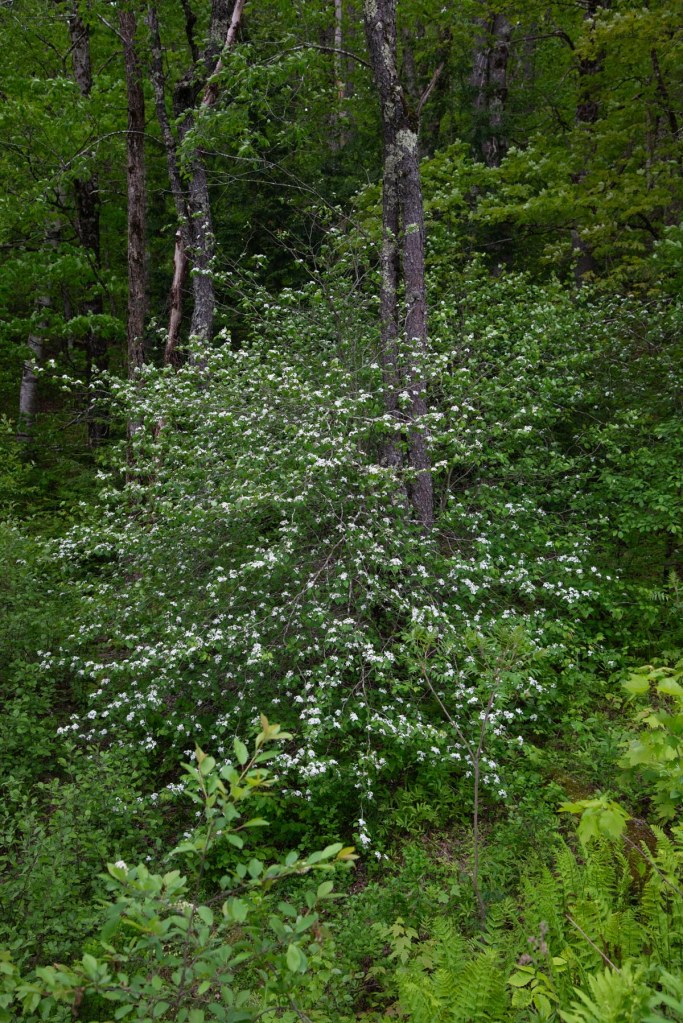
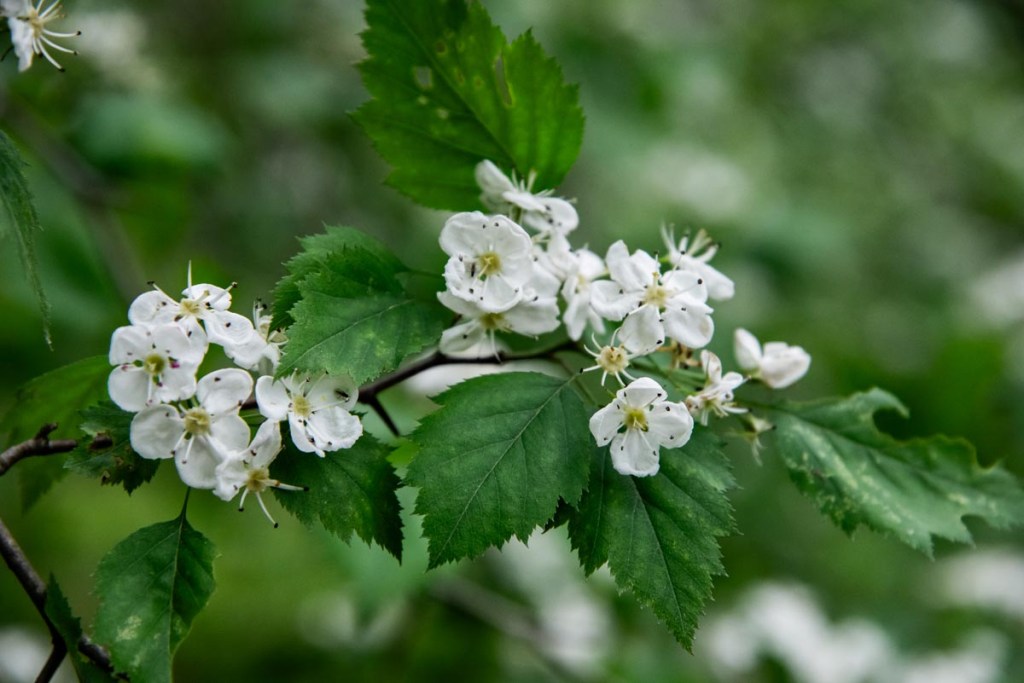
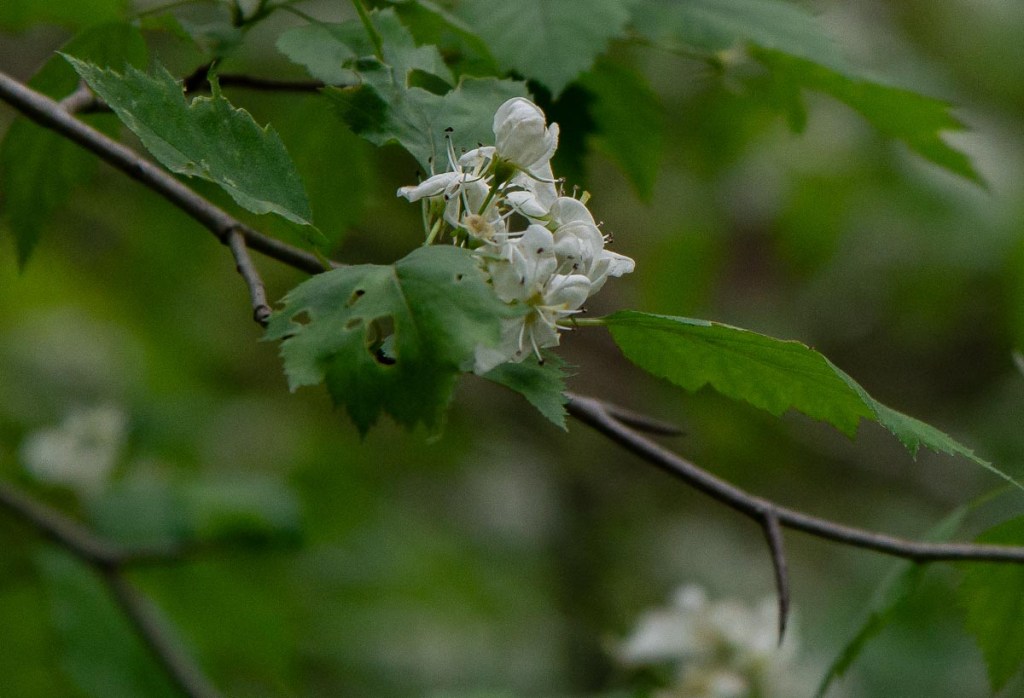
Hawthorn along North Road

Hawthorns are species of the genus Crataegus and the 47 species of this genus found in New England make it the second largest genus of flowering plants in New England. Identification of species is quite difficult. The major hurdle to identification is the large number of species that have been recognized by taxonomists (aka ‘Splitters’). I navigated the Go Botany (the Native Plant Trust) key to C. populnea for our North Road hawthorn, an identification that was supported when i submitted an image of the flower to iNaturalist.

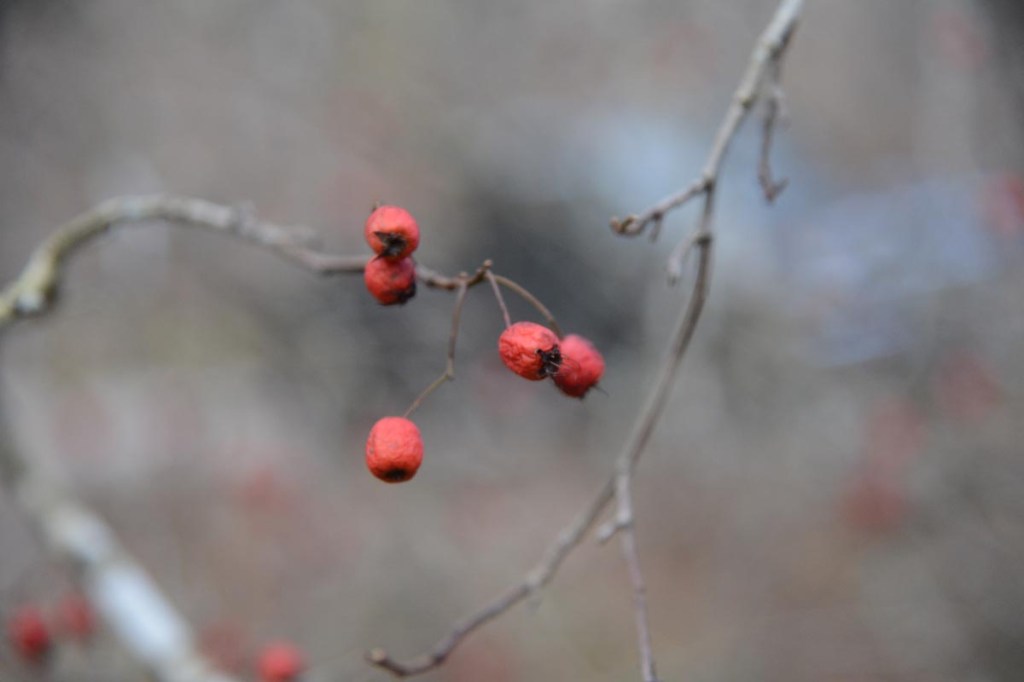
Crataegus poplnea, poplar hawthorn, is a species of northeastern USA and southeastern Canada but is rare in New England. Go Botany does not show any records for Hillsborough County. So, you can see my reservation in this identification. This identification is based on the flowering specimen growing on North Road. A second specimen growing some distance away at ‘The View,’ at the intersection of Deering Center Road and Old County Road, had completely finished flowering by mid May, so could be a different species. Go Botany says that C. populnea could be a hybrid between two other species, C. macrosperma and C. pruinosa. Flowers of C. pruinosa are fringed in pink and the species is not known for Hillsborough County. Crataegus macrosperma is widely distributed in New Hampshire, but its edible fruit appear to be larger than those of our Deering specimen. Poplar hawthorn is found in man-made or disturbed habitats, forest edges, forests, meadows and fields.
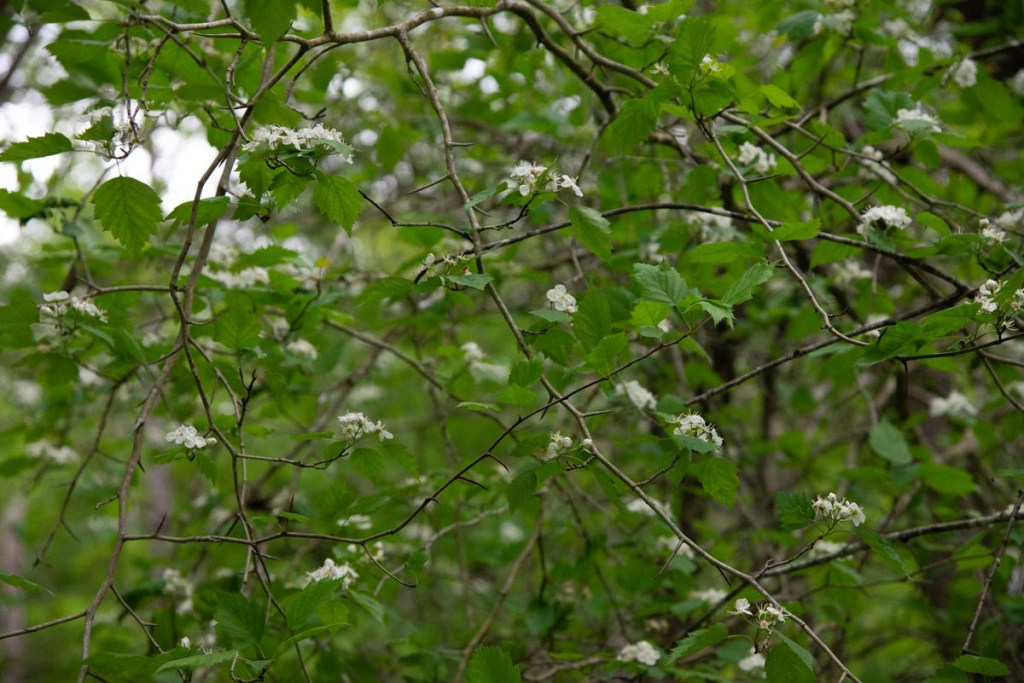
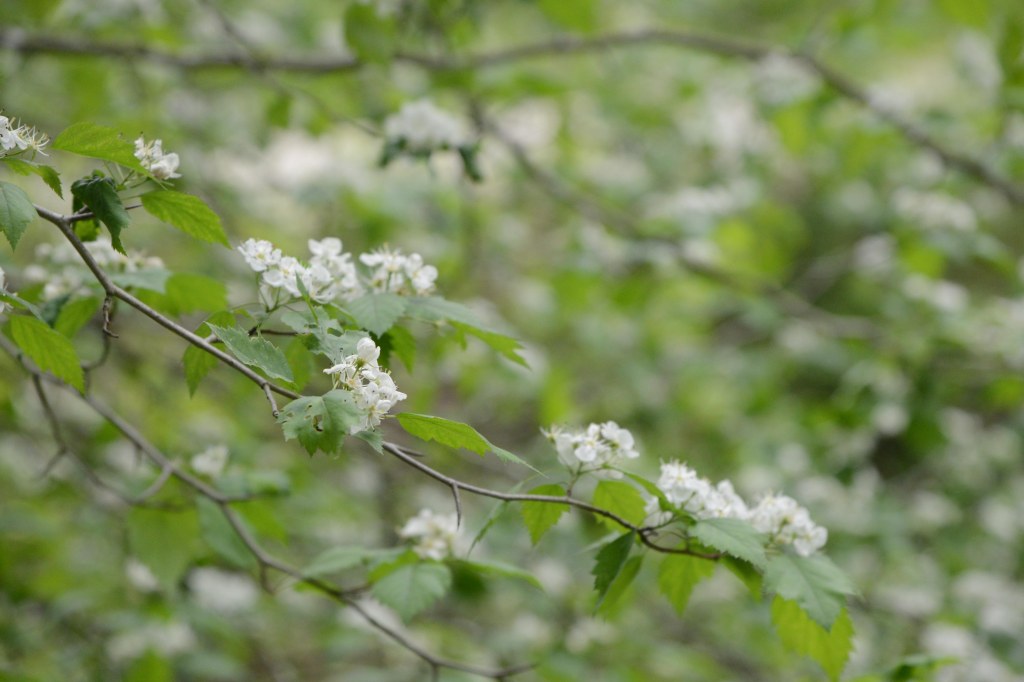
Crataegus is a genus of the rose family, so is related to apple, cherry, shadbush, and many others. The white flowers resemble flowers of all of them. Hawthorns are readily distinguished by having very long and sharp thorns (which are actually aborted branches and once were used as awls). The leaves of popular hawthorn are sightly lobed but deeply toothed. The fruit of hawthorn, like apples, are pomes and can vary in color from yellow to red to black. They have little nutrient content. Although edible, there is great variability in their edibility, some being mealy and others ‘just right.’ Native Americans dried the fruit in cakes for winter cooking. Decoction of the root is supposed to ease menstrual pain.

Haw is an old English word for ‘hedge’ and hawthorn hedges often separated fields. Maybe the most famous hawthorn hedge is the one in the village of Combray, in France, where young Marcel Proust walked on Sunday mornings with his family. Here is where young Marcel first discovered the sensuous beauty of nature, its colors and scent. Peeping through the hedge, he is transfixed by the beauty of a young girl with strawberry blonde hair in her family garden. Gilberte Swann remains Proust’s idee fixe through many of the 3000 pages of his novel In Search of Lost Time.

The hawthorns of Deering are not so romantic or even as sensuous as those in the hedge in Combray. But they are pretty little trees and I am glad to have found them here.

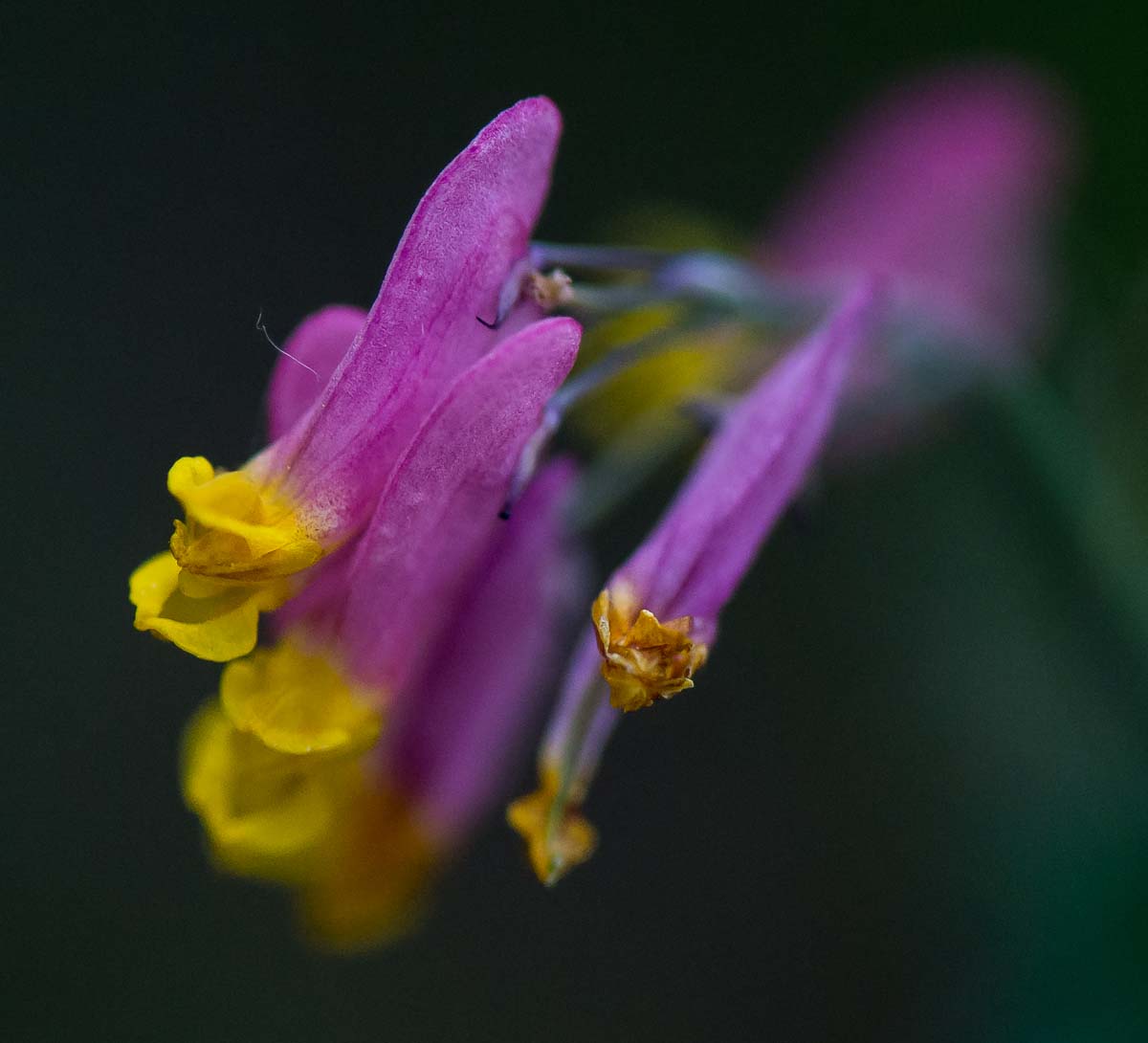
Rock harlequin: an accidental whimsy in the garden

Rock harlequin, Capnoides sempervirens, appeared in the garden late in May, a first. I had previously only seen this fire adapted native wildflower in Deering at two closes by spots on Hedgehog Mountain. The plant itself, a bit tall and scraggly, doesn’t have much to recommend it, apart from its greyish green leaves, as a garden feature. But rock harlequin’s flower is so unusual and alluring — whimsical even — that I could not resist posting pictures of it … for a second time (there is an earlier post about rock harlequin on this site).

Pollinators of this poppy relative include bumble bees and skipper butterflies. I suppose the bulk of these insects is needed to force open the flower as they land on the flower’s protruding lower lip to reveal pollen. Seeds, born in long pods, are dispersed by ants and by wind, and some consider the plant to be mildly invasive. There are certainly more problematic — and far less appealing — invaders than rock harlequin.

Trout Lily in Deering

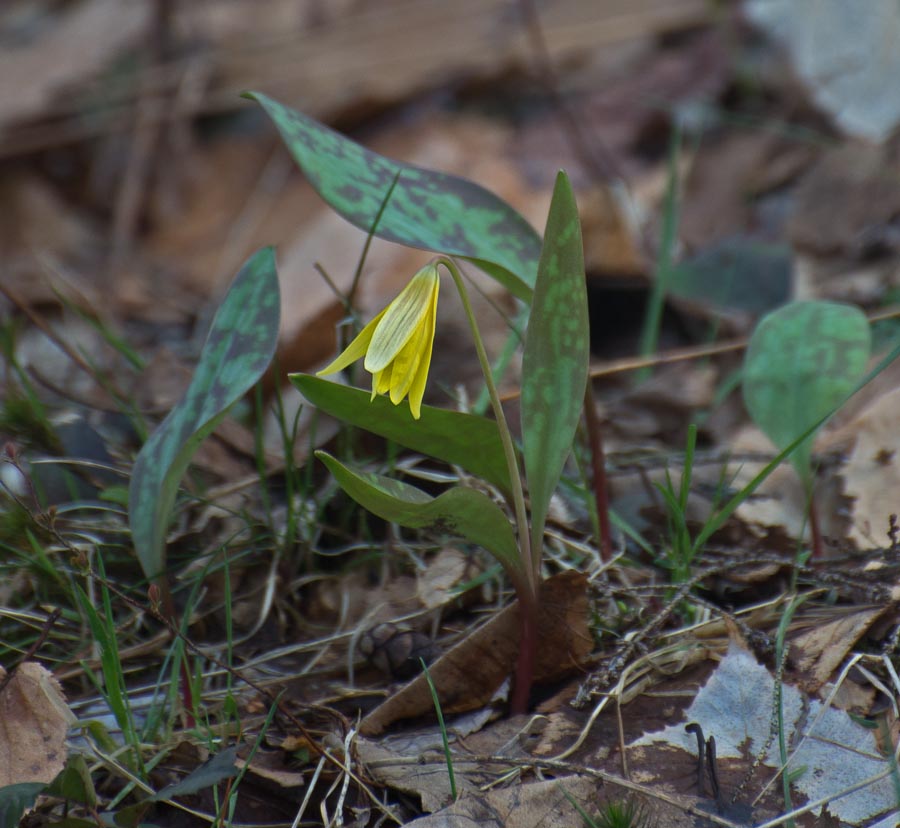
Trout lily, an early spring native wildflower, is rare in Deering.

I started documenting the wildflowers and flowering shrubs native to Deering when I first moved here in 2011. In 2023 my list includes about 300 species, most of which are plants typical of the northeast. One component of the northeastern flora that is mostly missing or, at best, poorly represented, are the earliest spring flowers. Skunk cabbage, which is exothermic and can melt its way through snow, seems to be missing. I have not seen any anemones or hepaticas either. Marsh marigold is represented by a single plant in a brook next to the Carew house, although I have not seen it for the past two years. I had not seen our earliest lily until wo years ago when trout lily appeared here at my home on Hedgehog Mountain. I don’t know where this trout lily came from, but it has come up reliably for what is now the third year. With that persistence, I am happy list trout lily as occurring naturally in Deering: I welcome it as one of few early iconic early spring flowers to flower in our town.

Trout Lily, Erythronium americanum, a member of the lily family, is found in moist places in deciduous forests. It is a small plant, 8 inches or less in height, characterized by its mottled leaves and a unique, yellow lily-like flower perched at the tip of a delicate stalk. Trout lily is one of the earliest of our native wildflowers and is certainly the first of our lilies, blooming at the same time and habitats as bloodroot, spring beauty, marsh mallow and others. The species has many other common names, but the best known of them is dog tooth violet. ‘Trout’ lily refers to the purple-brownish mottled leaves that suggest the fish, and also the plant flowers at the opening of trout season in New Hampshire. This mottling lead to the appellation ‘adder’s tongue,’ because of a perceived similarity of the leaves to snake skin. An early botanist objected to such a name for so pretty a flower and he proposed ‘fawn lily,’ supposing the mottling was more favorably compared to a young fawn. The very old name ‘dog-tooth violet’ comes from an Eurasian variety that has violet flowers and toothlike roots.

Trout lily is a North American native plant, distributed throughout the eastern states and provinces of the USA and Canada. It is closely related to Canada may flower, Mianthemum canadense, which is common in our area but blooms later and in the same places, in May and June, and tulip. The genus Erythronium includes about thirty-two species, most of which are native to the Central and Western states and provinces. A few species are found in Asia and Europe, respectively. Pink and white varieties occur in other states. Trout lily is the only eastern species, and I have only seen this pretty species at one location in Deering, here on Hedgehog Mountain.

Trout lily can reproduce sexually and produce seed. Pollinators include long-tongued insects, which can reach the nectaries that are located deep within the flower. The chief pollinators are blow-flies, mining bees and queen bumble bees. More commonly, trout Lily reproduces asexually by budding of perennial corms, and colonies 100 years old are known. Crickets and carabid beetles disperse the seed. White tailed deer sometimes nip off the buds and bears dig up the corms.

Young plants only produce one leaf. The don’t produce two leaves, and are then capable of flowering, until the bulb reaches sufficient size and has worked its way deeply into the soil (as much as 8 – 10 “). The leaves appear to be growing at ground level, but actually they emerge from a subterranean stem that lies several inches above the bulb. The plants do not flower until they are four to seven years old.

The roots of trout lily scavenge phosphorous from the spring run-off. The phosphorous is translocated to the leaves and is then returned to the soil when the leaves die back. Thus, trout lily performs an important environmental service. The ability of trout lily to accumulate phosphorous is thanks to mycorrhizal fungi. Once established, the roots of some plants are colonized by mycorrhizal fungi. The fungi sustain themselves through the winter with carbohydrates produced by the plant’s bulbs. This inhibits growth of the plants during the first season, but with the arrival of spring, fungi in roots of the infected plants enable them to absorb nutrients. This results in growth rates double that of ‘uninfected’ plants.

The young leaves and corms may be boiled and eaten, but in some people the concoction is emetic. Lore has it that a tea made from the leaves joins umpteen other teas as a cure for hiccups. Plants are also known to produce an antibiotic that is effective against gram-negative and gram-positive bacteria.

TALL WILD LETTUCE

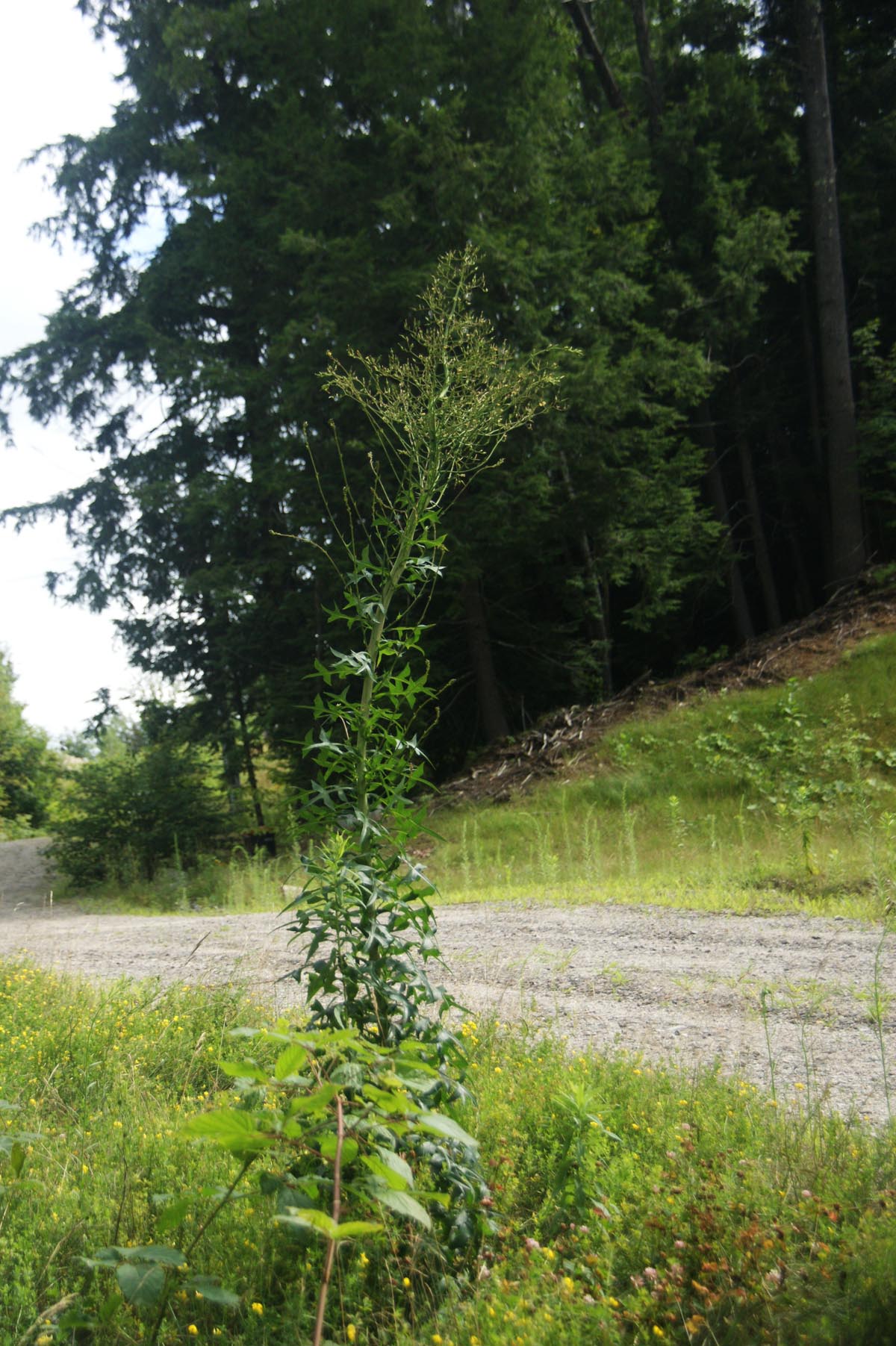
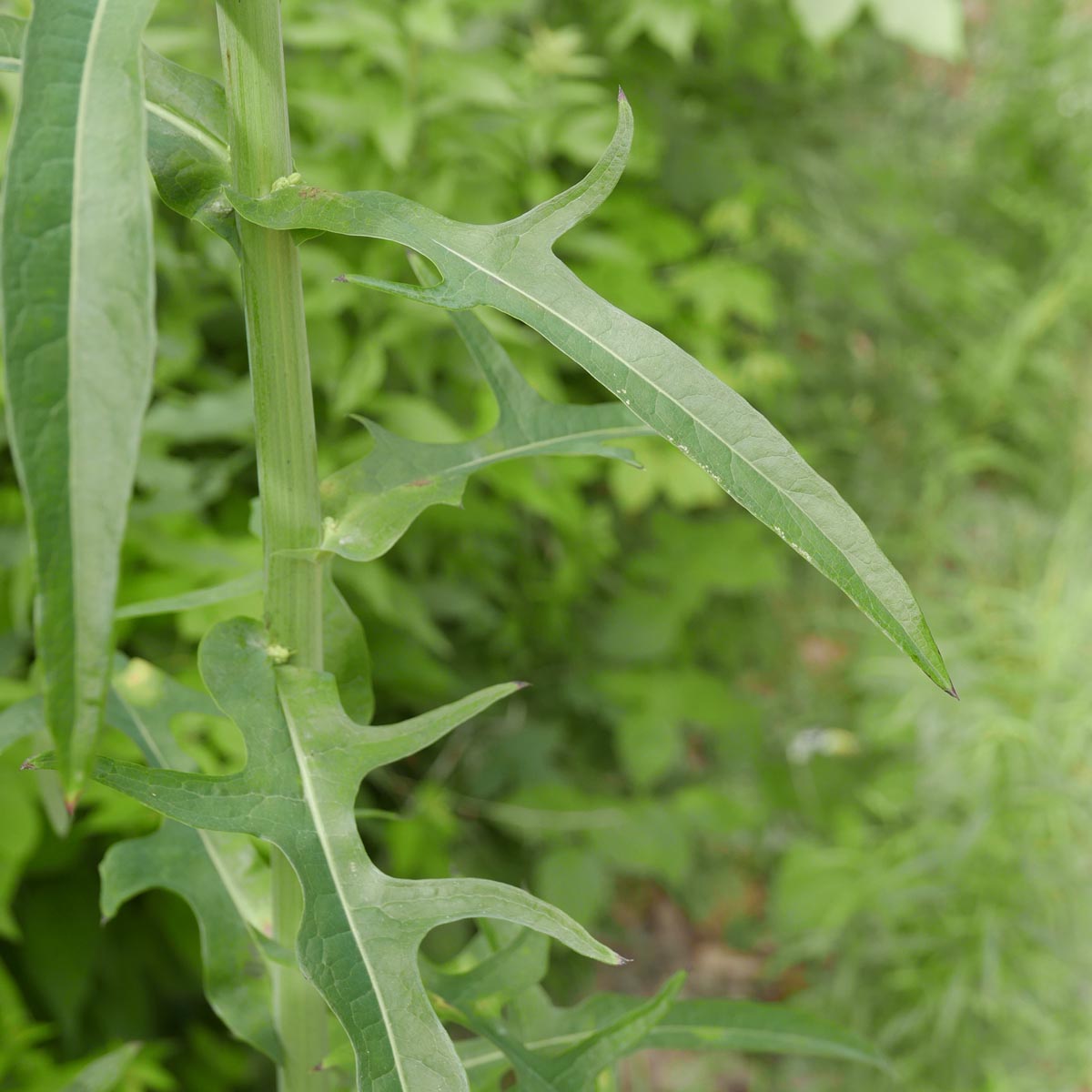
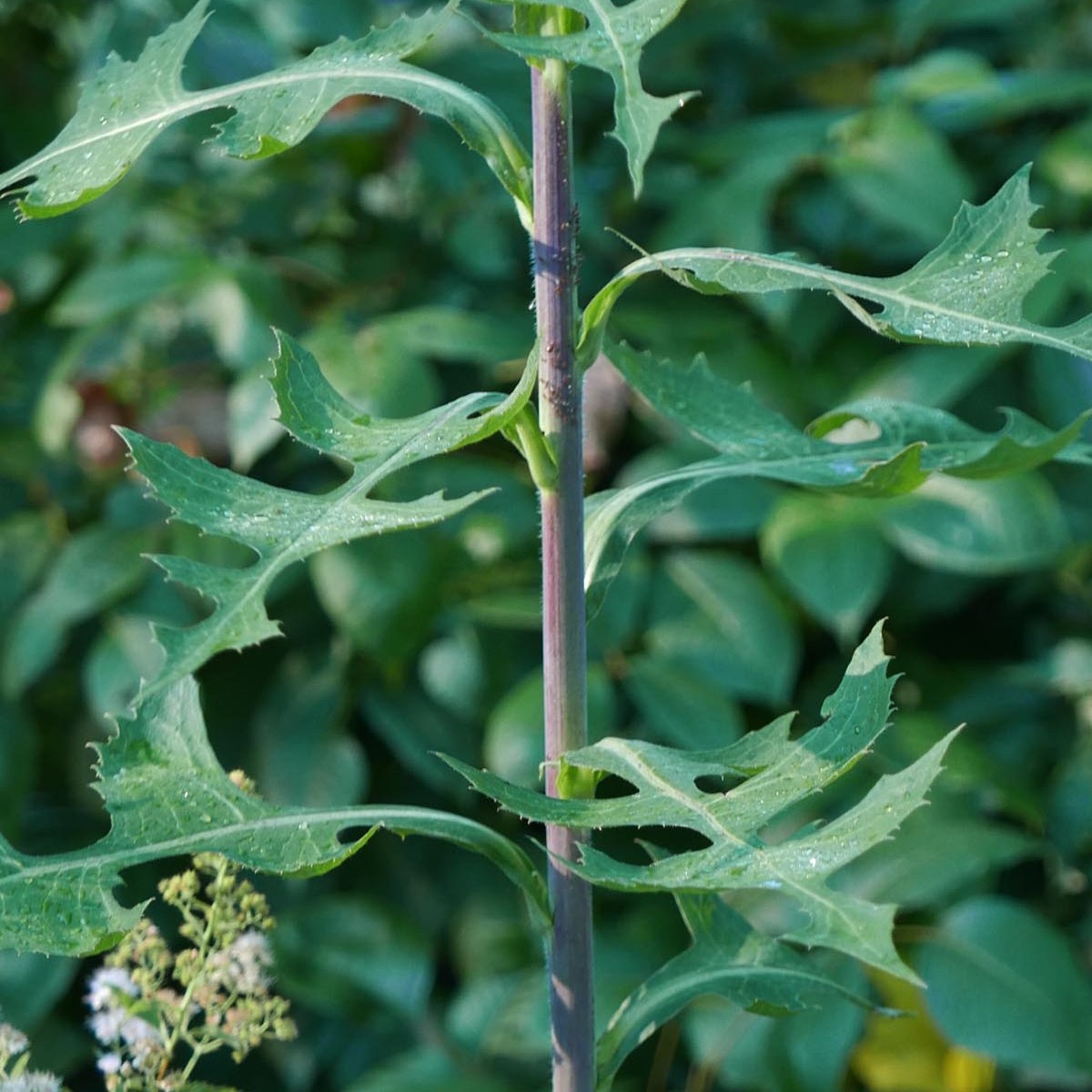
My daily (ok, frequent) walk leads along a diet road at the edge of forested land.  Late last year I noticed large rosettes of deeply lobbed leaves. The leaves looked like dandelion, the tips of the lobes being acute — pointed, but these were much larger than dandelion leaves, more than a foot long and correspondingly broader.  I did not know what they were. Winter ended and  I began to see tall-stalked plants with the same oddly shaped leaves.  As the season progressed, the stalks, elongated, ultimately reaching one or two meters in height. Flowers formed from elongated, openly branched clusters at the tip of the stalk and from the axils (where the leave departs from the stem) of the upper leaves. I realized that there were two, different but closely similar species of plants. When the species flowered, the first  early in July and the much more common second a month later, I could confirm the two tall plants to be species of wild lettuce.

These were not cute or pretty wildflowers – – one might call them ‘weeds!’

L:actuca canadensis

Canada lettuce is a native of North America, widespread in Eastern N. America – Nova Scotia to British Columbia, south to Georgia and Colorado. It grows in part to full shade, usually in disturbed sites in  thickets, woodland borders and clearings, and  moist open places in a wade range of soils.

Lactuca canadensis is biennial, which means that each plant lives for two years. Seeds germinate in late summer to fall, producing a rosette of leaves and i the second year long stalks arise from the leaves. Flowers and, ultimately the seeds form at the tip. That plant then dies. The genus name Lactuca implies a milky exudate that flows from the stem when the plant is wounded. In Canada lettuce the latex is light brown or white. The sticky sap can cause a skin rash in some people. The sap contains ‘lactucarium’, which is used in medicine for its anodyne, antispasmodic, digestive, diuretic, hypnotic, narcotic and sedative properties. The sap s sometimes collected commercially.

The plant should be used with caution, and never without the supervision of a skilled practitioner.

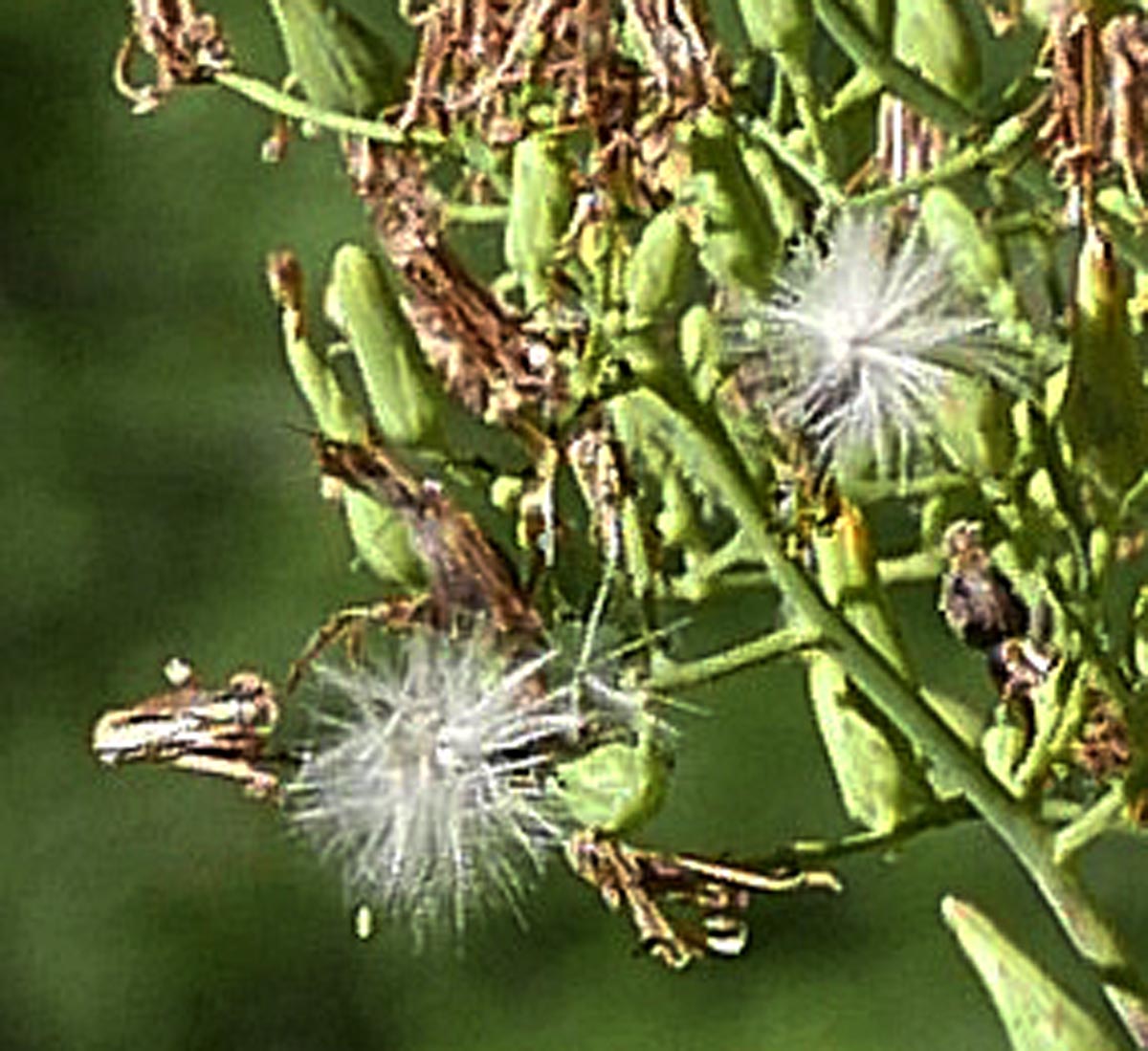
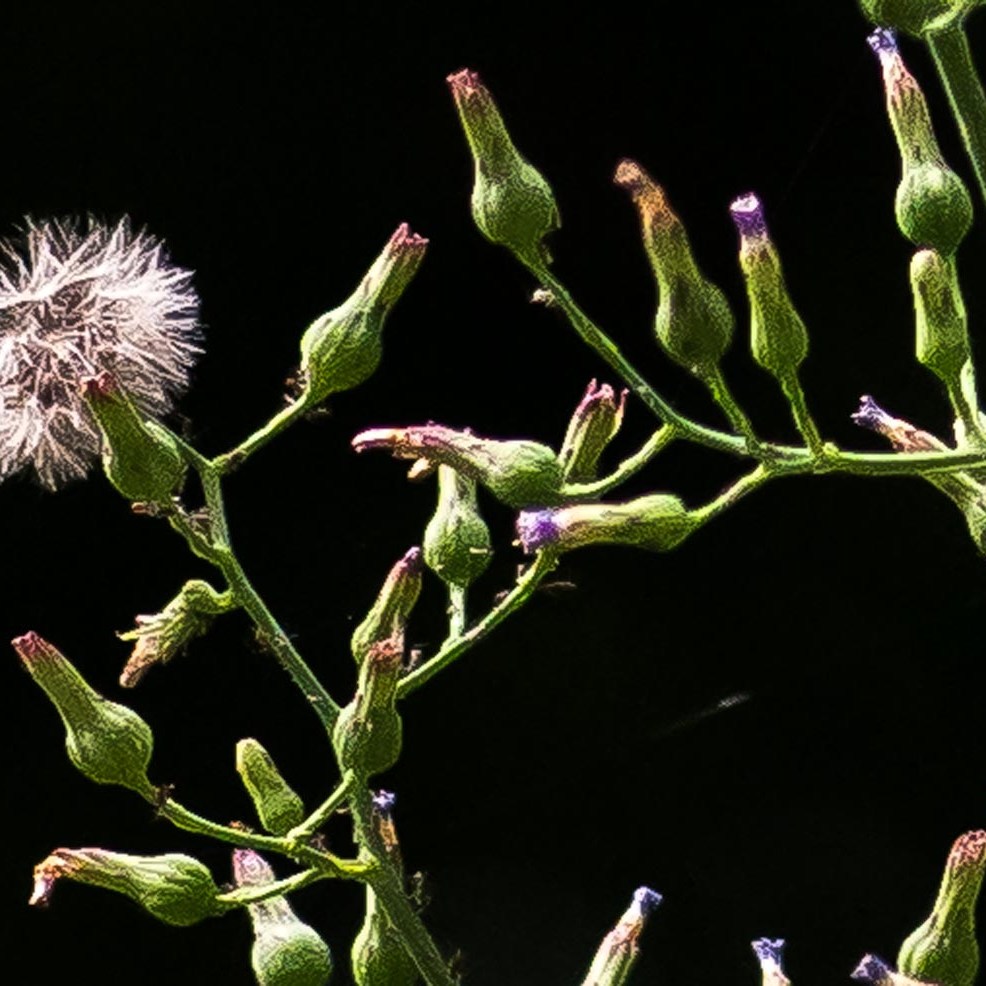
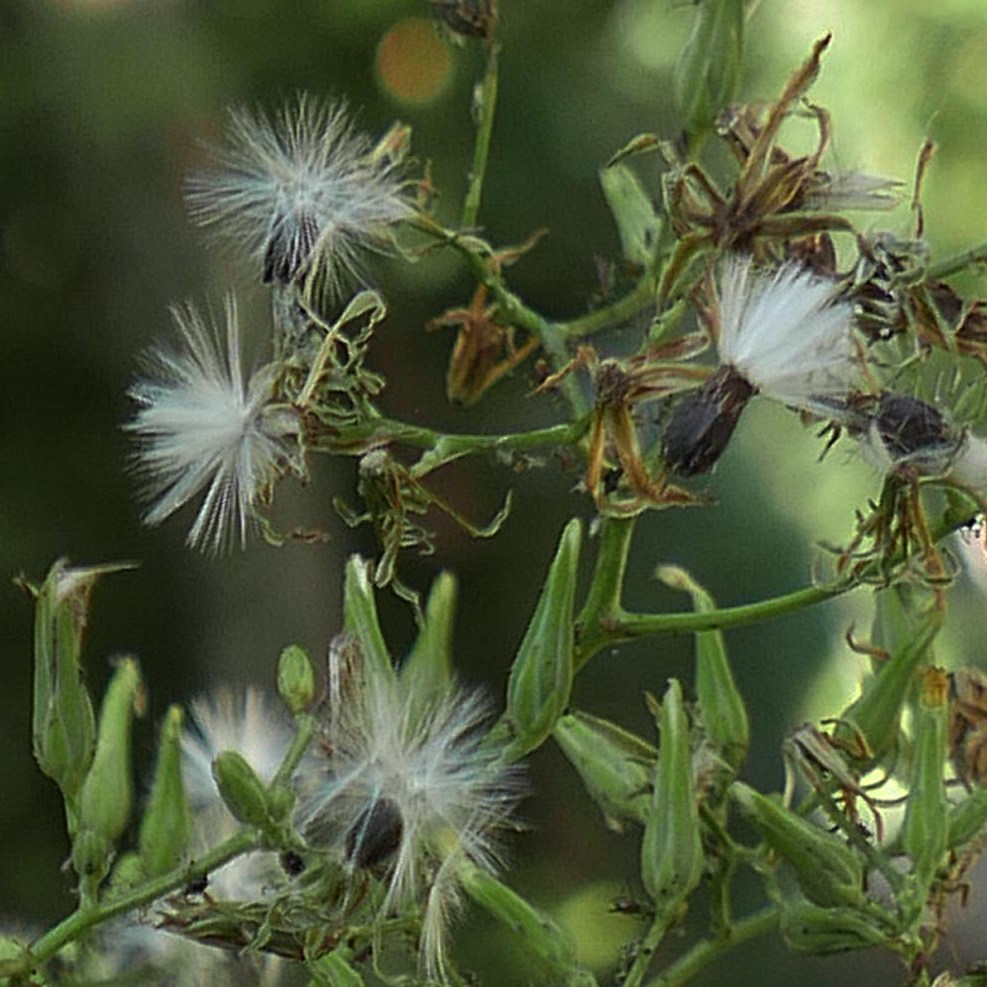
Small dandelion-like yellow flowers, each about 1/4 inch in diameter, occur in a narrow panicle up to 2″ long at the apex of the plant. The flowers are replaced by dark brown seeds – – achenes – – with tufts of white hair, which are attached together by thread-like beaks. Various bees pollinate Canada lettuce.

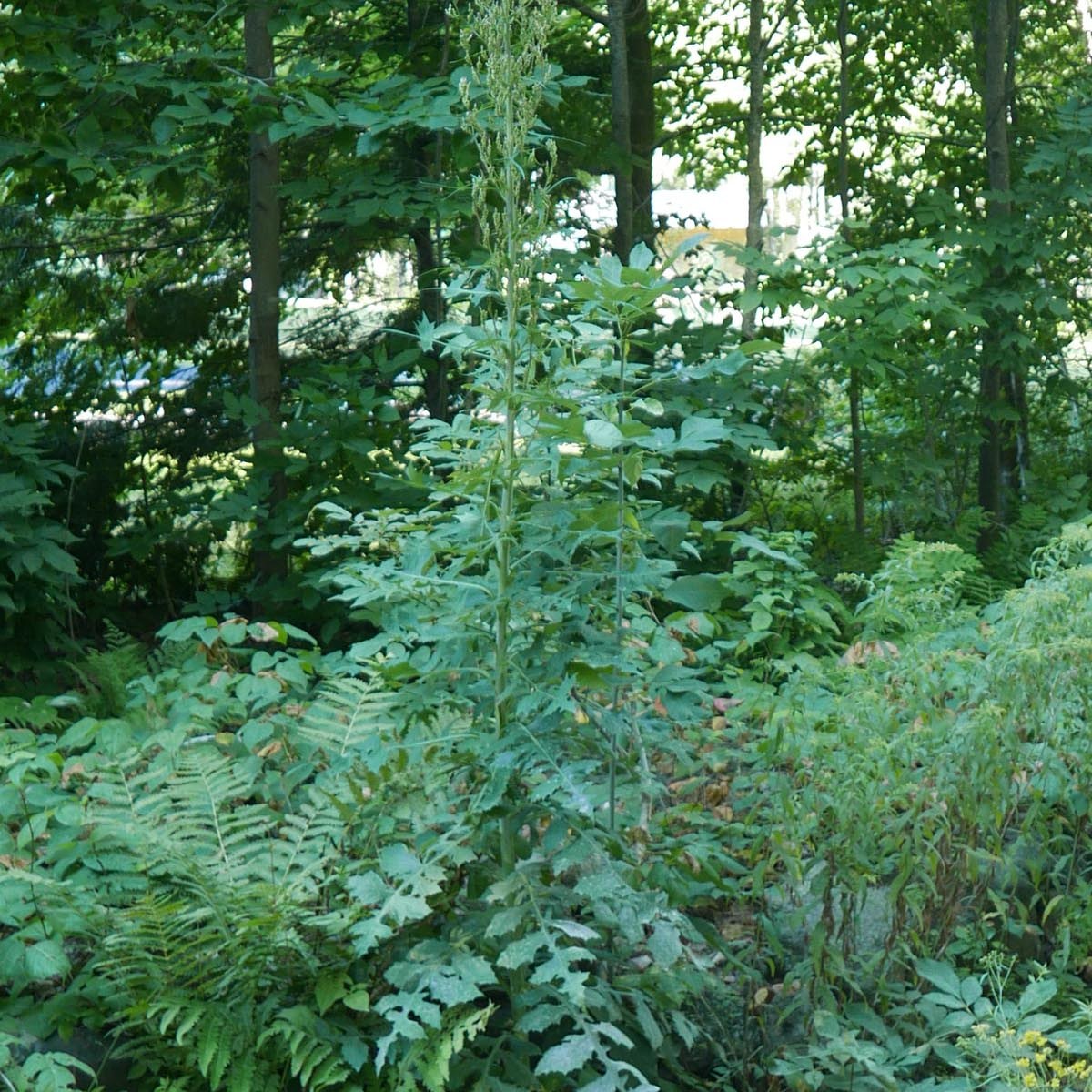
Lactuca biennis

2022 was the first year that I have seen this wild lettuce on my road — and it is difficult to overlook a seven-foot tall flower stalk! But this year several plants of this species are spread for a distance of about 50 meters along the shaded road.

Lactuca biennis, tall blue lettuce or wood lettuce, is native to North America. It is widespread across much of the United States and Canada, ranging from Alaska and Yukon south as far as California, New Mexico, and Georgia. The biennial plant is very similar to that of L. canadensis, and the two can be found growing together in disturbed sites, forest edges, meadows and fields. However, leaves of L. biennis are longer and broader and it’s little daisy-like flowers are blue. The plants can reach two meters in height. Various species of bumble bee have been recorded as pollinators of tall blue lettuce.

Like dandelion, leaves of L. biennis can be eaten in salads when young, but become bitter with age. Various medicinal uses have been attributed to tall blue lettuce including treatment of pain, vomiting, diarrhea, and heart trouble.

LAURELS IN DEERING

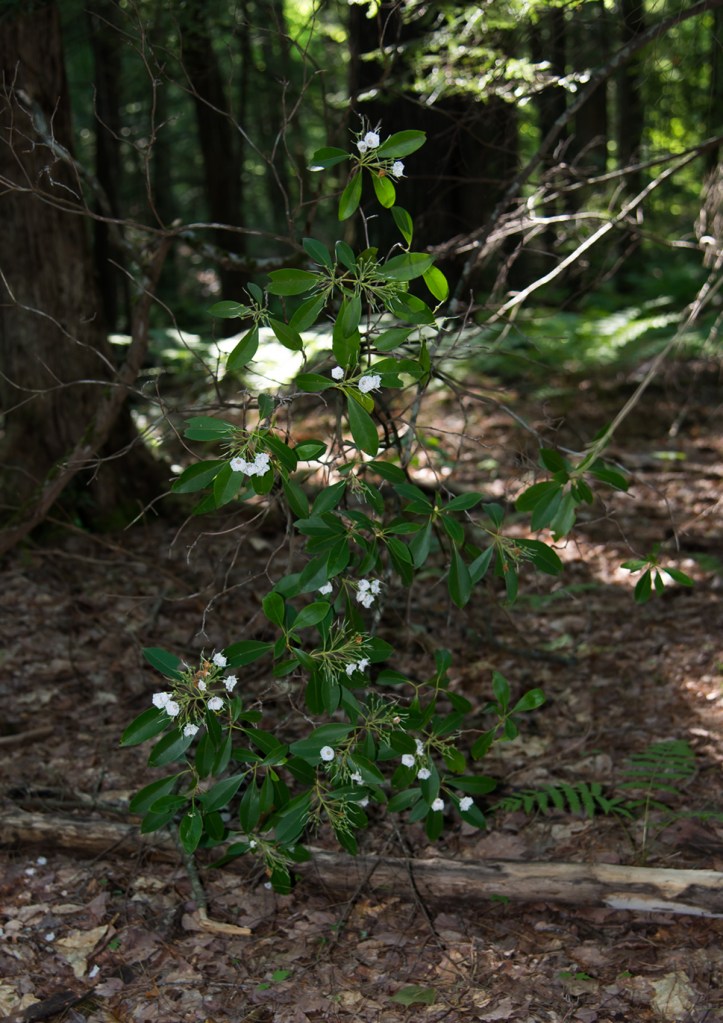
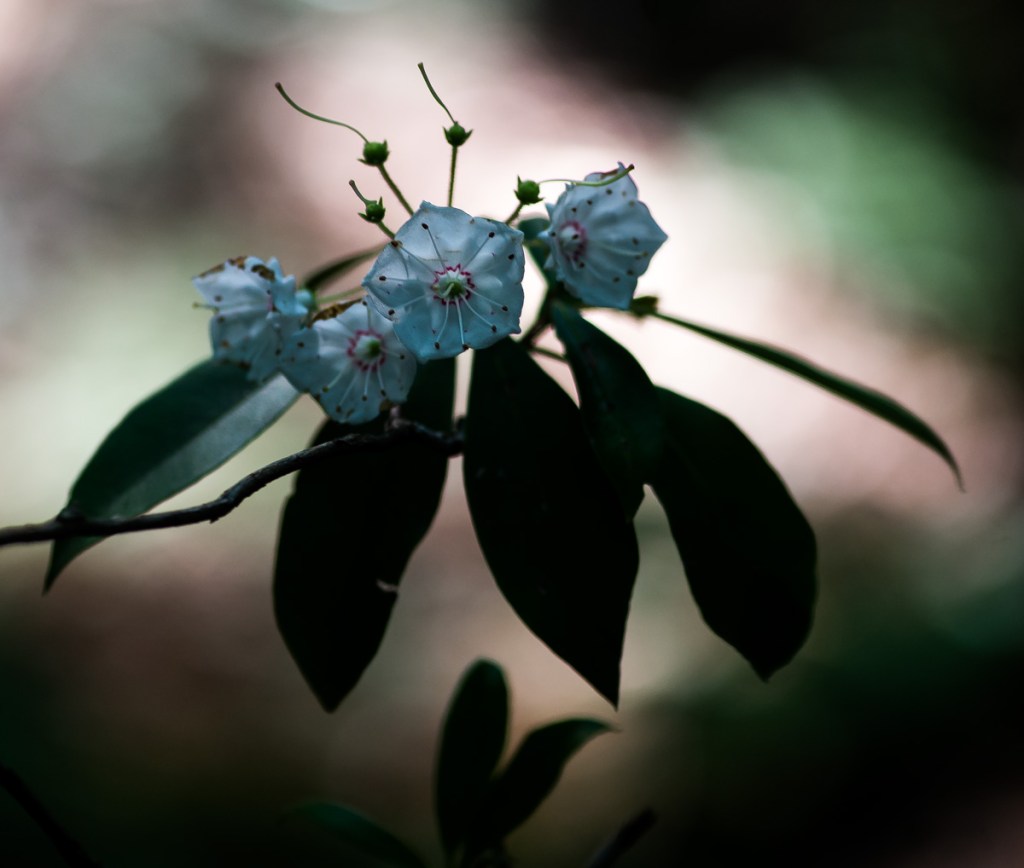
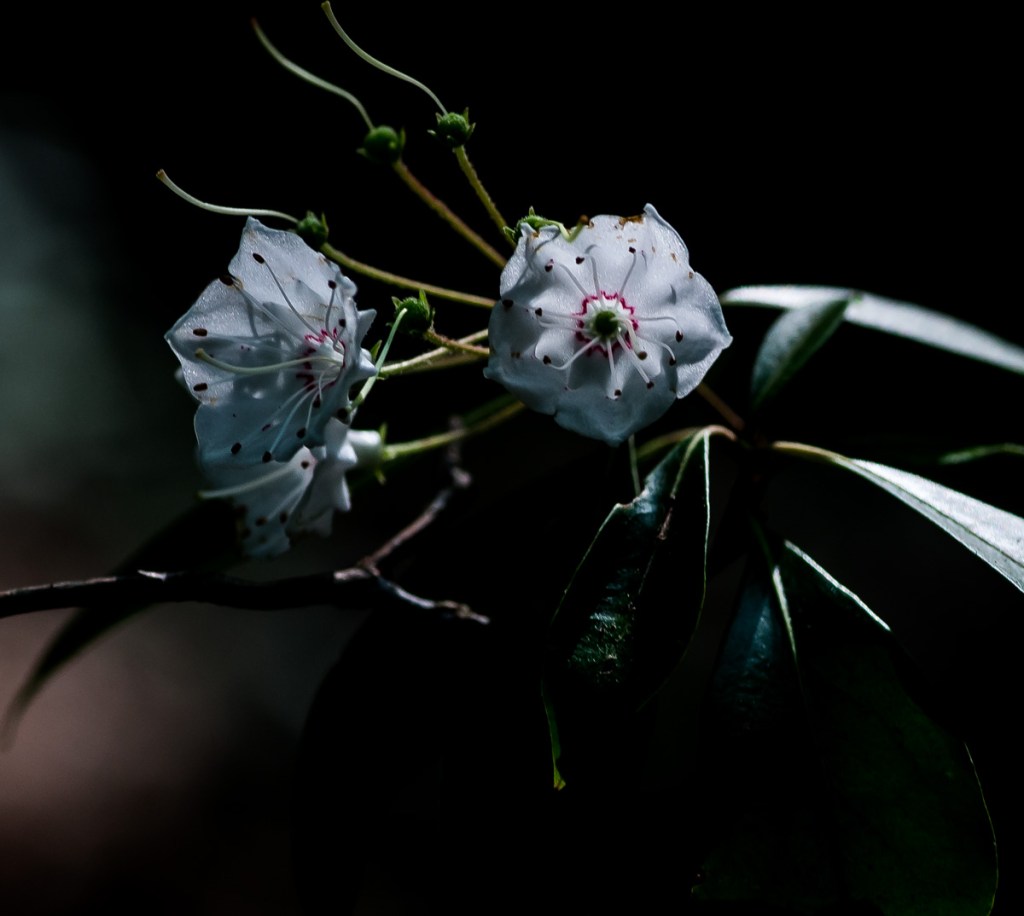
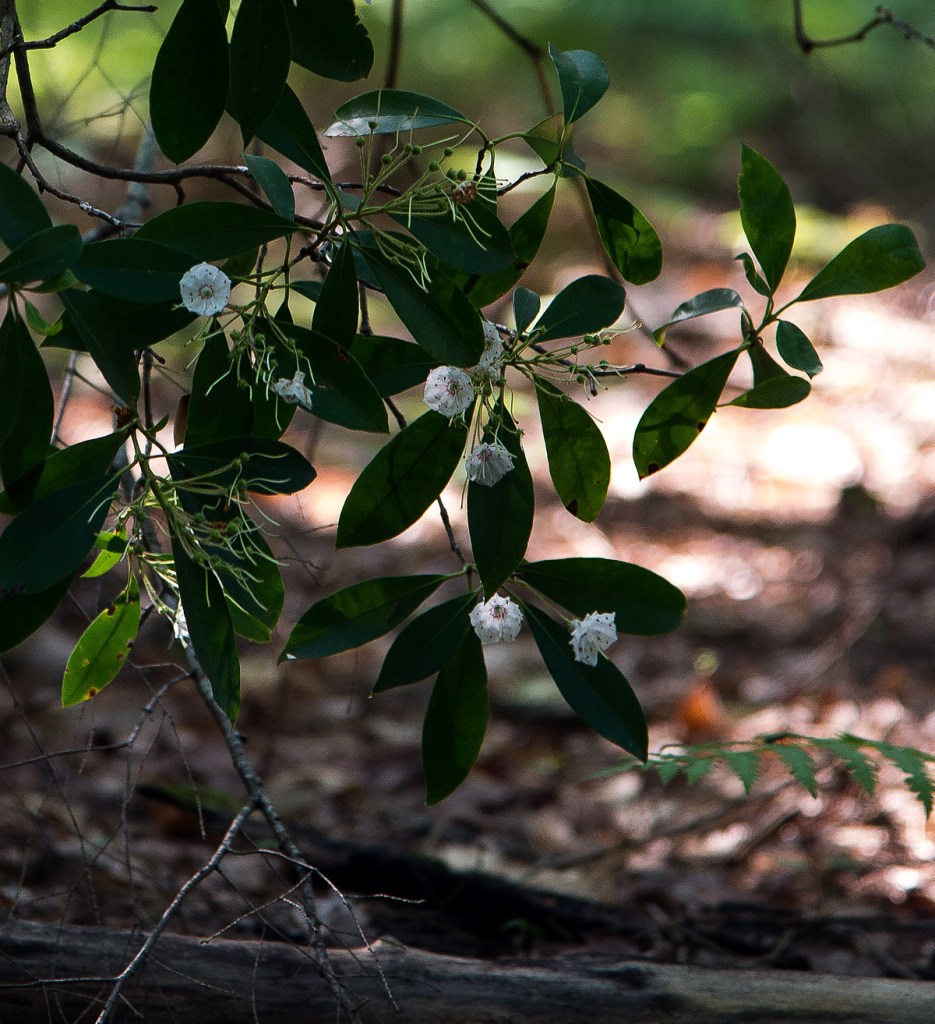
Two species of laurel occur in Deering, Kalmia angustifolia (sheep-laurel) and K. latifolia (mountain laurel).

Laurels are members of the plant family Ericaceae, along with blueberries, cranberries, rhododendron, azalea, trailing arbutus, Indian pipe, and many other plants that are common in our part of the world. The genus Kalmia was named by Linnaeus, in the 18th Century, in honor of one of his students, Peter Kalm, a Swedish-Finish botanist and naturalist who traveled and collected plants in the Americas during the 18th century.

Mountain laurel is a native North American evergreen, perennial shrub. It is common in acidic soils of the Appalachian Mountains, plateaus, piedmont, and coastal plains from southeast Maine to the Louisiana delta and north through Indiana and eastern Ohio to southern Quebec. It is found in the understory of conifer and hardwood forests, where it can form virtually impenetrable thickets, but it also forms dense cover on ‘balds’ at 4000 ft in the Appalachian Mountains. Typically the plant is a shrub, reaching 6 feet or so in height, but occasional ‘trees’ can reach 50 ft in height in the valleys of the Blue Ridge and Allegheny Mountains of the southern Appalachians. and can form dense thickets.

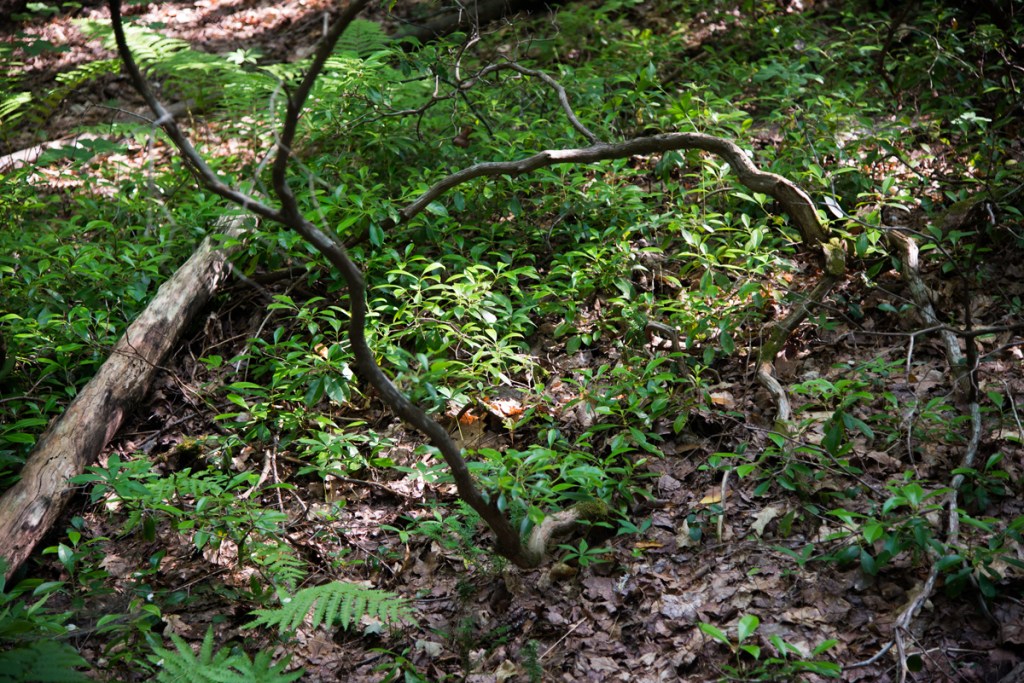
The species is fairly common in south central New Hampshire, often forming dense thickets in shaded forests. Here in Deering it is not difficult to find plants of mountain laurel, but Deering’s mountain laurel plants are mostly low growing with woody stems and form a more or less densely ground cover on the deeply shaded forest floor. I have never seen these plants to flower. In my wandering in Deering I have seen flowering mountain laurel at only one site, on a town-owned lot not far from where Manselville Brook enters the Contoocook River. At this site there are not more than a half dozen upright woody shrubs, about 6 feet tall. They flower in the middle of June.

The chief pollinators of mountain laurel are bumble bees and other bees. The sPtamens, which carry pollen, adhere to the petals under tension. When a bee enters the flower, the tension is released and the pollen is shot onto the furry bee. The pollen can be shot for as much as a foot, fertilizing other flowers. If the flower is not visited by a bee, the stamens can release pollen and self fertilize their flower.

Members of the Ericaceae have fungi – – mycorrhizae — associated with their root hairs. The morphology of the mycorrhizal association, and the fungi that associate with roots of members of the Ericaceae are different from tree mycorrhizae. Tree mycorrhizae tend to be mushrooms while the fungi that associate with roots of the Ericaceae are taxonomically distinct. The nature of the ericoid mycorrhizal association is the least understood of all of the mycorrhizal associations.

Green parts of the plant, flowers, twigs, and pollen are all toxic, including food products made from them. Although mountain laurel pollen does not affect bees, the honey made from the pollen may induce neurotoxic and gastrointestinal symptoms in humans eating more than a modest amount. Symptoms of toxicity begin to appear about 6 hours following ingestion. Humans, their pets and livestock are all affected. Sheep and goats will readily graze on mountain laurel, and horses will eat the plant if there is nothing else to eat. Even ruffed grouse that feed on the leaves are sometimes killed.

Mountain laurel is unrelated to the true laurels (Lauraceae), which are used in cooking. Please do not substitute a leaf of a Kalmia species (mountain laurel, bog laurel, sheep laurel) for a bay leaf (Laurus nobilis) in your cooking!

Mountain laurel is the official state flower of Connecticut and Pennsylvania.

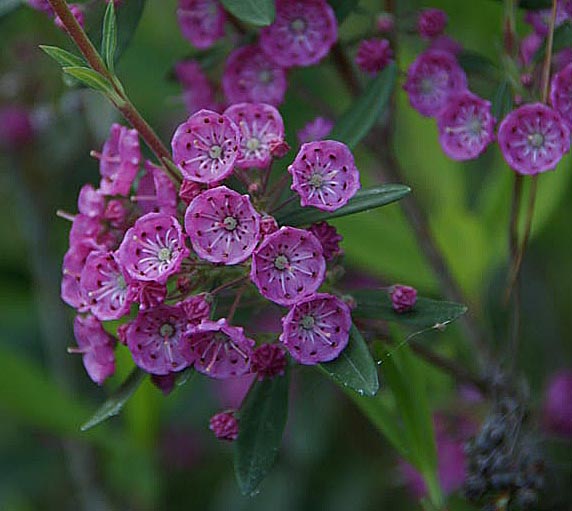
Sheep laurel, Kalmia angustifolia, is a perennial shrub that can get to be 3 feet tall and up to 6 feet wide. It has ridiculously showy, pink flowers in clusters formed below the branch tips so that leaves usually form further along the stem, above the flowers. Flowering is from late spring into summer. Leaves are held in whorls of two or three and are 1.5- 2.5 inches long. The plant forms a tap root that can be 3 ft deep, and a dense network of roots. Sheep laurel is colonial and can form dense stands.

Sheep laurel is native to northeastern North America. It is found from Newfoundland and Labrador west through Ontario and occasionally as far south as Georgia. It is common in the eastern Great Lakes region, the St. Lawrence region, northern New England, and the Maritime provinces.

There are two varieties of K. angustifolia. The variety carolina occurs in Virginia, the Carolinas, Tennessee and Georgia.

Sheep laurel is adapted to a wide range of habitats. bogs, swamps, other wetlands, and alpine summits in the Adirondack region of upstate New York. Here in Deering I have seen sheep laurel along water’s edge at Black Fox Pond, in the Audubon Preserve, and in Deering Lake.

Like mountain laurel, sheep laurel foliage is toxic. On the other hand, it provides winter forage and cover for wild grouse and other birds.

LOTUS CORNICULATUS: BIRD’S-FOOT-TREFOIL

A lot of plants having yellow flowers bloom late in June in what some would call their lawn. We don’t do anything to encourage a grassy expanse of lawn, so what we get is probably anathema to most home owners.

Well, one price they pay for that lush green-ness is that they don’t get to see much of a variety of wildflowers. Woe betide the not-grass that appears in the ‘well-manicured’ lawn.

OK, sermon ended.

Currently four species of hawkweed, at least two species of cinquefoil and a small St John’s wort are blooming in great profusion around town. All have yellow flowers. But, so do goldenrod, evening primroses and larger St. John’s wort, whose plants are up but not yet flowering. We have passed from the spring, when white and green flowers were effective in attracting wild bees and other insect pollinators maybe more by odor than plant color? But, now we are full on bee time and yellow is the dominant flower color of the day.

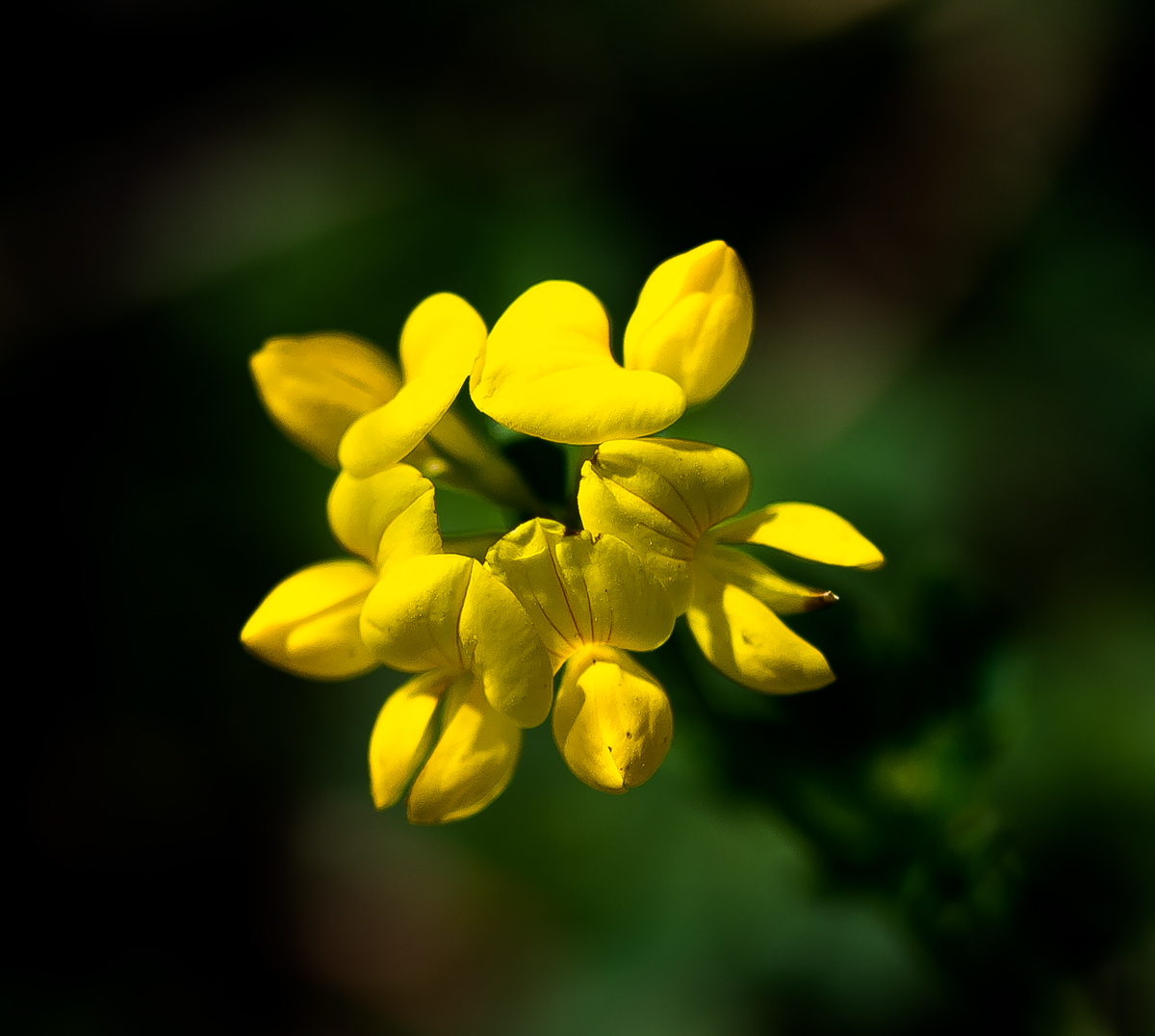
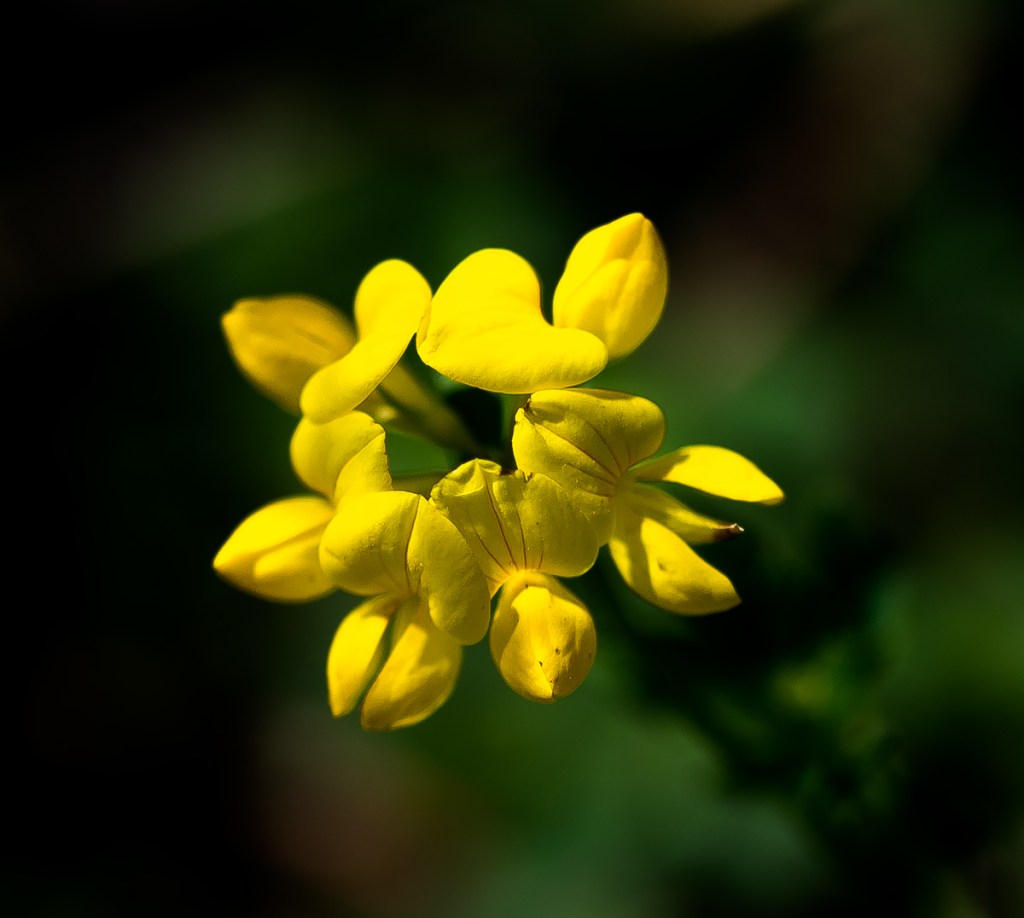
Scouting around our ‘garden’ a few days ago I noticed scattered plants of bird’s-foot-trefoil . I had not previously seen this species in Deering. It’s common enough. Certainly I have overlooked it.

Bird’s-foot-trefoil , Lotus corniculatus, is a member of the pea family. It’s low, sprawling herbaceous plants have 3 clover like leaflets (actually 5, with 2 opposite leaflets at the base of the ‘trefoil’ or triple leaflets. This is the only legume with 5 leaflets). The plants can stand up to 2 ft tall and flowering branches terminate in a head, or floret, of pea-like yellow flowers. The fruit is a pod about one inch long. One brown to purple seed pod is produced per flower situated at right angles to the flower stalk and thus the 5-6 splayed pods resemble a bird’s foot.

Bird’s-foot-trefoil is a perennial, native to Eurasia but now widely distributed in North America after having been introduced around 1900. It is a “long-day “plant, requiring sixteen hours of sunlight to flower, just right now for the end of June. In some parts of North America and Australia the plant is considered a bothersome invasive while elsewhere it is planted for erosion control, because of its deep tap root, and as a forage legume on poor soil because of its nodulated roots that fix nitrogen. Several cultivars are available for agricultural use.

Flowers of bird’s-foot-trefoil flowers occur in florets of 4-8. Each floret is bisexual, thus can self pollinate although the plant has a self-incompatibility mechanism that prevents self-seeding. Most pollination is effected between plants by insects. Pollen in the plant matures before the flower opens. Filaments push the loose pollen forward into the closed tip of the united lower petals (keel), and pollination occurs when an insect’s weight on the keel forces a ribbon-like mass of pollen from the keel opening, some of it adhering to the insect’s underside. Further pressure as the insect seeks the nectaries causes the female stigma to slide into the same contact area, where it’s stickiness may pick up pollen from another plant that got stuck onto the insect. Like some other legumes, the bird’s-foot-trefoil produces highly nutritious pollen.

Honey bees and, especially, bumble bees are the principle pollinators of bird’s- foot-trefoil. Some bees became highly specialized on these plants; in fact, the decline of several bumble bee species has been linked to the reduced availability of clover, bird’s-foot-trefoil and other legumes. In Scotland, three of the scarcest bee species are believed to be completely dependent on bird’s-foot-trefoil’s pollen; the pine-wood mason bee, the mountain mason bee (Osmia inermis) and the wall mason bee (Osmia parietina).

But more importantly for the aspect of ecosystem services, the bird’s-foot-trefoil is a larval food plant for several butterflies and moths and a valuable nectar source for many other insects.

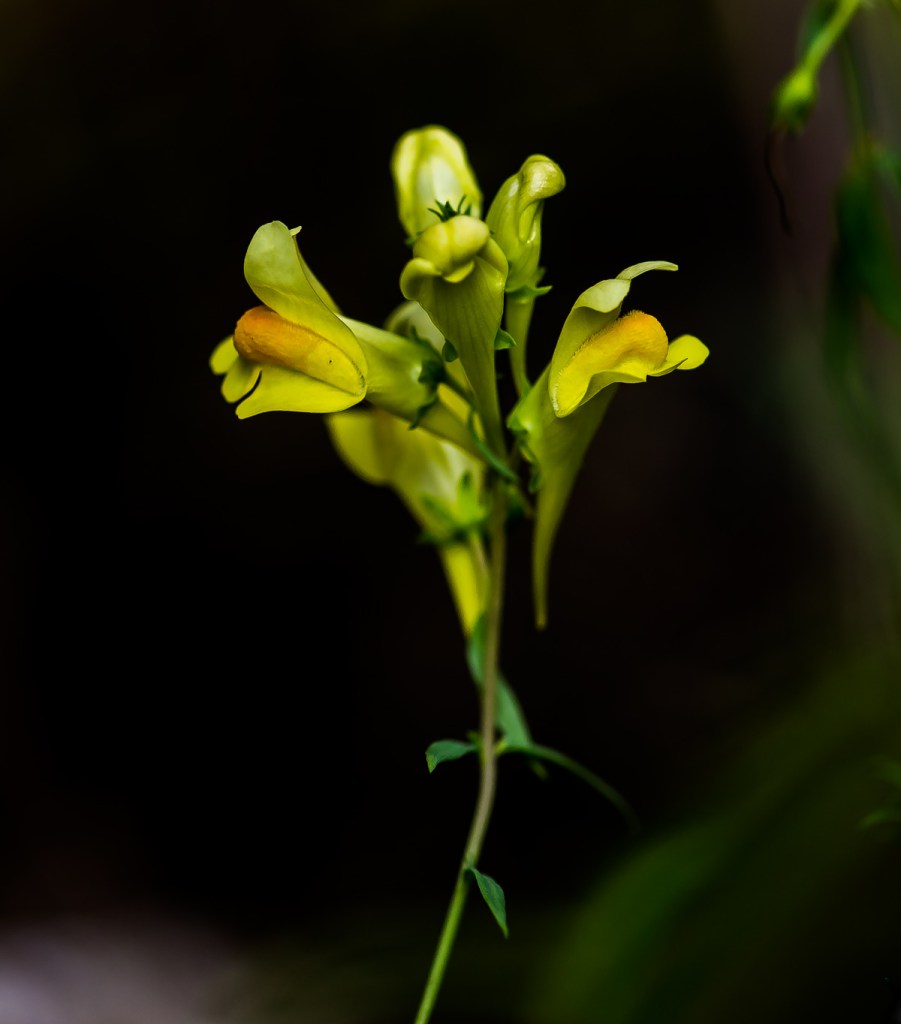
Bird’s-foot-trefoil can be confused with another yellow-flowered herb, butter-and-eggs, Linaria vulgaris Butter-and-eggs, or common toadflax, occupies much the same habitat as bird’s-foot-trefoil but flowers much later in the season. Butter-and-eggs can be problematic because through its vigorous growth it can out-compete other pasture natives and form dense mats that prevent the establishment of desired species. The plant is mildly toxic to livestock.

(In writing this post I relied heavily on The Book of Field and Roadside. Open-Country Weeds, Trees, and Wildflowers of Eastern North America by John Eastman. 2003. Stackpole books. It is one of three similar books by the same author. I am not sure that they are still in print. I found mine on E Bay).

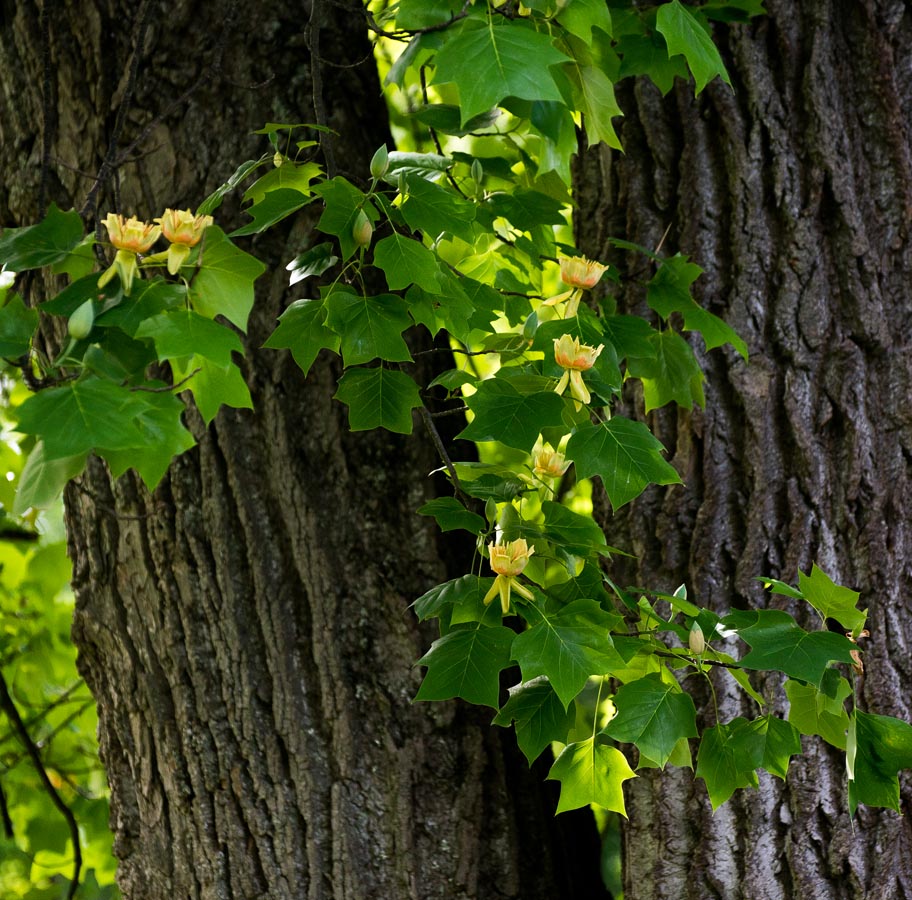
TULIP POPLAR IN BLOOM!

When we took up residence at our new home on Hedgehog Mountain we planted three Tulip Poplar trees. We got them from Arbor Day Foundation as not very hopeful bare root sticks. Over the ten years we’ve been here, two have survived. One is not much more than 3 ft tall while the other is pushing 30 feet.

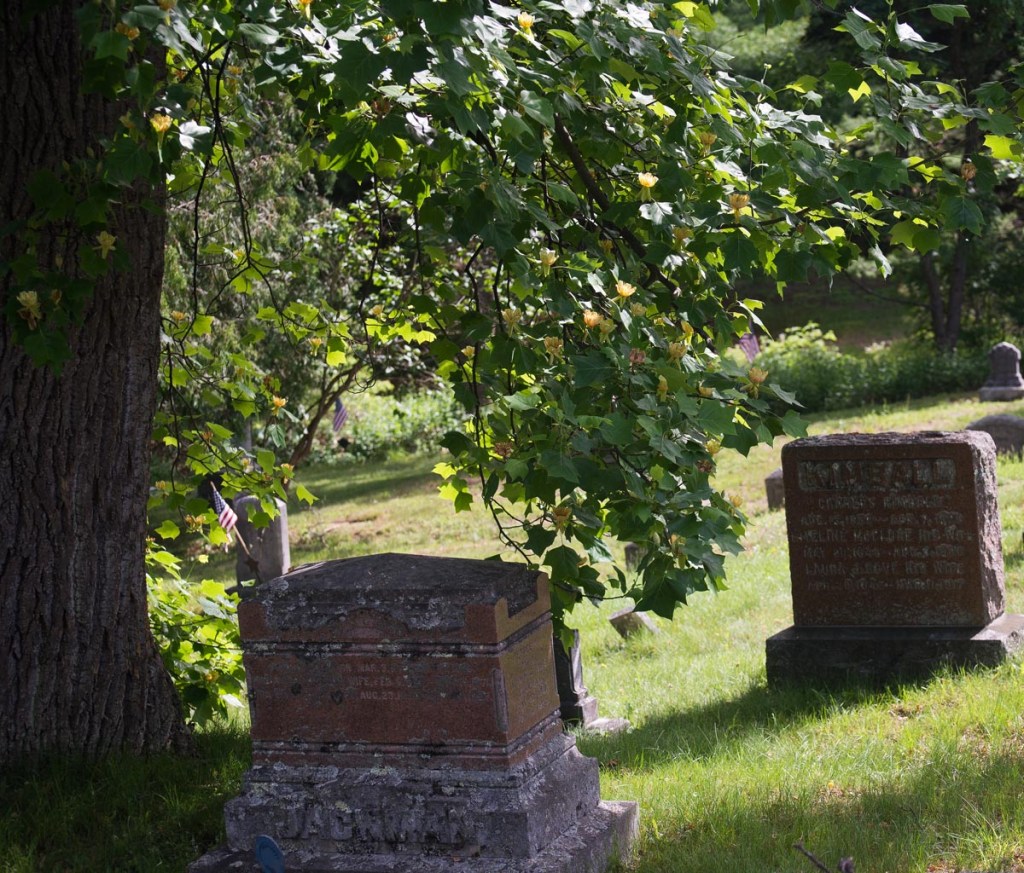
Late last year we found old flowers seeds on the big tree, but we had not seen flowering. Moreover, I had never seen flowers son the two really big trees in Appleton Cemetery.

Tulip poplar, Liriodendron tulipiera, is native to the mid Atlantic region and Appalachian Mountains. In its native range, trees can reach 150 or more feet in height, with long, straight, unbranched trunks and a spreading crown. I have seen magnificent trees in Maryland, not far from Washington DC, and in North Carolina. The species does not occur naturally this far north. These trees are beautiful. The few trees that I know for Deering are planted, the largest in the Appleton Cemetery sometime late in the 19th Century and in memory of some now unknown soul.

Although I had never seen the Appleton trees to flower, I have seen tulip poplar seedlings in Deering. One in Appleton Cemetery, next to the road and one deep inside the Titcomb Conservation Easement on Clement Hill Road — not so far from Appleton Cemetery. I am assuming the Appleton trees provided the seed. Maybe one day, with a warming climate, there will be magnificent specimens of tulip poplar in our forest?

The Appleton trees are currently in full bloom. It is a bit difficult to see the flowers in the trees as you travel at the legal speed of 35 mph on Deering Center Rd, but if you know to look at the trees, the flowers are visible from the road.

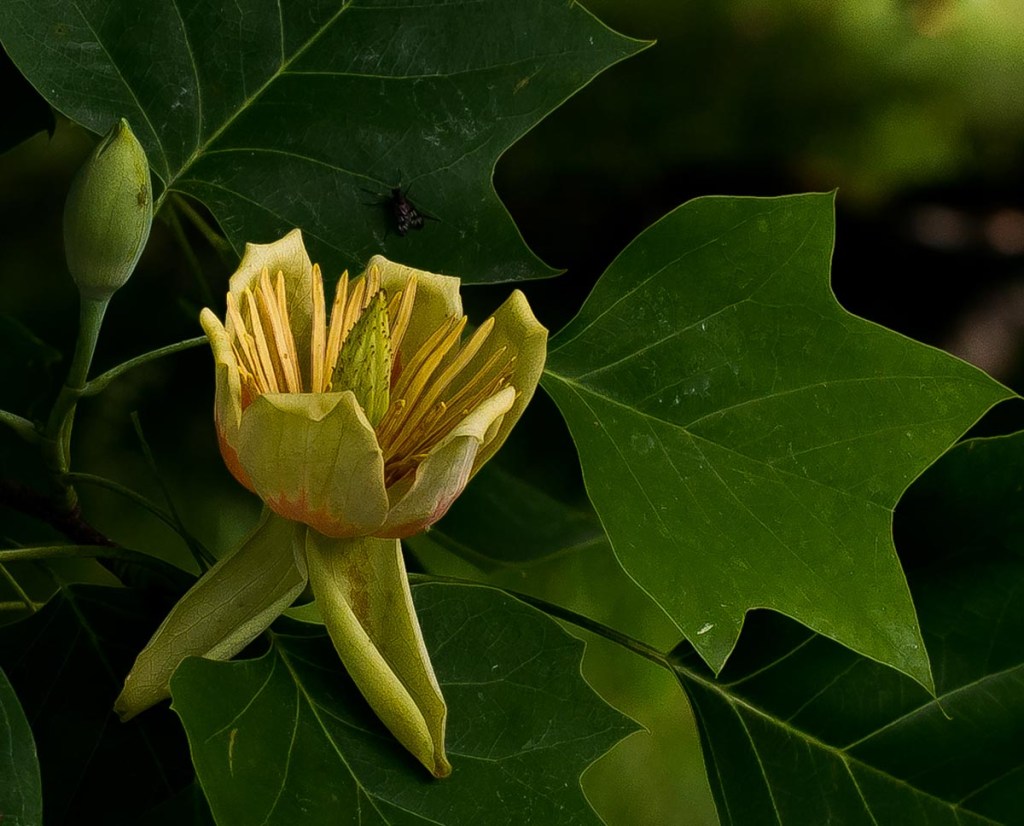
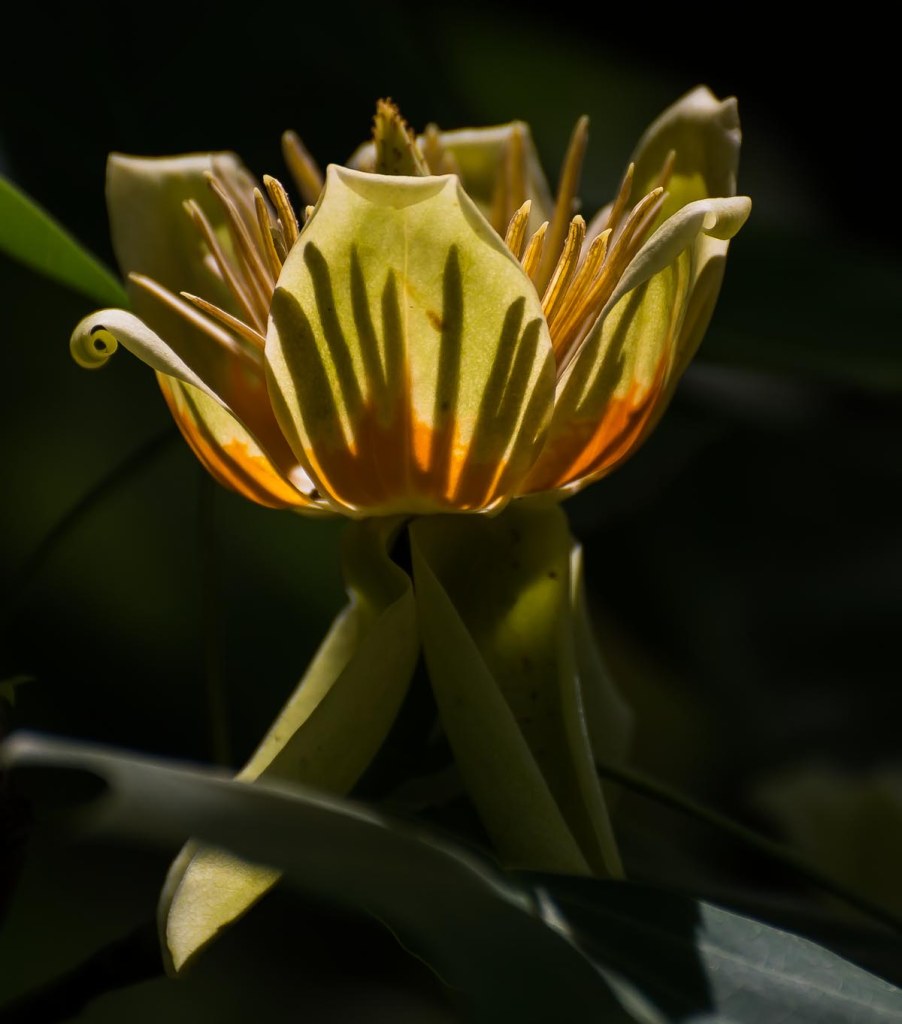
Tulip poplar is related to Magnolia, and their flowers are similar. But while the flowers of Magnolia are, basically, white or pink, the flowers of tulip poplar are orange and green. The flowers bear a superficial resemblance to a tulip. The flowers are quite beautiful and well worth a visit.

Here are some pictures.

NARROW-LEAVED BLUE-EYED GRASS

When I retired eleven years ago I decided that our new home would not have a lawn that required care. No verdant landscape rolling toward the horizon for me!

Here in Deering, on Hedgehog Mountain, what passes for soil is sand and is definitely on the acidic side. Just as well I didn’t want a lawn to mow because where we live, our little piece of heaven, is not a good bet for a grassy lawn anyway.

What we do have, though is a meadow of sorts. Not a lot of grass, but lots of flowering plants come up through the season. Pollinators love it.

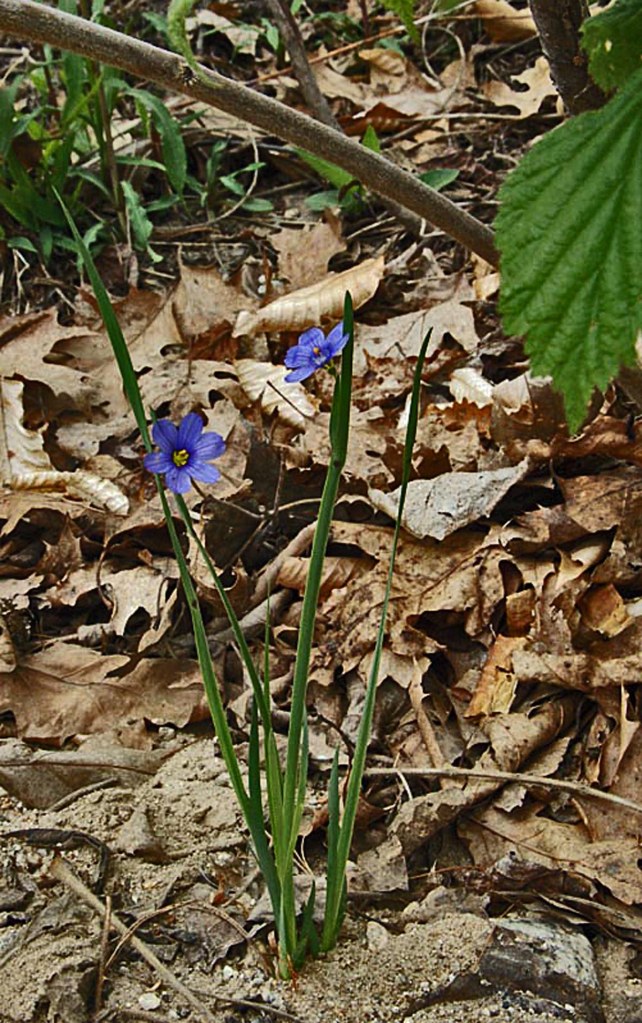
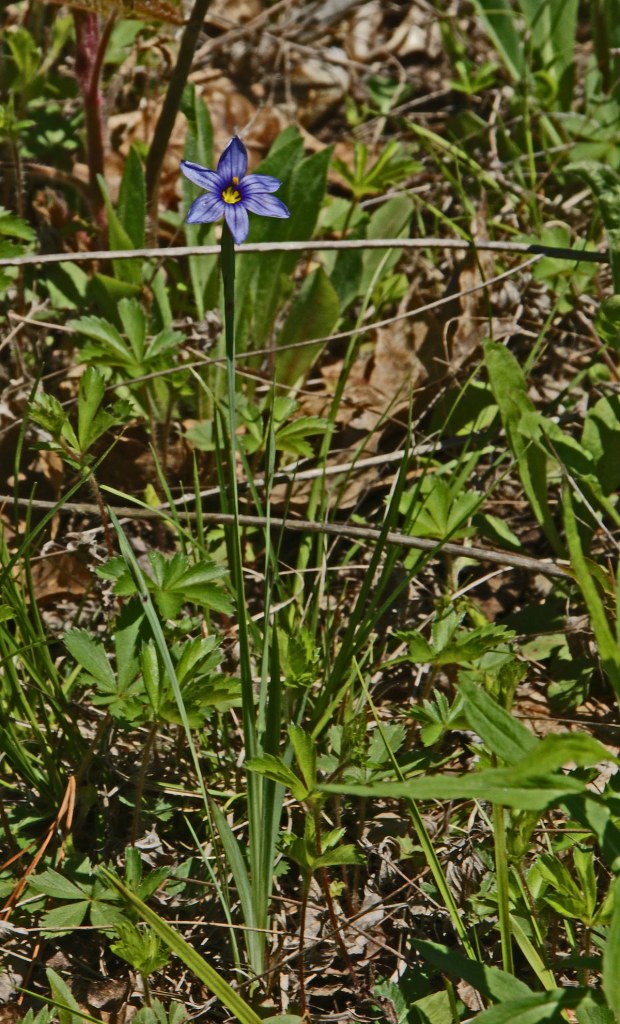
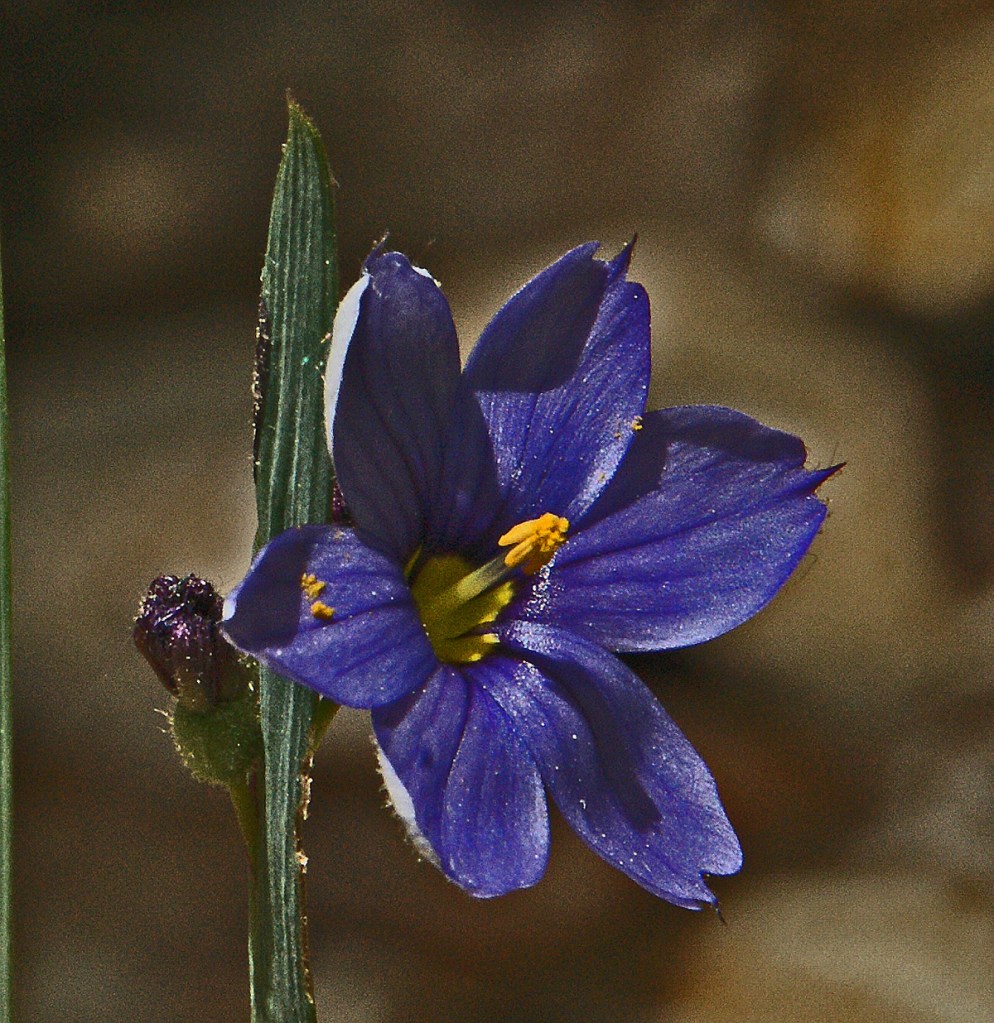
One of the niftier North American native plants that flowers this time of year is narrow-leaved blue-eyed grass, Sisyrinchium angustifolium. Our plants stand maybe ten inches tall and have narrow, grass-like leaves. Pretty deep blue, star-like flowers having six points arise in succession at the tips of the branches. Usually about three flower buds occur at the end of a stem, but buds open in succession — not at the same time — and remain open for a day or less, never at night. Thus the time window for pollination is rather small, but this is made up for by the continuing succession of flowers from May through midsummer. Without the flowers it would be difficult to recognize the plant as anything other than a grass, but Sisyrinchium is a genus of the Iris family.

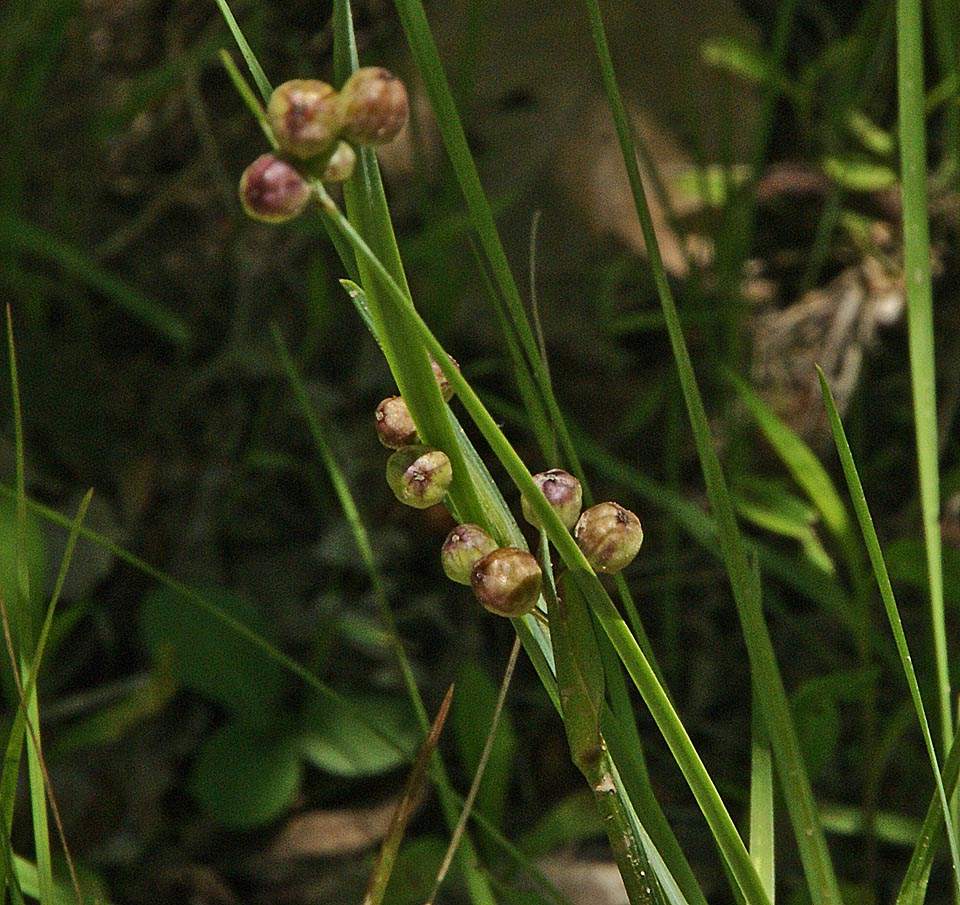
On-line pictures of blue-eyed grass show the plants growing in dense clusters. Not so here. Blue-eyed grass prefers moist habitats, where it can be seen to be quite exuberant. Maybe it’s our nasty soil, but for us the plants are abundant, but are typically scattered. They are perennial from a rhizome, and reproduce by seed. The fibrous rhizomes store food. The capsule contains three seeds.
The profuse blooms of Narrow-leaved Blue-eyed grass attract a variety of pollinators including sweat bees, bumble bees, bee flies, and syrphid flies as well as spring butterflies such as the lovely blue Azures. Their seeds provide food for songbirds. Native Americans cooked and ate the spring greens and used the plant medicinally “to regulate” the bowels and treat diarrhea, and made a plant tea to treat stomach aches, but it seems far too lovely to eat!

The plant can be propagated and can make a nice addition to your garden, for those who make a distinction between ‘garden’ and ‘not garden.’