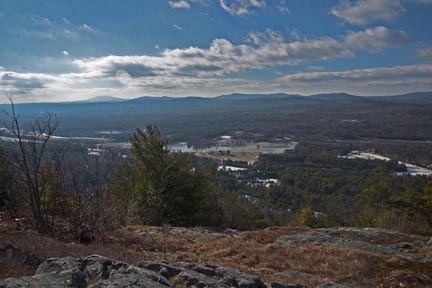
Most roads in Deering are lined by trees. Sometimes homes are guarded by old sugar maples, singly or in a line in front, but mostly secondary forest is kept at bay behind ancient rock walls. Little spring flowering trees are common along disturbed roadsides and in wetlands. Shadbush, at first, then chokeberry, pin cherry and choke cherry bear clusters of pretty white flowers at the tips of branches, are common.
Hawthorns are not common, or at any rate I have seen only two widely separated trees in flower here in Deering. I might be wrong about the commonness of hawthorn because two wee volunteer seedlings have become well established in our garden on Hedgehog Mountain. Doubtless I have not seen all the hawthorns in town. .
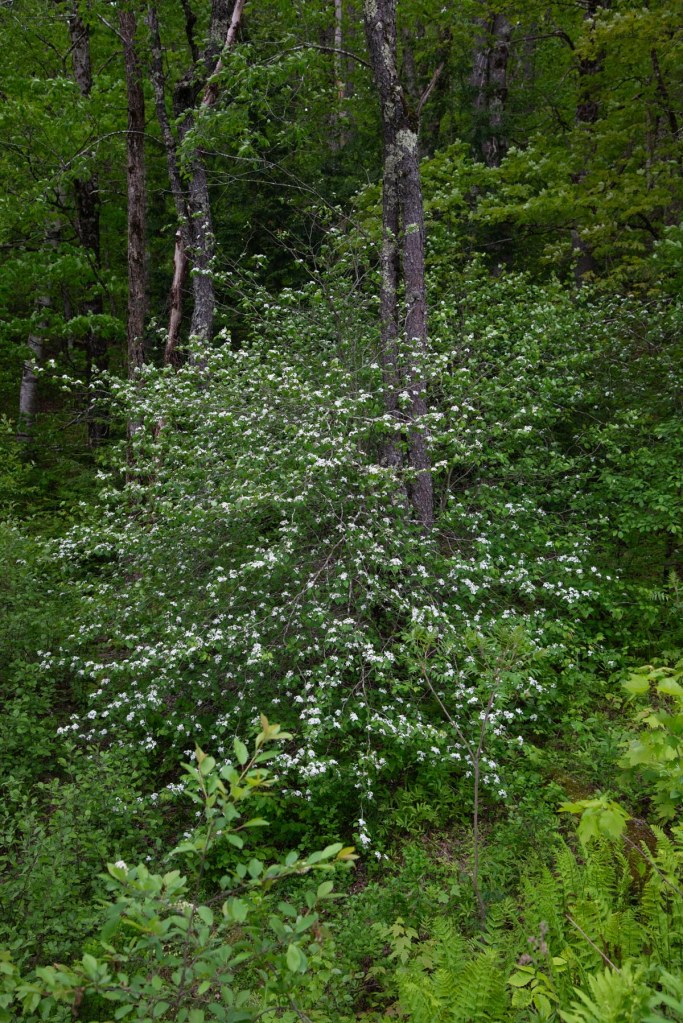
Hawthorns are species of the genus Crataegus and the 47 species of this genus found in New England make it the second largest genus of flowering plants in New England. Identification of species is quite difficult. The major hurdle to identification is the large number of species that have been recognized by taxonomists (aka ‘Splitters’). I navigated the Go Botany (the Native Plant Trust) key to C. populnea for our North Road hawthorn, an identification that was supported when i submitted an image of the flower to iNaturalist.
Crataegus poplnea, poplar hawthorn, is a species of northeastern USA and southeastern Canada but is rare in New England. Go Botany does not show any records for Hillsborough County. So, you can see my reservation in this identification. This identification is based on the flowering specimen growing on North Road. A second specimen growing some distance away at ‘The View,’ at the intersection of Deering Center Road and Old County Road, had completely finished flowering by mid May, so could be a different species. Go Botany says that C. populnea could be a hybrid between two other species, C. macrosperma and C. pruinosa. Flowers of C. pruinosa are fringed in pink and the species is not known for Hillsborough County. Crataegus macrosperma is widely distributed in New Hampshire, but its edible fruit appear to be larger than those of our Deering specimen. Poplar hawthorn is found in man-made or disturbed habitats, forest edges, forests, meadows and fields.
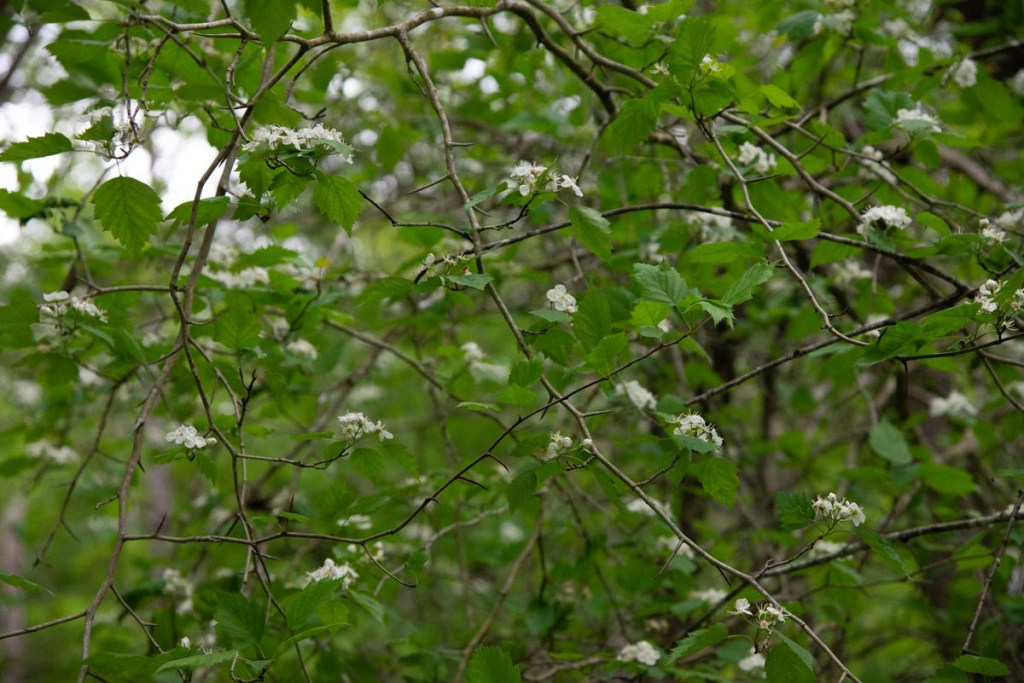
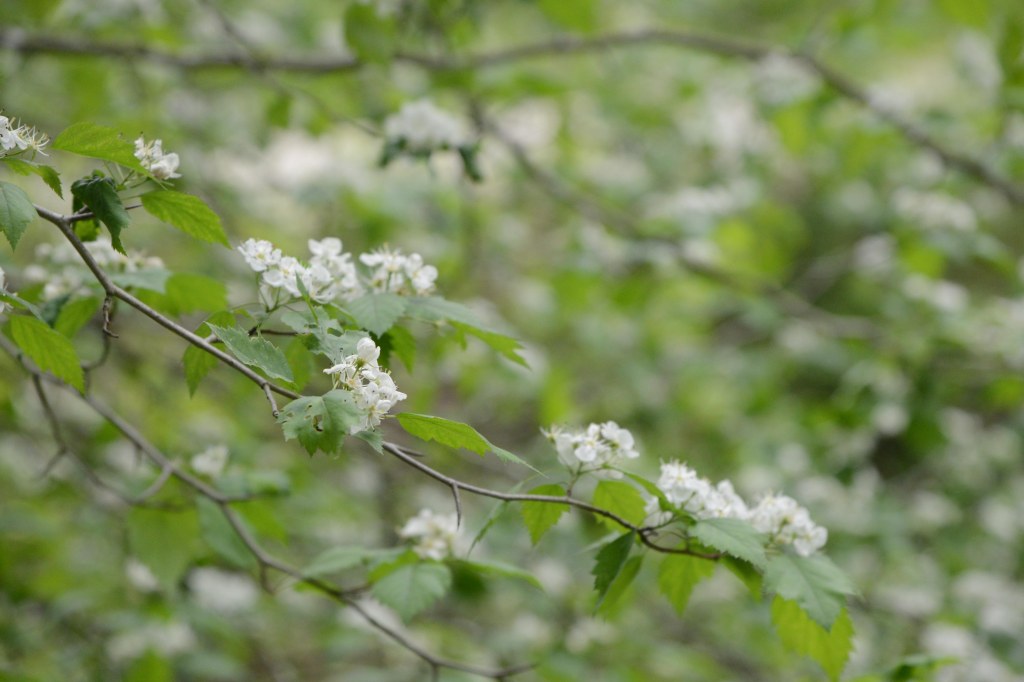
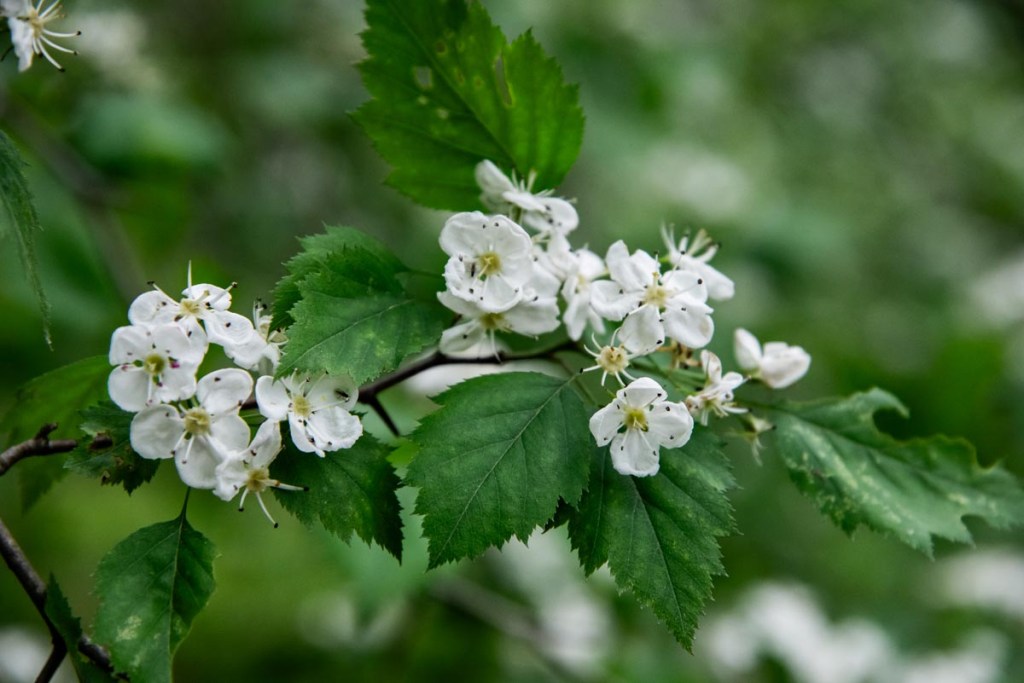
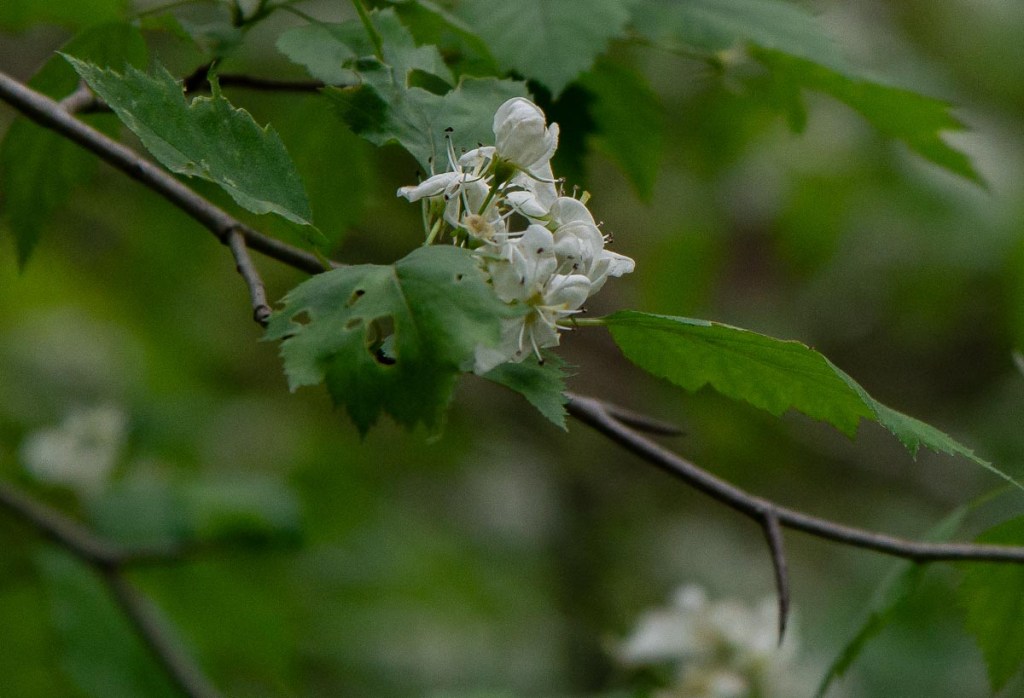
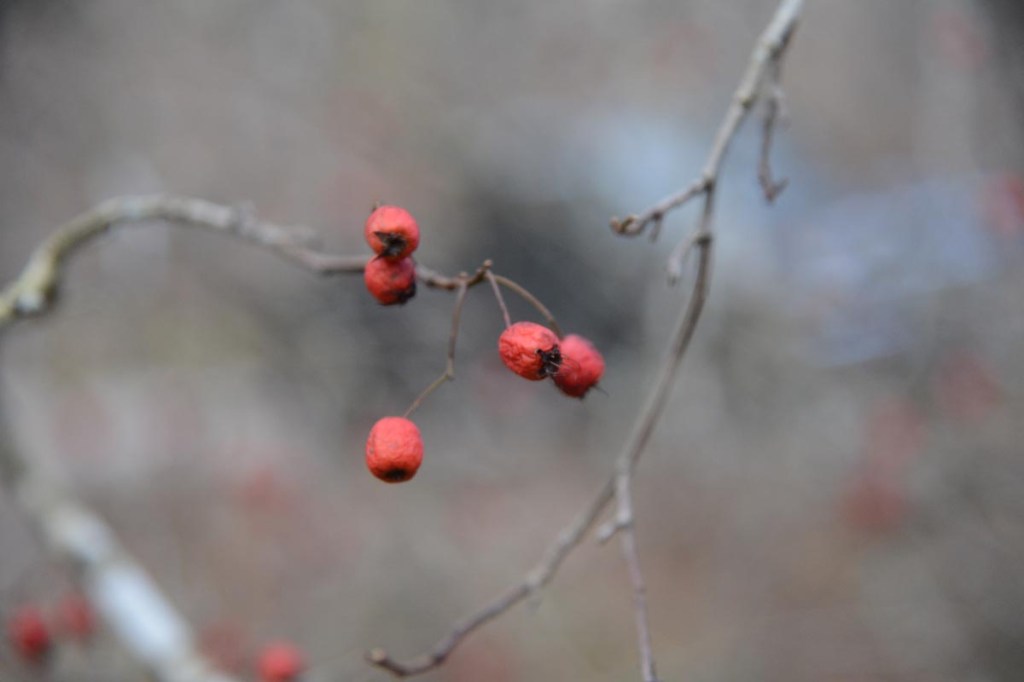
Crataegus is a genus of the rose family, so is related to apple, cherry, shadbush, and many others. The white flowers resemble flowers of all of them. Hawthorns are readily distinguished by having very long and sharp thorns (which are actually aborted branches and once were used as awls). The leaves of popular hawthorn are sightly lobed but deeply toothed. The fruit of hawthorn, like apples, are pomes and can vary in color from yellow to red to black. They have little nutrient content. Although edible, there is great variability in their edibility, some being mealy and others ‘just right.’ Native Americans dried the fruit in cakes for winter cooking. Decoction of the root is supposed to ease menstrual pain.
Haw is an old English word for ‘hedge’ and hawthorn hedges often separated fields. Maybe the most famous hawthorn hedge is the one in the village of Combray, in France, where young Marcel Proust walked on Sunday mornings with his family. Here is where young Marcel first discovered the sensuous beauty of nature, its colors and scent. Peeping through the hedge, he is transfixed by the beauty of a young girl with strawberry blonde hair in her family garden. Gilberte Swann remains Proust’s idee fixe through many of the 3000 pages of his novel In Search of Lost Time.
The hawthorns of Deering are not so romantic or even as sensuous as those in the hedge in Combray. But they are pretty little trees and I am glad to have found them here.
 DEERING'S NATURAL HISTORY