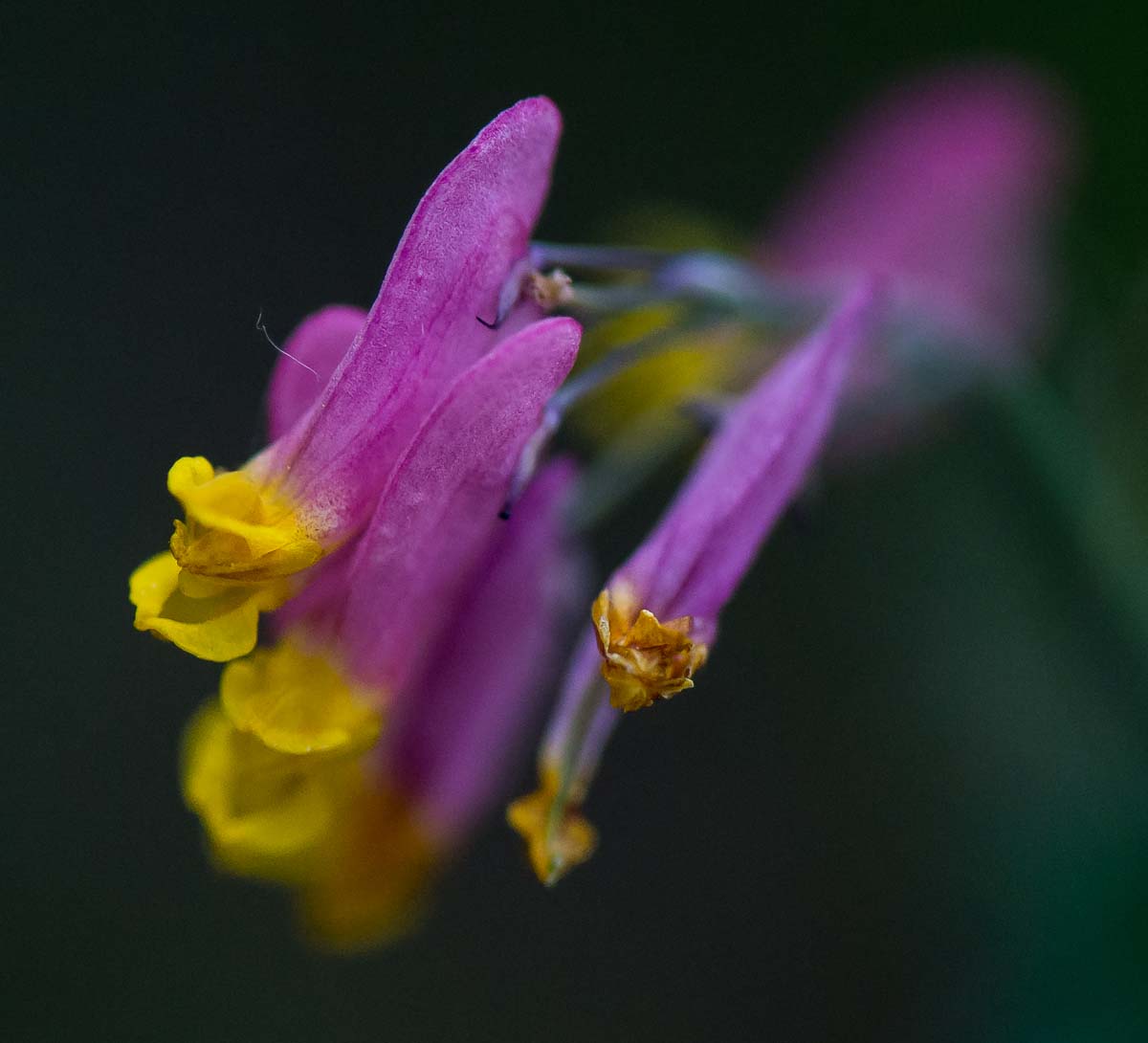
Rock harlequin, Capnoides sempervirens, appeared in the garden late in May, a first. I had previously only seen this fire adapted native wildflower in Deering at two closes by spots on Hedgehog Mountain. The plant itself, a bit tall and scraggly, doesn’t have much to recommend it, apart from its greyish green leaves, as a garden feature. But rock harlequin’s flower is so unusual and alluring — whimsical even — that I could not resist posting pictures of it … for a second time (there is an earlier post about rock harlequin on this site).
Pollinators of this poppy relative include bumble bees and skipper butterflies. I suppose the bulk of these insects is needed to force open the flower as they land on the flower’s protruding lower lip to reveal pollen. Seeds, born in long pods, are dispersed by ants and by wind, and some consider the plant to be mildly invasive. There are certainly more problematic — and far less appealing — invaders than rock harlequin.
Rock-harlequin is a very pretty and unusual native wildflower. A wonderful addition to Deering’s flora.
Capnoides (Corydalis) sempevirens, Rock-harlequin or pale corydalis, is a delicate, lacy, 1-2 ft biennial with compound leaves that are divided into many lobes. The bicolored, tubular flowers are very pretty and morpologically unusual for Deering’s flora.
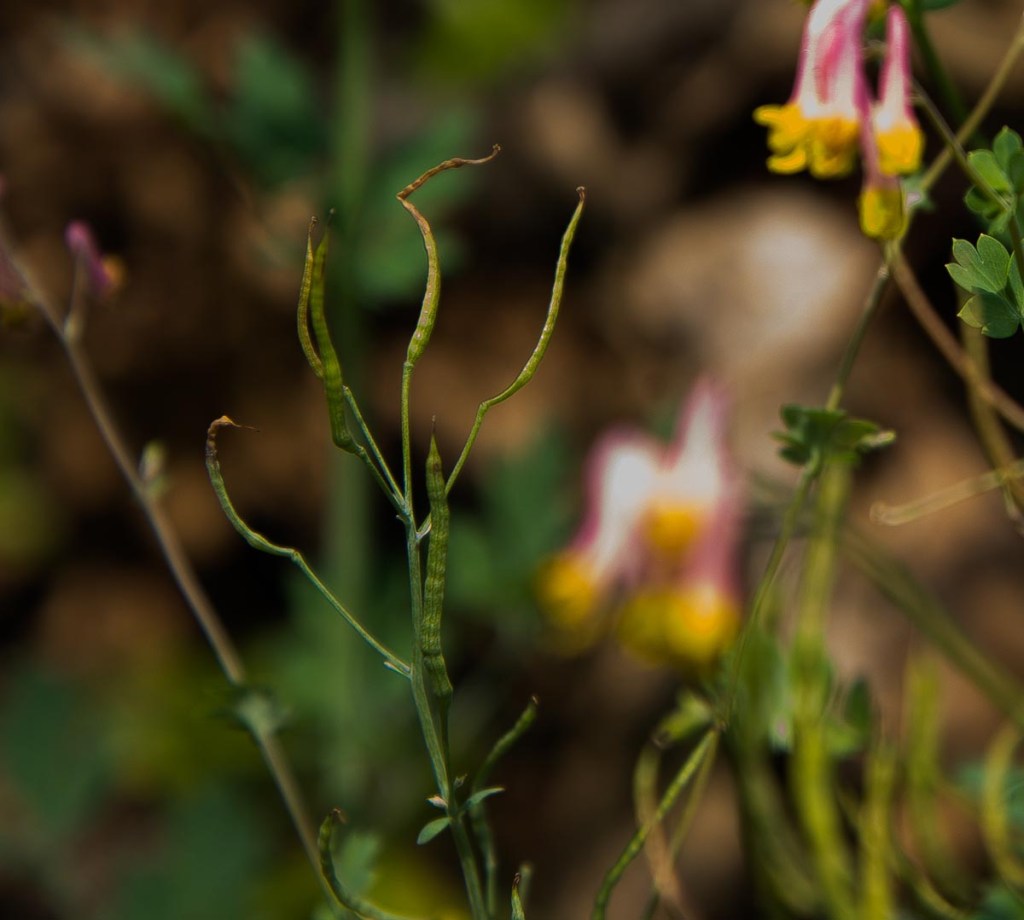
In the plant’s first summer the only foliage is a basal rosette, but in its second year the plant sends up many branched stems, each tipped with bunches of pink and yellow, flowers. The flowers are sac-like, tubular, pink and yellow and they occur in clusters at ends of branched stems bearing intricately divided leaves. The flowers give way to long, narrow seed pods. Seeds are spread by ants.
Rock-harlequin flowers from early summer through to early fall. It grows in rock crevices, talus, forest clearings, open woods, and on burned or otherwise disturbed areas in shallow, often dry soil. In burned zones it occurs within five years of a fire. In Deering I have found this pretty flower in two locations: the northern end of the Hedgehog Mountain Trail at the overlook, and on Little Hedgehog Mountain overlook, which is a short north leading trail from Hedgehog Mountain Road near the Landing. Both of these sites are exposed and rocky.
Rock-harlequin is native to North America, occurring widely in Eastern USA as far south as Tennessee and Georgia and as far west as Minnesota and Iowa, and it is found in Alaska and all Canadian provinces.
Capnoides sempervirens is a member of the poppy family (as might be guessed by the deeply dissected leaves). Additional species of Capnoides occur in Eastern North America. The Iroquois used a decoction prepared from plants of Corydalis sempervirens medicinally to alleviate piles. Some Corydalis species contain toxic alkaloids.



 DEERING'S NATURAL HISTORY