THE EARLY … BEE! GETS THE POLLEN!

Native bees take advantage of pollen produced by Pussy Willow soon after snow disappears in this New Hampshire town.

This past winter’s snow is all but gone now. Just a few resistant, dirty lumps of the stuff persist in very deeply shaded spots here on Hedgehog Mountain.

Can’t say I miss it. The winter seemed long and very very dark to me. Nope. Don’t miss the snow and cold at all!

I’ve been thinking about looking for early wildflowers. We have not yet found skunk cabbage here in Deering. It should be the earliest of the spring wildflowers. Skunk cabbage does occur a few miles down the road in Francestown. Why not Deering?

Last weekend I was out with friends Mike, Kay & Stephen, and Staci & Andrew placing bird boxes on the Gregg Hill lot.

The Gregg Hill Lot, and Greg Hill, is located in the center of ‘downtown’ Deering. This 14 acre lot is the home site of some of Deering’s earliest settlers who arrived late in the 18th Century. The Gregg Family built its home atop a 1,300 ft hill, one of the highest spots in town. That hill is now known as Gregg Hill. A succession of owners occupied the Gregg Hill Lot, which is just below the summit of Gregg Hill, and for several years — 1924 to about 1960 — one of New Hampshire’s earliest skiing rope tows was located on this steep slope.

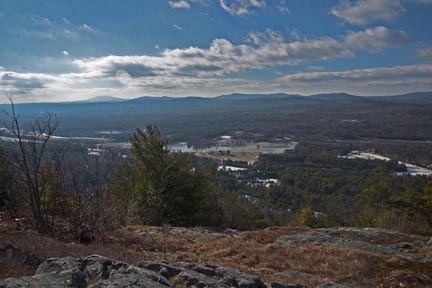
Currently the Gregg Hill lot is owned by the Town of Deering, and the town Conservation Commission is in the process of developing pollinator gardens there, while donating a conservation easement to the Piscataquog Land Conservancy. The ultimate aim is for a trail to lead from Deering Center Road, through the meadow and pollinator gardens, to a spectacular view at the summit.

While we were putting out the bird boxes on Gregg Hill, we noticed that the willows at the bottom of the slope, are Pussy Willows. And now they are flowering! A first Spring (wild) flower!

Pussy Willow — Salix discolor — is a North American native plant. Native Pussy Willow has a wide northern distribution and there are many horticultural varieties of this popular species.

Mike reminded us that Pussy Willow is dioecious: individual plants are unisexual, female or male. Indeed, we found both on the site. The flowers are botanically known as ‘catkins.’ The male catkins are at first enclosed in downy silver hairs. and so might be what one usually think of when one thinks of Pussy Willow. Male catkins are showier than the female. The yellow stamens develop from within the silvery down and produce prodigious amounts of pollen. The female catkins have many carpels with yellow styles that are divided at the tips. Both sexes have nectar glands to attract pollinators.

Various insects are attracted to Pussy Willow flowers. These include, among others, flies, beetles, wasps and bees. Native bees are important pollinators of these early flowers. We observed several native bees, maybe Mining Bees, working the male and female catkins.

In addition to Pussy Willow being a super candidates for pollinator gardens, its leaves provide a banquet for several butterfly caterpillars.

Black Swallow wort: a nasty invasive in our zip code!

A bunch of invading plants that no walls can keep out are living in our town of Deering, a small rural community located in south central New Hampshire/the  Monadnock Region,.

We have been successful thanks to a Lake Hosts boat inspection program and an active group of Weed Watchers, in preventing the introduction of highly invasive Variable Milfoil into our lake, and — unlike most towns in our area — Japanese Knotweed is not a conspicuous feature of our roadsides because members of the Conservation Commission  cut the stuff back each year.

But this year I am noticing a whole lot of black swallow wort in town. This plant — Cynanchium louisiae — is disastrously invasive. It grows thickly on the ground and quickly covers everything, preventing the growth of other plants. Even covering street signs! Like all successful invasive species, black swallow wort has no local  parasites or browsers to limit its development. And, like milkweed, the seed come out of the pods in a fluff that is easily scattered by wind.

There is a dense growth of this invasive in the Tom Rush meadows, but few go up there to see it. Where it is most conspicuous is along roadsides, probably in front of your own home. Lurking in rock walls or around your mail box.

Black swallow wort is a native of Europe that was introduced into the United States, through Massachusetts, in the mid 19th Century. The plant is widely distributed in eastern USA and Canada but is not common west of the Mississippi River. A second swallow wort, Cynanchum rossicum, was introduced into New England from Europe as an ornamental late in the 19th Century. Its distribution is limited to the New England states. I have not seen it in Deering.

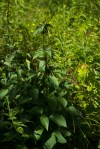
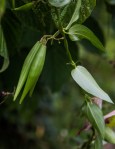
Black swallow wort is easily recognized. It’s a low growing herb with dark green leaves; the plant tends to vine. The leaves are paired, opposite each other on the stem, narrowly heart-shaped, and drawn to a fine point. The have a strongly developed central vein that causes the halves of the leaf blade to form a kind of V-shape down the length of the leaf. Flowers form at the tips of the vine and are small, dark purple. Kind of pretty actually. The fruit is a twin capsule. The roots are white and thick, forming a mat in the soil; there can be a tap root.

Apart from its invasive nature, black swallow wort and other swallow worts, which are related to milkweed, are toxic to Monarch butterflies, deer and cattle. The plants themselves contain the toxin, and they put toxins into the soil that prevents  growth of other plants.

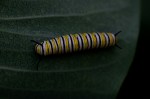
We all know by now that milkweed is the preferred medium for development of Monarch butterflies. The butterflies mate, most famously in Mexico, but in other western sites as well. They then migrate north and east looking for a place to lay their eggs. In March and April they lay their eggs on milkweed and, lamentably, black swallow wort .  About two days later the eggs hatch to the distinctive caterpillar, which feeds on milkweed.

However Monarch caterpillars that hatch on swallow worts are not able to feed. They avoid the toxin in the plants, and thus do not survive. From an ecological point of view, they are wasted.

After two weeks, the caterpillars on attach themselves to a stem or leaf of milkweed and begin the process of metamorphosis that leads to the beautiful Monarch butterfly.  The emergent butterfly will fly away to enjoy about two weeks of feeding on all sorts of flowers but, just before dying, they lay their eggs.


Clearly, black swallow wort is a bad actor. But you can help to control it.

Cutting it back is not good because that will only encourage more growth. Most of what I see in town along roadsides can maybe controlled by digging. You can dig it out, but dig deeply so as to get as much root as possible. You will have to return and dig out what you have missed but eventually . Glyphosate is effective.